Alabama Science CHE.4.d
The Standard
- CHE.4
- Use stoichiometric ratios to support the claim that atoms, and therefore mass, are conserved during chemical reactions.
Qualitatively and quantitatively determine the limiting reactant when given the masses of all reactants.
2023 Alabama Course of Study: Science
Teacher's field guide
What This Standard Means
What Students Need to Do
- Students use a balanced equation to see which reactant runs out first. They convert given masses to moles and compare the amounts using the equation's coefficients.
What Mastery Looks Like
- Given 6 g H2 and 32 g O2 for 2H2 + O2 → 2H2O, a student finds 3 mol H2 and 1 mol O2. They explain that O2 runs out first, leaving 1 mol H2.
Common Misconceptions
- Students often pick the reactant with the smaller mass. Others convert to moles but compare the totals without using the coefficients.
How to Assess It
- Exit ticket: For 2H2 + O2 → 2H2O, which reactant runs out first with 6 g H2 and 32 g O2? Show the mole conversions and ratio you used.
Lesson moves
Ways to Teach It
Give pairs five H2 molecule tokens and two O2 molecule tokens; have them group the tokens 2:1 and identify what runs out.
Ask: O2 has more grams than H2 in this example, so why does it run out first?
Sort two cards for 2H2 + O2: 6 g H2 with 32 g O2, and 2 g H2 with 32 g O2; justify each.
Set out 10 bread-slice cards and 3 cheese-slice cards; build two-slice sandwiches, then name the ingredient that limits production.
Free download
Printable CHE.4.d Worksheet
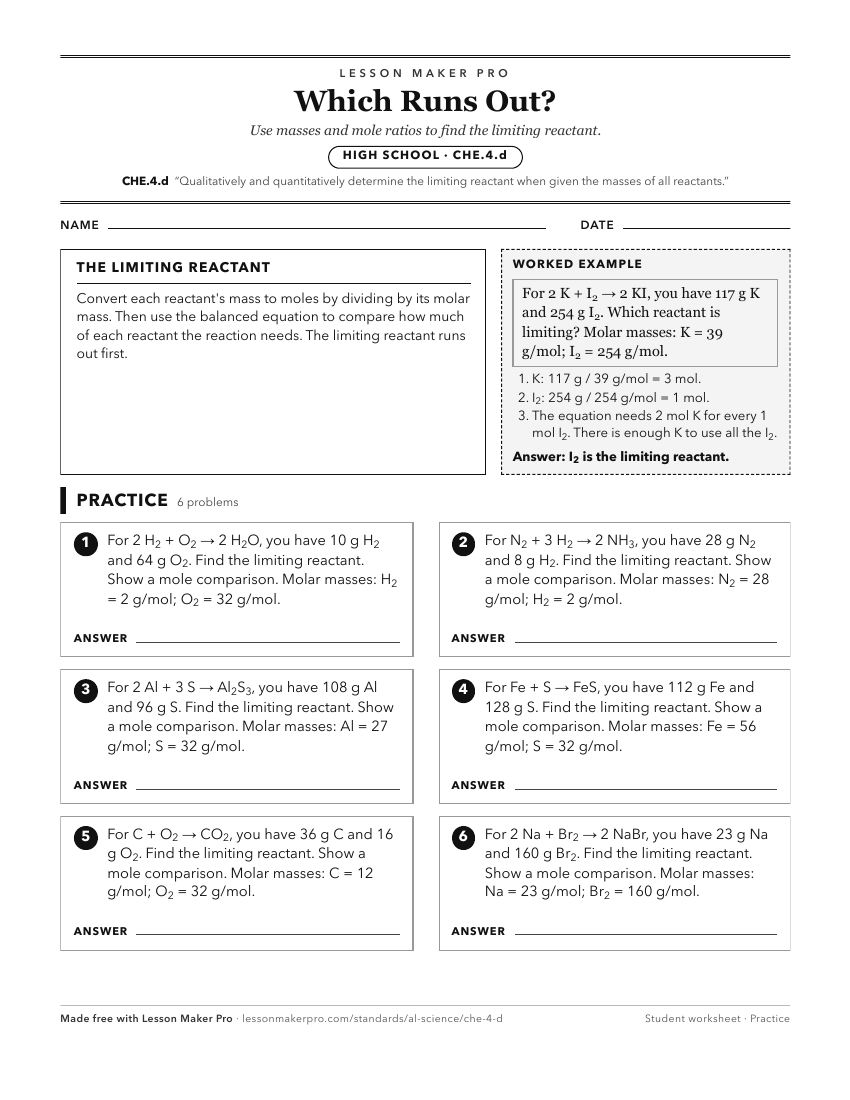
A ready-to-print activity worksheet aligned to CHE.4.d, with an answer key for the teacher on its own page. No account needed.
PDF, US Letter, prints cleanly in black and white.
Download the worksheetKeep exploring
Related Standards
- CHE.3.a
Use qualitative and quantitative reasoning to describe and balance chemical equations to satisfy the law of conservation of matter.
- CHE.3.b
Use qualitative and quantitative reasoning to classify chemical reactions, predict the products of single replacement and double replacement reactions, and repr...
- 8.6
Observe and analyze data regarding characteristic properties of substances before and after they are combined to determine whether a chemical reaction has occur...
- 5.4
Analyze data from tests to determine whether a new substance is formed after two or more substances are combined.
Turn this exact standard into a lesson
Grade, subject, topic, and the complete standard are prefilled. Create one free, no account needed.
Also for this standard:Make a WorksheetMake a QuizMake a Sub Lesson