Alabama Science BIO.6
The Standard
Develop and use models to illustrate interactions between ecological hierarchy levels, including biosphere, biome, ecosystem, community, population, and organism.
2023 Alabama Course of Study: Science · Ecosystems: Interactions, Energy, and Dynamics
Teacher's field guide
What This Standard Means
What Students Need to Do
- Students build a model that connects one organism to its population, community, ecosystem, biome, and the biosphere. They show where nonliving things, such as water and sunlight, fit in the model.
What Mastery Looks Like
- A student can place one frog in a frog population, that population in a pond community, and that community in a pond ecosystem. They can place the pond within a biome and the biosphere, then explain how drought could affect the frogs and other species.
Common Misconceptions
- Students may call one frog a population or include pond water in the community. They may treat a biome as one ecosystem or mistake a local habitat for the entire biosphere.
How to Assess It
- Give students a temperate forest pond with frogs, fish, algae, and water. Ask them to sketch and label all six levels, then explain why water belongs in the ecosystem but not the community.
Lesson moves
Ways to Teach It
Give groups six nesting cups to label, then have them place cards showing one frog, local frogs, pond species, pond water, and Earth.
Ask, 'If a pond dries up, what changes for one frog, its population, and the pond community?' Have partners trace the effects.
Run a card-sort relay with six level labels and examples from one forest pond; teams fix any misplaced cards.
At a schoolyard tree, identify that tree, others of its species, nearby species, and nonliving features; locate your biome on a map.
Free download
Printable BIO.6 Worksheet
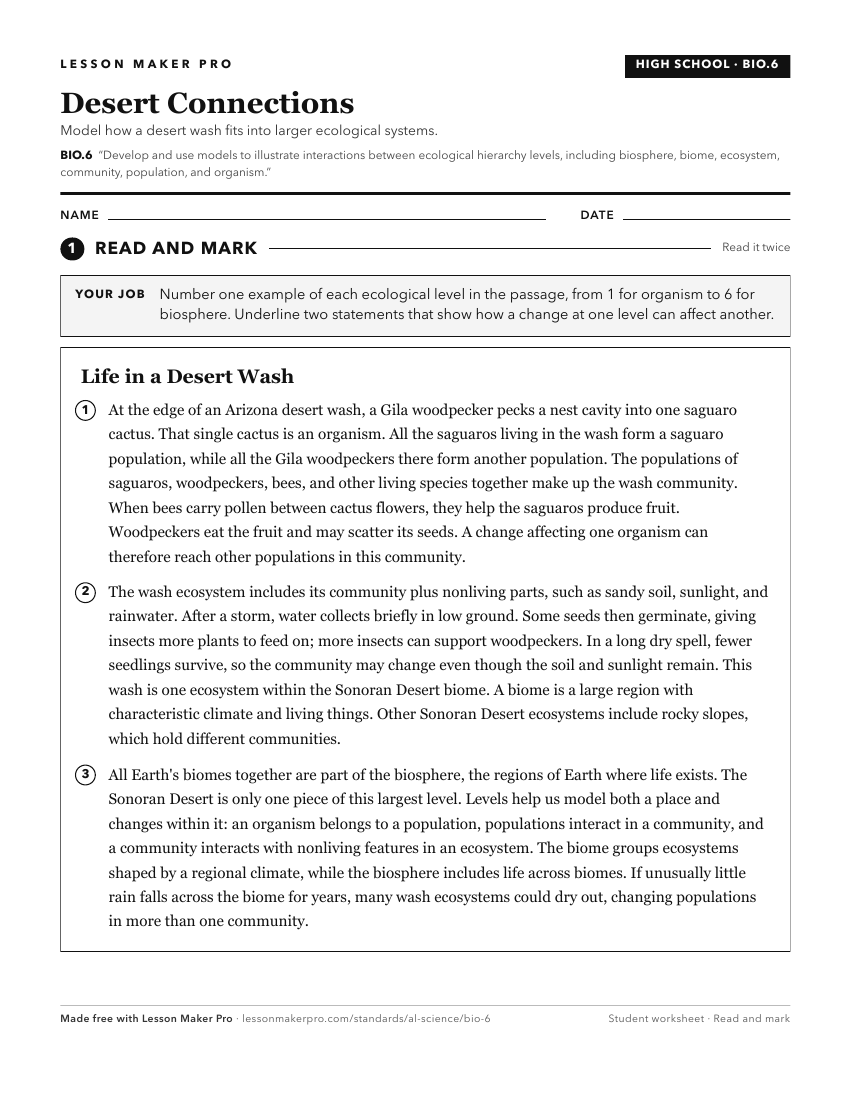
A ready-to-print activity worksheet aligned to BIO.6, with an answer key for the teacher on its own page. No account needed.
PDF, US Letter, prints cleanly in black and white.
Download the worksheetKeep exploring
Related Standards
- 5.12
Use a model to represent how any two of Earth's systems (atmosphere, biosphere, geosphere, and hydrosphere) interact and support life.
- 3.5
Develop and use models to compare the diverse life cycles of organisms other than humans, including birth, growth, reproduction, and death.
- K.6
Use models of natural habitats to represent the interdependence among plants and animals native to their community.
- BIO.7
Develop and use models to illustrate the flow of matter and energy between abiotic and biotic factors in ecosystems, including loss of heat, 10% rule, and the c...
Turn this exact standard into a lesson
Grade, subject, topic, and the complete standard are prefilled. Create one free, no account needed.
Also for this standard:Make a WorksheetMake a QuizMake a Sub Lesson