Alabama Science BIO.3.a
The Standard
- BIO.3
- Develop and use models to explain how events during the cell cycle lead to the formation of new cells and repair of multicellular organisms, including cell growth, DNA replication, separation of chromosomes, and separation of cell contents.
Construct an explanation of the process of DNA replication during cellular division (S-phase).
2023 Alabama Course of Study: Science
Teacher's field guide
What This Standard Means
What Students Need to Do
- Explain how DNA copies itself during S phase, before a cell divides. Show how the two strands separate and each guides a new matching strand. Identify the old and new strand in each copy.
What Mastery Looks Like
- Given a short DNA sequence, a student writes its matching strand using A with T and C with G. They draw two finished DNA molecules, each with one old strand and one new strand.
Common Misconceptions
- Students may place DNA copying during mitosis instead of S phase. Some think both strands in each finished molecule are brand new, or pair A with C instead of T.
How to Assess It
- On an exit ticket, give students an original DNA pair, ACGT and TGCA. Ask them to draw the two DNA molecules made after replication and label every strand old or new.
Lesson moves
Ways to Teach It
Give pairs colored paper DNA strands and letter tiles; have them separate the strands and build a matching new strand on each.
Ask students to write why a cell needs two DNA copies before it divides, then compare answers with a partner.
Play a matching-card round where students pair A with T and C with G, then check each other's completed strands.
Show a photo of a healing cut and ask students to mark when a skin cell copies its DNA before dividing.
Free download
Printable BIO.3.a Worksheet
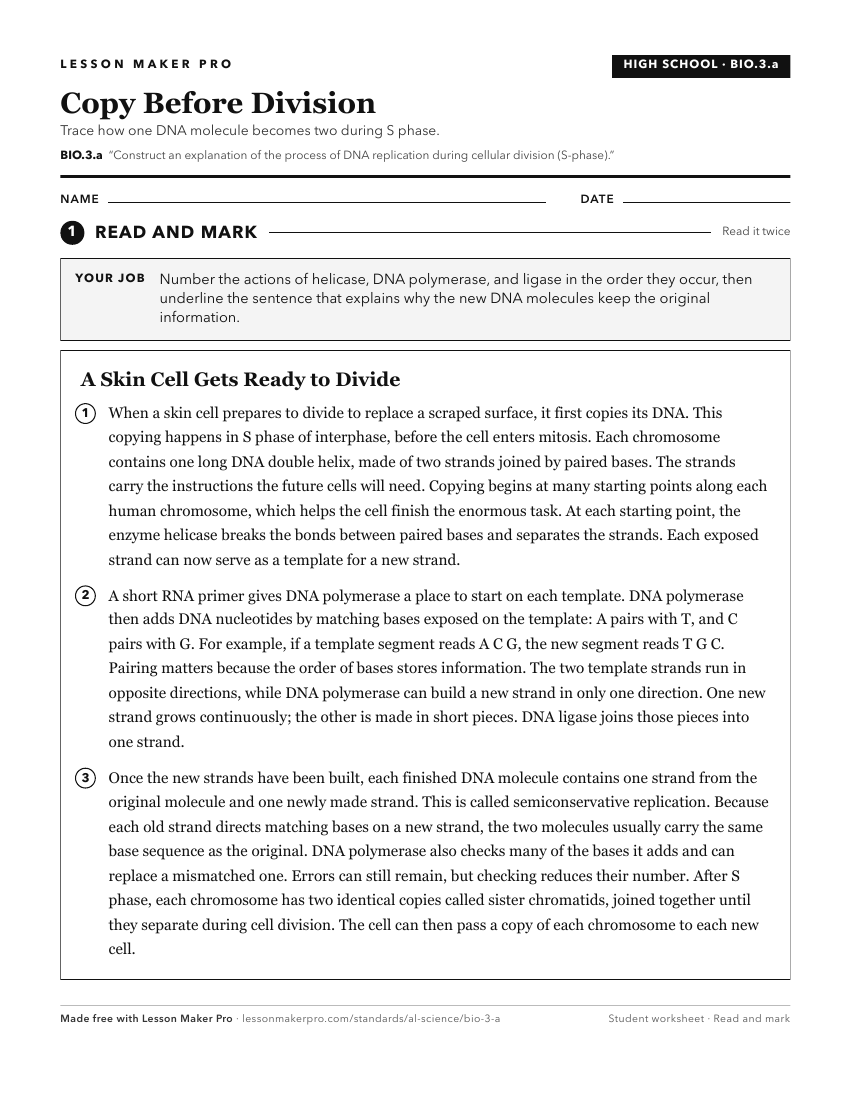
A ready-to-print activity worksheet aligned to BIO.3.a, with an answer key for the teacher on its own page. No account needed.
PDF, US Letter, prints cleanly in black and white.
Download the worksheetKeep exploring
Related Standards
- 7.3
Construct an explanation of how the process of mitosis maintains complex organisms and ensures new cells with identical genetic information.
- BIO.3
Develop and use models to explain how events during the cell cycle lead to the formation of new cells and repair of multicellular organisms, including cell grow...
- BIO.12
Develop and use an evidence-based model to illustrate the formation of reproductive cells through the process of meiosis.
- BIO.12.a
Construct an explanation of how new genetic combinations and variations occur during crossover.
Turn this exact standard into a lesson
Grade, subject, topic, and the complete standard are prefilled. Create one free, no account needed.
Also for this standard:Make a WorksheetMake a QuizMake a Sub Lesson