Alabama Math K.FC.B.4
Standard Cluster
- K.FC.B
- Count to tell the number of objects.
Connect counting to cardinality using a variety of concrete objects. a. Say the number names in consecutive order when counting objects. b. Indicate that the last number name said tells the number of objects counted in a set. c. Indicate that the number of objects in a set is the same regardless of their arrangement or the order in which they were counted. d. Explain that each successive number name refers to a quantity that is one larger.
2019 Alabama Course of Study: Mathematics · Count to tell the number of objects.
Cluster contents
Standards in This Cluster
K.FC.B.4 is a cluster heading. These are the individual standards under it.
- K.FC.B.4.a
Say the number names in consecutive order when counting objects.
- K.FC.B.4.b
Indicate that the last number name said tells the number of objects counted in a set.
- K.FC.B.4.c
Indicate that the number of objects in a set is the same regardless of their arrangement or the order in which they were counted.
- K.FC.B.4.d
Explain that each successive number name refers to a quantity that is one larger.
Teacher's field guide
What This Cluster Means
What Students Need to Do
- Children count objects by touching each one and saying the numbers in order. They tell how many there are without starting over. They see that moving the objects does not change the total, but adding one does.
What Mastery Looks Like
- A child counts six cubes without skipping or repeating one, then says there are six cubes. They still say six after the cubes are spread out. When one cube is added, they say seven.
Common Misconceptions
- Children may skip a number or count the same object twice. Some start counting again when asked, "How many?" Others think a spread-out group has more because it takes up more space.
How to Assess It
- Set out six cubes and ask, "Count these. How many?" Spread them out and ask again, then add one cube and ask for the new total.
Lesson moves
Ways to Teach It
Give pairs six bottle caps to count, then rearrange them in a circle and predict the total before checking.
Show five blocks spread apart and five blocks touching, then ask, "Do these groups have the same number? How do you know?"
Play Count and Cover: partners roll a die, place that many counters on a mat, add one, and name the new total.
At snack time, ask a child to count the napkins, move one to each seat, and say whether the total changed.
Free download
Printable K.FC.B.4 Worksheet
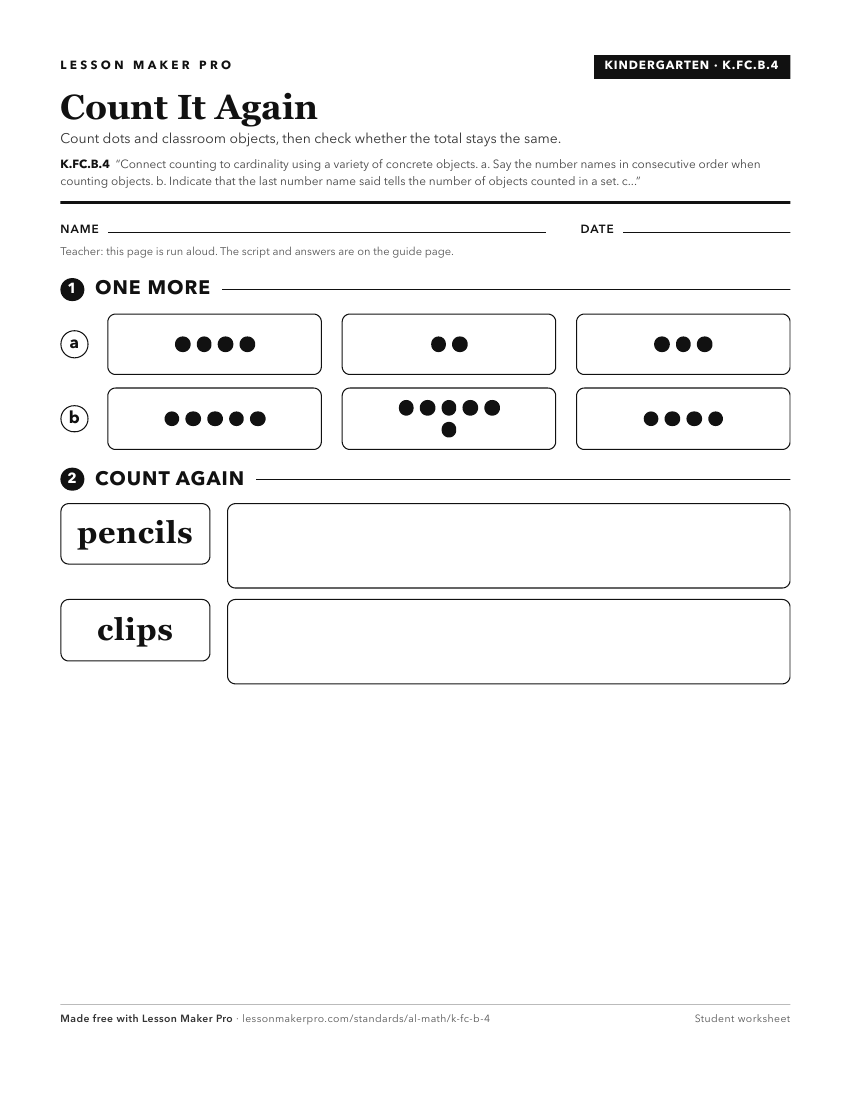
A ready-to-print activity worksheet aligned to K.FC.B.4, with an answer key for the teacher on its own page. No account needed.
PDF, US Letter, prints cleanly in black and white.
Download the worksheetKeep exploring
Related Standards
- K.FC.B.5.b
Count using no more than 10 concrete objects in a scattered configuration.
- FM.AC.A.6
Use multiple representations and methods for counting objects and developing more efficient counting techniques. Note: Representations and methods may include t...
- FM.AC.A.7.a
Use various counting models (including tree diagrams and lists) to identify the distinguishing factors of a context in which the Fundamental Counting Principle ...
Turn this cluster into a lesson
Grade, subject, topic, and the complete cluster are prefilled. Create one free, no account needed.
Also for this cluster:Make a WorksheetMake a QuizMake a Sub Lesson