Alabama Math GDA.GM.J.35
Standard Cluster
- GDA.GM.J
- Recognizing congruence, similarity, symmetry, measurement opportunities, and other geometric ideas, including right triangle trigonometry, in real-world contexts provides a means of building understanding of these concepts and is a powerful tool for solving problems related to the physical world in which we live.
Discover and apply relationships in similar right triangles. a. Derive and apply the constant ratios of the sides in special right triangles (45˚-45˚-90˚ and 30˚-60˚-90˚). b. Use similarity to explore and define basic trigonometric ratios, including sine ratio, cosine ratio, and tangent ratio. c. Explain and use the relationship between the sine and cosine of complementary angles. d. Demonstrate the converse of the Pythagorean Theorem. e. Use trigonometric ratios and the Pythagorean Theorem to solve right triangles in applied problems, including finding areas of regular polygons.
2019 Alabama Course of Study: Mathematics
Cluster contents
Standards in This Cluster
GDA.GM.J.35 is a cluster heading. These are the individual standards under it.
- GDA.GM.J.35.a
Derive and apply the constant ratios of the sides in special right triangles (45˚-45˚-90˚ and 30˚-60˚-90˚).
- GDA.GM.J.35.b
Use similarity to explore and define basic trigonometric ratios, including sine ratio, cosine ratio, and tangent ratio.
- GDA.GM.J.35.d
Demonstrate the converse of the Pythagorean Theorem.
- GDA.GM.J.35.e
Use trigonometric ratios and the Pythagorean Theorem to solve right triangles in applied problems, including finding areas of regular polygons.
Teacher's field guide
What This Cluster Means
What Students Need to Do
- Students work out the side ratios in 45° and 30° right triangles. They use similar triangles to explain why sine, cosine, and tangent ratios stay the same. They use those ratios, the Pythagorean Theorem, and its converse to solve problems.
What Mastery Looks Like
- Given a 30° right triangle with a short leg of 6, a student finds the hypotenuse as 12 and the long leg as 6√3. They explain why sin 30° equals cos 60° and check whether 5, 12, and 13 make a right triangle. They can split a regular polygon into right triangles to find its area.
Common Misconceptions
- Students may swap opposite and adjacent sides when the reference angle changes. Some think sin 30° equals cos 30°, rather than cos 60°. Others test three side lengths without using the longest side as the hypotenuse.
How to Assess It
- Exit ticket: A triangle has sides 5, 5√3, and 10. Show that it is right, then find sin 30° and cos 60° and explain why they match.
Lesson moves
Ways to Teach It
Fold a paper square diagonally and an equilateral paper triangle in half, then label and compare the resulting side lengths.
Ask: Why does sin 35° equal cos 55°? Have students sketch a right triangle and label both angles.
Play a card sort matching right-triangle sketches with sine, cosine, or tangent equations and missing-side answers.
Give students a regular hexagon with 8 cm sides; have them draw and split its center triangles to find the area.
Free download
Printable GDA.GM.J.35 Worksheet
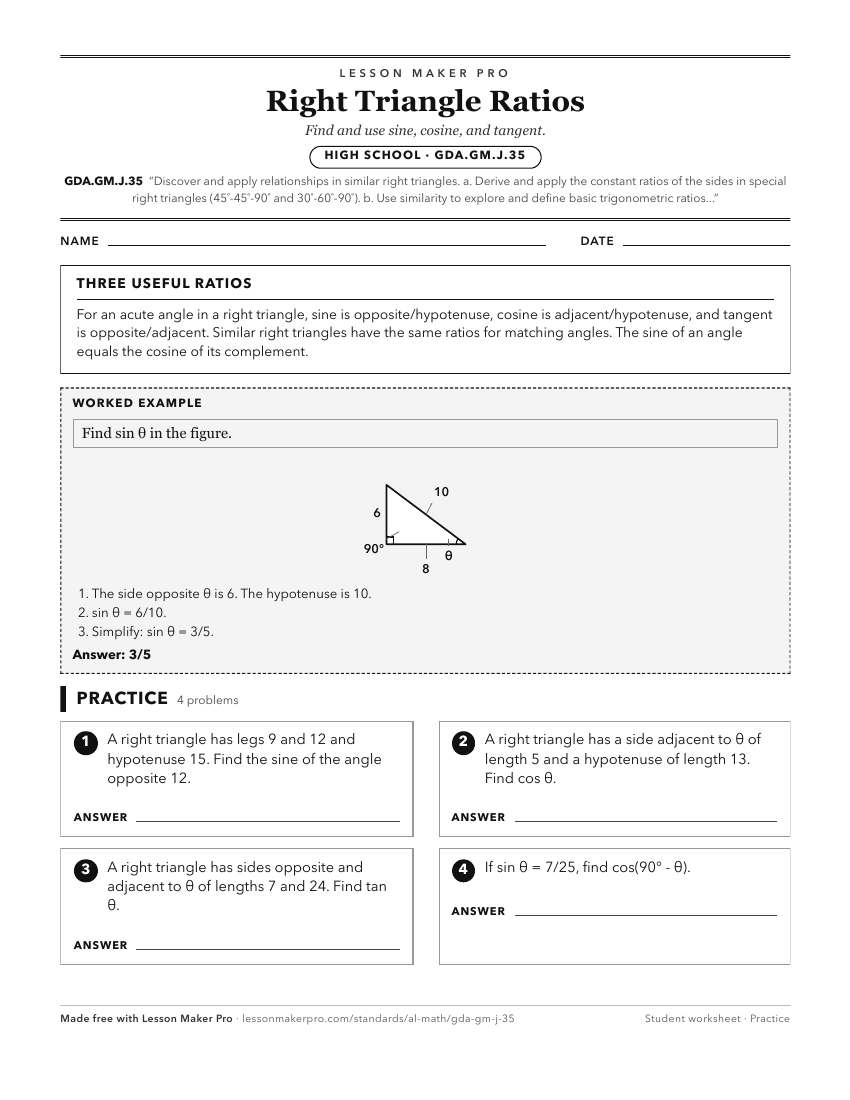
A ready-to-print activity worksheet aligned to GDA.GM.J.35, with an answer key for the teacher on its own page. No account needed.
PDF, US Letter, prints cleanly in black and white.
Download the worksheetKeep exploring
Related Standards
Turn this cluster into a lesson
Grade, subject, topic, and the complete cluster are prefilled. Create one free, no account needed.
Also for this cluster:Make a WorksheetMake a QuizMake a Sub Lesson