Alabama Math GDA.GM.E.25
Standard Cluster
- GDA.GM.E
- Showing that two figures are congruent involves showing that there is a rigid motion (translation, rotation, reflection, or glide reflection) or, equivalently, a sequence of rigid motions that maps one figure to the other.
Verify criteria for showing triangles are congruent using a sequence of rigid motions that map one triangle to another. a. Verify that two triangles are congruent if and only if corresponding pairs of sides and corresponding pairs of angles are congruent. b. Verify that two triangles are congruent if (but not only if) the following groups of corresponding parts are congruent: angle-side-angle (ASA), side-angle-side (SAS), side-side-side (SSS), and angle-angle-side (AAS).
2019 Alabama Course of Study: Mathematics
Cluster contents
Standards in This Cluster
GDA.GM.E.25 is a cluster heading. These are the individual standards under it.
- GDA.GM.E.25.a
Verify that two triangles are congruent if and only if corresponding pairs of sides and corresponding pairs of angles are congruent.
- GDA.GM.E.25.b
Verify that two triangles are congruent if (but not only if) the following groups of corresponding parts are congruent: angle-side-angle (ASA), side-angle-side ...
Teacher's field guide
What This Cluster Means
What Students Need to Do
- Students slide, turn, or flip one triangle to see whether it fits exactly on another. They use matching measurements to explain when that fit is guaranteed.
What Mastery Looks Like
- Students match the right vertices and identify a valid test, such as SAS or AAS. They explain how to align one side and place the third vertex. They know triangles that fit exactly have all corresponding sides and angles equal.
Common Misconceptions
- Students sometimes pair sides or angles that do not correspond, or call a nonincluded angle SAS. Three matching angles do not guarantee the same size. Two sides and a nonincluded angle may allow different triangles.
How to Assess It
- Two triangles each have sides of 5 cm and 7 cm with a 40° angle between them. Ask students to name the congruence test and describe how they would move one triangle to cover the other.
Lesson moves
Ways to Teach It
Draw two triangles with 5 cm and 7 cm sides enclosing 40°, cut them out, and slide, turn, or flip them to overlap.
Ask: Can two triangles with 40°, 60°, and 80° angles have different sizes? Sketch a pair to defend your answer.
Hand out marked triangle pairs showing ASA, SAS, SSS, AAS, AAA, or SSA; students sort them by whether congruence is guaranteed.
Give students two shelf-bracket plans with 20 cm and 30 cm sides enclosing 60°; ask whether the cut brackets will stack exactly.
Free download
Printable GDA.GM.E.25 Worksheet
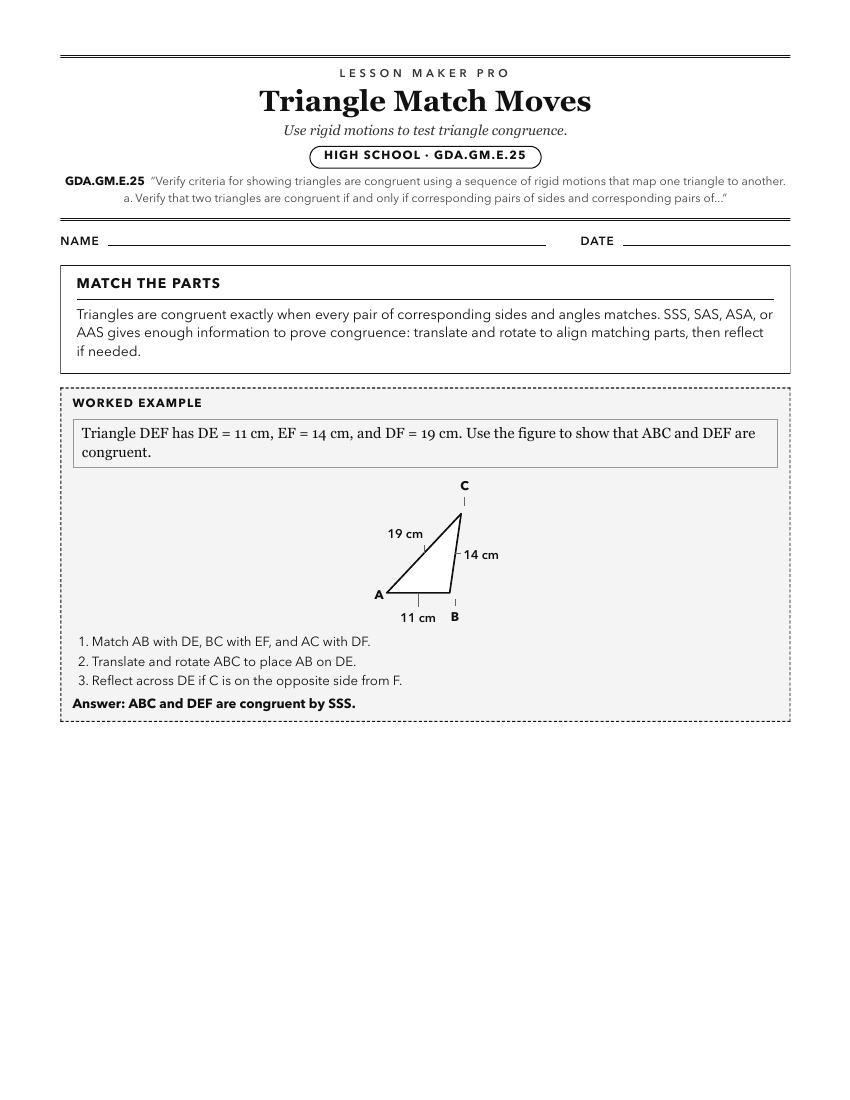
A ready-to-print activity worksheet aligned to GDA.GM.E.25, with an answer key for the teacher on its own page. No account needed.
PDF, US Letter, prints cleanly in black and white.
Download the worksheetKeep exploring
Related Standards
- GDA.GM.F.28
Verify criteria for showing triangles are similar using a similarity transformation (sequence of rigid motions and dilations) that maps one triangle to another.
- 7A.GM.C.42.a
Given a pair of two-dimensional figures, determine if a series of rigid motions maps one figure onto the other, recognizing that if such a sequence exists the f...
Turn this cluster into a lesson
Grade, subject, topic, and the complete cluster are prefilled. Create one free, no account needed.
Also for this cluster:Make a WorksheetMake a QuizMake a Sub Lesson