Alabama Math GDA.GM.C.20
The Standard
- GDA.GM.C
- When an object is the image of a known object under a similarity transformation, a length, area, or volume on the image can be computed by using proportional relationships.
Derive and apply the formula for the length of an arc and the formula for the area of a sector.
2019 Alabama Course of Study: Mathematics
Teacher's field guide
What This Standard Means
What Students Need to Do
- Students use the central angle to find what fraction of a circle an arc or sector covers. They use that fraction to find arc length from circumference and sector area from circle area.
What Mastery Looks Like
- A student can explain why a 90° arc is one quarter of a circle’s circumference. Given a radius and central angle, they calculate arc length and sector area with the correct units.
Common Misconceptions
- Students may use the full circumference or circle area instead of taking a fraction. They may use the diameter as the radius or forget to square the radius when finding area.
How to Assess It
- Exit ticket: A circle has radius 6 cm and a 60° central angle. Find the arc length and sector area, and show the fraction you used.
Lesson moves
Ways to Teach It
Cut a 90° sector from a paper circle, then use string to compare its curved edge with the full circumference.
Ask students to write why a 60° sector has one sixth of the circle’s area.
Give pairs cards with radii and angles, and have them match each card to an arc length and sector area.
For a 16-inch pizza, find the crust length and area of a 45° slice.
Free download
Printable GDA.GM.C.20 Worksheet
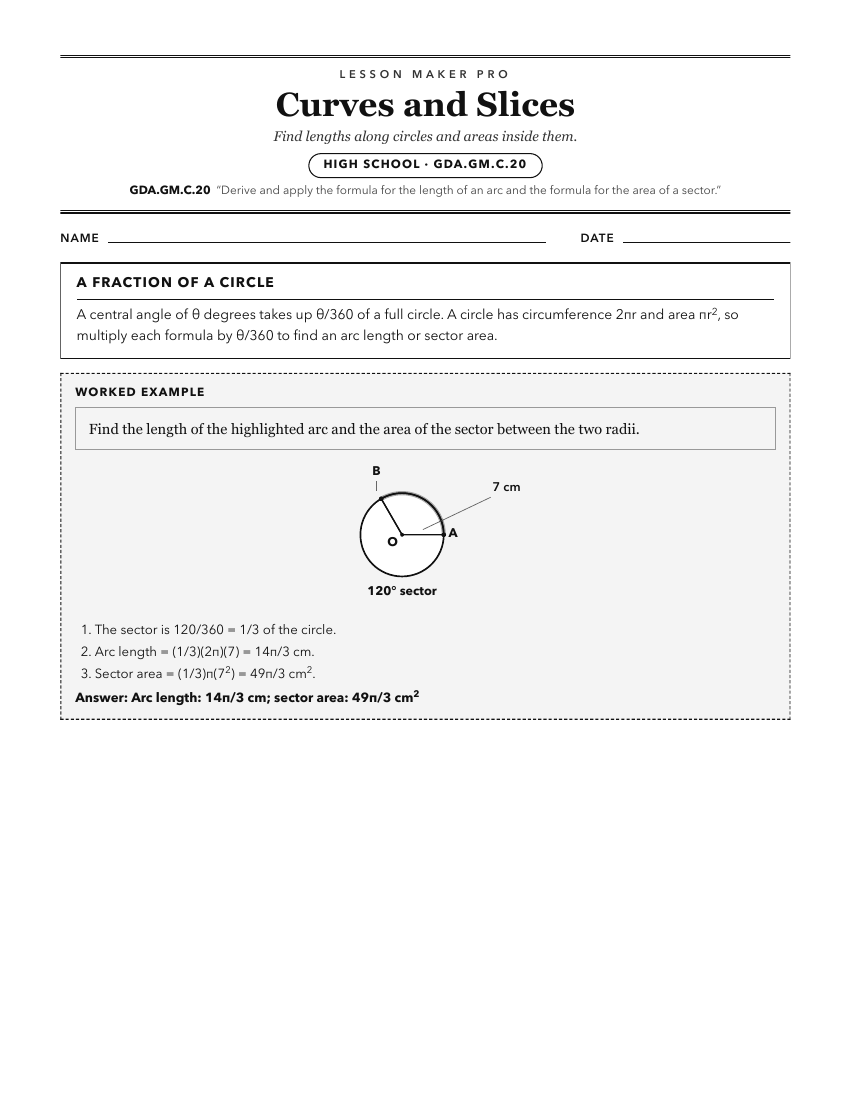
A ready-to-print activity worksheet aligned to GDA.GM.C.20, with an answer key for the teacher on its own page. No account needed.
PDF, US Letter, prints cleanly in black and white.
Download the worksheetKeep exploring
Related Standards
- 7A.GM.B.36.a
Informally derive the formula for area of a circle.
- 7.GM.B.20.a
Informally derive the formula for area of a circle.
- A2S.GM.B.37
Derive and apply the formula A = ½·ab·sin(C) for the area of a triangle by drawing an auxiliary line from a vertex perpendicular to the opposite side, extending...
- PC.F.H.37.b
Use the angle sum formulas for sine, cosine, and tangent to derive the double angle formulas.
Turn this exact standard into a lesson
Grade, subject, topic, and the complete standard are prefilled. Create one free, no account needed.
Also for this standard:Make a WorksheetMake a QuizMake a Sub Lesson