Alabama Math GDA.GM.A.17
Standard Cluster
- GDA.GM.A
- Areas and volumes of figures can be computed by determining how the figure might be obtained from simpler figures by dissection and recombination.
Model and solve problems using surface area and volume of solids, including composite solids and solids with portions removed. a. Give an informal argument for the formulas for the surface area and volume of a sphere, cylinder, pyramid, and cone using dissection arguments, Cavalieri's Principle, and informal limit arguments. b. Apply geometric concepts to find missing dimensions to solve surface area or volume problems.
2019 Alabama Course of Study: Mathematics
Cluster contents
Standards in This Cluster
GDA.GM.A.17 is a cluster heading. These are the individual standards under it.
Teacher's field guide
What This Cluster Means
What Students Need to Do
- Students split solids into pieces or subtract holes to find volume. For surface area, they count only exposed faces. They use nets, matching slices, and thin bands to explain formulas for cylinders, cones, pyramids, and spheres.
What Mastery Looks Like
- A student can find the paintable area of a tank with a conical roof without counting the joined circles. They can work backward from a given volume to find a missing radius. They can explain why a cone holds one-third as much as a cylinder with the same base and height.
Common Misconceptions
- Students often count faces where solids touch or miss the inner wall of a drilled hole. They may use the diameter as the radius or give square units for volume. Some assume a cone and cylinder with the same base and height hold equal amounts.
How to Assess It
- Exit ticket: A cylinder with radius 3 cm and height 8 cm has a centered cylindrical hole of radius 1 cm through its full height. Find its remaining volume and exposed surface area, including the inner wall.
Lesson moves
Ways to Teach It
Build a cone and cylinder with matching bases and heights from cardstock, then pour rice from the cone into the cylinder three times.
Sketch horizontal slices of a sphere and a snug cylinder with two cones removed, cone tips at the center; why do the areas match?
Give pairs cards showing prisms and pyramids with equal bases and heights; have them race to match each pyramid to one-third its prism volume.
Using a 2-foot-radius, 6-foot-tall cylindrical tank and a label reading 100 square feet per can, find cans needed to paint sides and top.
Free download
Printable GDA.GM.A.17 Worksheet
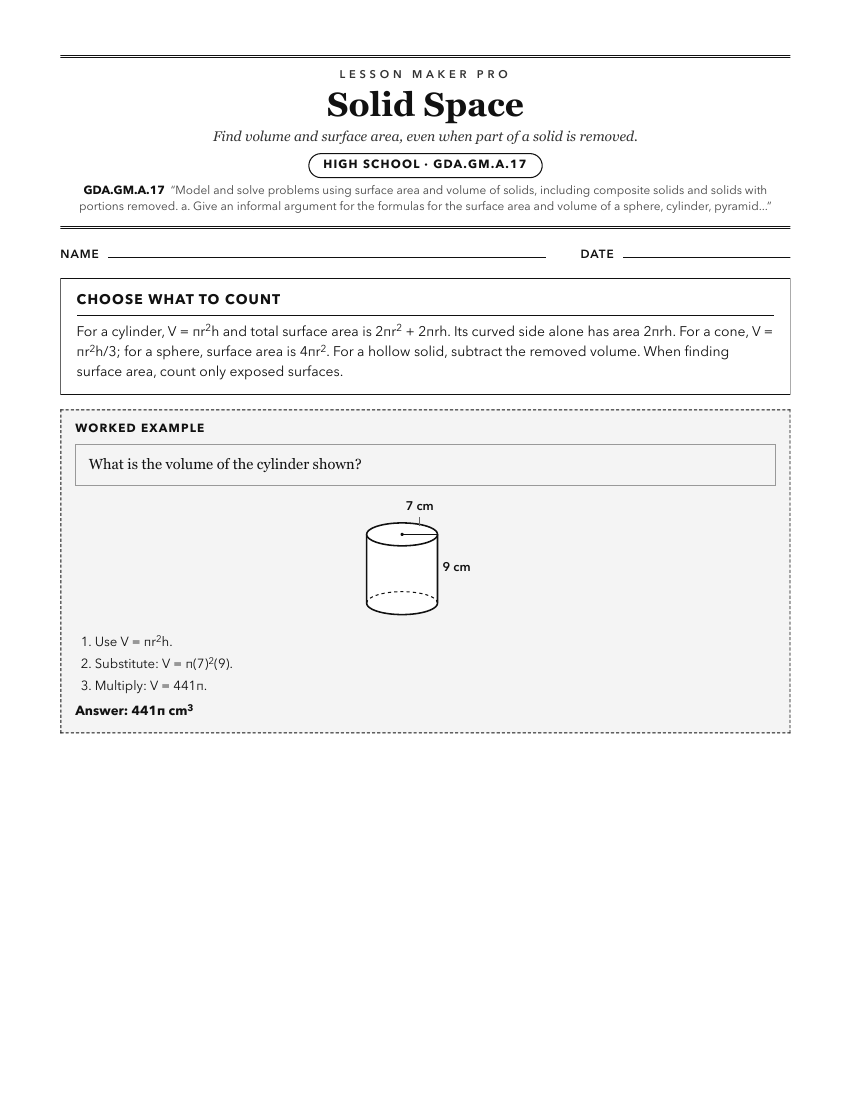
A ready-to-print activity worksheet aligned to GDA.GM.A.17, with an answer key for the teacher on its own page. No account needed.
PDF, US Letter, prints cleanly in black and white.
Download the worksheetKeep exploring
Related Standards
- 7A.GM.B.39
Solve real-world and mathematical problems involving area, volume, and surface area of two- and three-dimensional objects composed of triangles, quadrilaterals,...
- 7.GM.B.22
Solve real-world and mathematical problems involving area, volume, and surface area of two- and three-dimensional objects composed of triangles, quadrilaterals,...
- 6.GM.B
Solve real-world and mathematical problems to determine area, surface area, and volume.
Turn this cluster into a lesson
Grade, subject, topic, and the complete cluster are prefilled. Create one free, no account needed.
Also for this cluster:Make a WorksheetMake a QuizMake a Sub Lesson