Alabama Math FM.FDV.A.28
The Standard
- FM.FDV.A
- Methods used to solve non-trivial problems of division of objects often reveal issues of fairness.
Use spreadsheets to examine apportionment methods in large problems.
2019 Alabama Course of Study: Mathematics
Teacher's field guide
What This Standard Means
What Students Need to Do
- Students put population data and a fixed number of seats into a spreadsheet. They use formulas to calculate quotas and compare seat allocations from two methods across many districts.
What Mastery Looks Like
- A student can fill formulas down a large table and check that the assigned seats add up to the required total. They can identify districts with different results and explain how each method assigned the seats.
Common Misconceptions
- Rounding every quota to the nearest whole number can leave the seat total wrong. Copying a formula without fixing the total-population cell can make later rows use the wrong denominator.
How to Assess It
- Exit ticket: Use a spreadsheet to assign 40 seats by Hamilton's method to populations 510, 920, 1210, 1720, 2280, and 3360. Submit your remainder formula and final seat counts, which should be 2, 4, 5, 7, 9, and 13.
Lesson moves
Ways to Teach It
Give pairs a spreadsheet with 20 district populations and 100 seats; have them calculate Hamilton quotas, remainders, and final seats.
Display Hamilton and Jefferson allocations for the same districts, then ask students to explain why one district gets a different seat count.
Have teams change the seat total from 100 to 101 in their sheets and race to identify every district whose allocation changes.
Use a sample list of 20 homeroom enrollments to divide 200 library books, then compare the allocations from Hamilton and Jefferson.
Free download
Printable FM.FDV.A.28 Worksheet
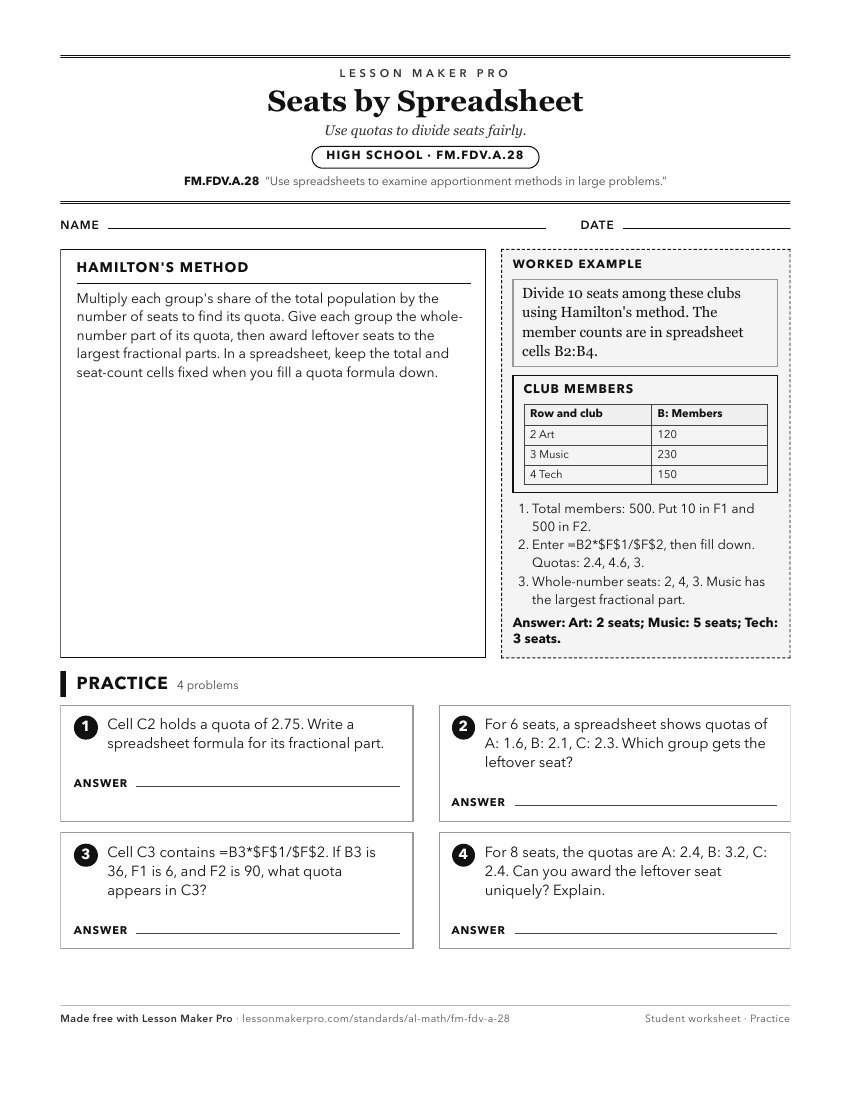
A ready-to-print activity worksheet aligned to FM.FDV.A.28, with an answer key for the teacher on its own page. No account needed.
PDF, US Letter, prints cleanly in black and white.
Download the worksheetKeep exploring
Related Standards
- FM.FDV.A.26
Explain and apply mathematical aspects of fair division, with respect to classic problems of apportionment, cake cutting, and estate division. Include applicati...
- A2S.DSP.C.25.b
Estimate areas under a normal curve to solve problems in context, using calculators, spreadsheets, and tables as appropriate.
- FM.FDV.A.27
Identify and apply historic methods of apportionment for voting districts including Hamilton, Jefferson, Adams, Webster, and Huntington-Hill. Identify issues of...
- FM.FDV.A
Methods used to solve non-trivial problems of division of objects often reveal issues of fairness.
Turn this exact standard into a lesson
Grade, subject, topic, and the complete standard are prefilled. Create one free, no account needed.
Also for this standard:Make a WorksheetMake a QuizMake a Sub Lesson