Alabama Math A1P.AF.G.22
Standard Cluster
- A1P.AF.G
- Functions can be described by using a variety of representations: mapping diagrams, function notation (e.g., f(x) = x²), recursive definitions, tables, and graphs.
Define sequences as functions, including recursive definitions, whose domain is a subset of the integers. a. Write explicit and recursive formulas for arithmetic and geometric sequences and connect them to linear and exponential functions.
2019 Alabama Course of Study: Mathematics
Cluster contents
Standards in This Cluster
A1P.AF.G.22 is a cluster heading. These are the individual standards under it.
Teacher's field guide
What This Cluster Means
What Students Need to Do
- Students treat term numbers as integer inputs and term values as outputs. They write rules for arithmetic and geometric sequences using either the term number or the previous term. They connect constant addition to linear functions and constant multiplication to exponential functions.
What Mastery Looks Like
- Given 5, 8, 11, 14, a student writes a_n = 5 + 3(n - 1) and a recursive rule that starts at 5 and adds 3. Given 5, 10, 20, 40, they write a_n = 5(2)^(n - 1) and a recursive rule that doubles each term. They name the first pattern linear, the second exponential, and use positive integers for term numbers.
Common Misconceptions
- Students often use n instead of n - 1 when the first term is a_1. They may add in a geometric sequence instead of multiplying. They may give a recursive rule without a starting term or draw a continuous graph instead of separate points.
How to Assess It
- Exit ticket: For 6, 9, 12 and 6, 18, 54, write explicit and recursive rules, then label each pattern linear or exponential. State which term numbers are allowed.
Lesson moves
Ways to Teach It
Build 3, 5, 7, 9 with tiles and 2, 4, 8, 16 with counters; label term numbers and write both rule types.
Ask: Which pattern, 4, 7, 10, 13 or 4, 8, 16, 32, is linear? Write how you know.
Give pairs of sequence cards; students race to match each card with its explicit rule, recursive rule, and graph.
Use a plant growing 2 cm weekly and a bacteria colony doubling hourly; write formulas using whole-number time steps.
Free download
Printable A1P.AF.G.22 Worksheet
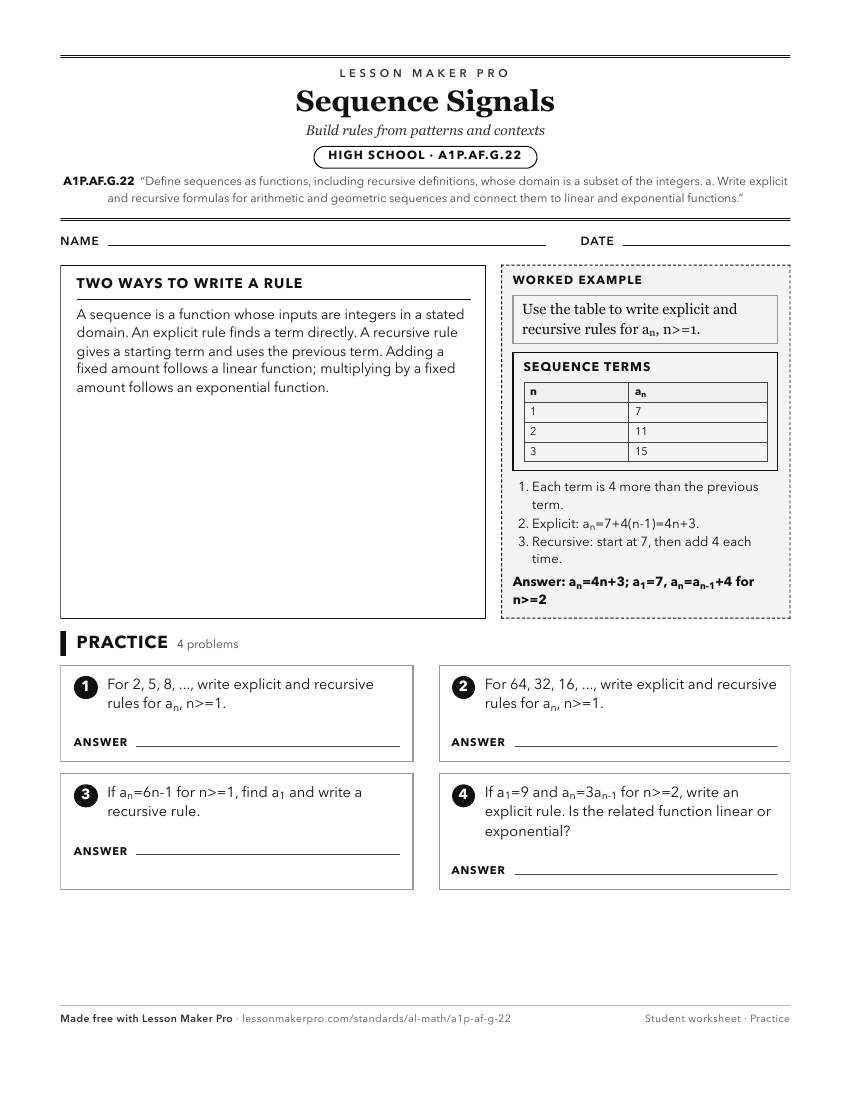
A ready-to-print activity worksheet aligned to A1P.AF.G.22, with an answer key for the teacher on its own page. No account needed.
PDF, US Letter, prints cleanly in black and white.
Download the worksheetKeep exploring
Related Standards
- 8A.AF.H.24
Define sequences as functions, including recursive definitions, whose domain is a subset of the integers.
- 8A.AF.H.24.a
Write explicit and recursive formulas for arithmetic and geometric sequences and connect them to linear and exponential functions.
- A1P.AF.E.15
Define a function as a mapping from one set (called the domain) to another set (called the range) that assigns to each element of the domain exactly one element...
Turn this cluster into a lesson
Grade, subject, topic, and the complete cluster are prefilled. Create one free, no account needed.
Also for this cluster:Make a WorksheetMake a QuizMake a Sub Lesson