Alabama Math 8A.DSP.H.45
The Standard
- 8A.DSP.H
- Conditional probabilities – that is, those probabilities that are "conditioned" by some known information – can be computed from data organized in contingency tables. Conditions or assumptions may affect the computation of a probability.
Compute the conditional probability of event A given event B, using two-way tables or tree diagrams.
2019 Alabama Course of Study: Mathematics
Teacher's field guide
What This Standard Means
What Students Need to Do
- Students find the chance of one event among cases where another event has happened. They use a two-way table or tree diagram to find the matching cases and the total in that group.
What Mastery Looks Like
- Given a table, students divide the count in both groups by the total in the given group. On a tree, they add the matching path probabilities, then divide by the probability of the given event. They can explain why changing the given event changes the denominator.
Common Misconceptions
- Students may divide by the total number of cases instead of the number in the given group. They may reverse the two events or miss a path on a tree diagram.
How to Assess It
- Exit ticket: Of 12 soccer players, 5 bike to school. Of 8 nonplayers, 3 bike to school. Make a two-way table and find P(bikes | plays soccer). Circle your denominator.
Lesson moves
Ways to Teach It
Sort 12 cards: 4 blue circles, 2 blue squares, 3 red circles, and 3 red squares. Make a table and find P(circle | blue).
Ask: Why does P(circle | blue) use 6 as the denominator, while P(blue | circle) uses 7? Have students write one sentence.
Play a draw-and-predict game with two red and two blue counters. Draw twice without replacement, then use a tree to check P(first red | second blue).
Survey classmates about bus rides and after-school clubs. Use a two-way table to find P(bus rider | club member).
Free download
Printable 8A.DSP.H.45 Worksheet
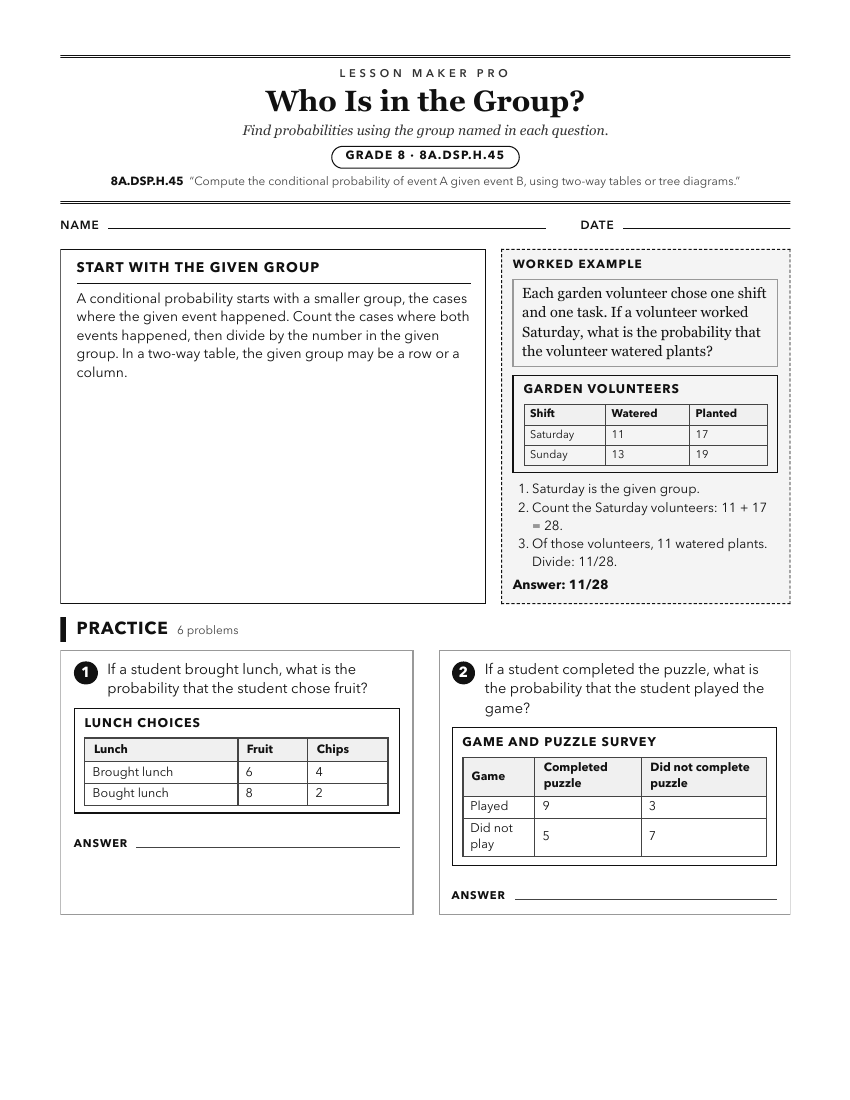
A ready-to-print activity worksheet aligned to 8A.DSP.H.45, with an answer key for the teacher on its own page. No account needed.
PDF, US Letter, prints cleanly in black and white.
Download the worksheetKeep exploring
Related Standards
- A1P.DSP.G.39
Compute the conditional probability of event A given event B, using two-way tables or tree diagrams.
- 8A.DSP.G.44
Explain whether two events, A and B, are independent, using two-way tables or tree diagrams.
- A1P.DSP.F.38
Explain whether two events, A and B, are independent, using two-way tables or tree diagrams.
- A1P.DSP.G.41
Explain why the conditional probability of A given B is the fraction of B's outcomes that also belong to A, and interpret the answer in context.
Turn this exact standard into a lesson
Grade, subject, topic, and the complete standard are prefilled. Create one free, no account needed.
Also for this standard:Make a WorksheetMake a QuizMake a Sub Lesson