Alabama Math 8A.DSP.A.36
The Standard
- 8A.DSP.A
- Investigate patterns of association in bivariate data.
Use a linear model of a real-world situation to solve problems and make predictions. a. Describe the rate of change and y-intercept in the context of a problem using a linear model of a real-world situation.
2019 Alabama Course of Study: Mathematics
Teacher's field guide
What This Standard Means
What Students Need to Do
- Students use an equation, table, or graph of a real situation to find values and make predictions. They explain the rate of change and starting value using the right units.
What Mastery Looks Like
- Given a taxi fare of $3 plus $2 per mile, a student identifies $3 as the starting fare and $2 as the charge for each mile. They predict that a five-mile ride costs $13.
Common Misconceptions
- Students may mix up the starting fee and the charge per mile. They may say a zero-mile ride costs $0 or add the per-mile charge only once, regardless of distance.
How to Assess It
- Exit ticket: A ride costs C = 3 + 2m dollars for m miles. Explain what 3 and 2 mean, then find the cost of 7 miles.
Lesson moves
Ways to Teach It
Give pairs counters to model a $3 pickup fee plus $2 per mile; build and record fares for 0 through 4 miles.
Ask: Why does a zero-mile taxi ride cost $3, and how much does the fare change with each mile?
Match two phone plans, $15 plus $4 per gigabyte and $10 plus $6 per gigabyte, with equations and three-gigabyte bills.
Show a mock parking sign charging $4 to enter plus $2 per hour; students predict a five-hour bill and explain each fee.
Free download
Printable 8A.DSP.A.36 Worksheet
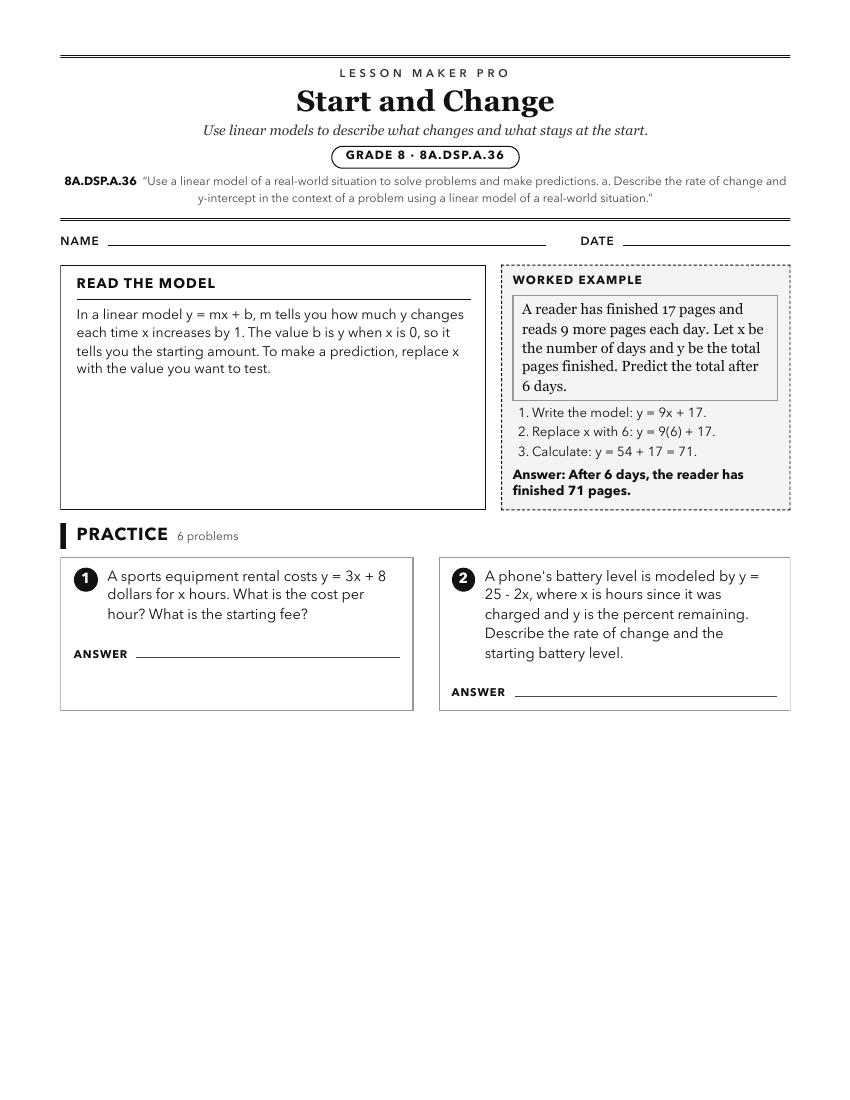
A ready-to-print activity worksheet aligned to 8A.DSP.A.36, with an answer key for the teacher on its own page. No account needed.
PDF, US Letter, prints cleanly in black and white.
Download the worksheetKeep exploring
Related Standards
- 8.DSP.A.20
Use a linear model of a real-world situation to solve problems and make predictions.
- GDA.DSP.F.15
Evaluate possible solutions to real-life problems by developing linear models of contextual situations and using them to predict unknown values.
- GDA.DSP.F.15.a
Use the linear model to solve problems in the context of the given data.
- 6.AF.B
Use equations and inequalities to represent and solve real-world or mathematical problems.
Turn this exact standard into a lesson
Grade, subject, topic, and the complete standard are prefilled. Create one free, no account needed.
Also for this standard:Make a WorksheetMake a QuizMake a Sub Lesson