Alabama Math 8A.DSP.A.34
The Standard
- 8A.DSP.A
- Investigate patterns of association in bivariate data.
Construct and interpret scatter plots for bivariate measurement data to investigate patterns of association between two quantities, describing patterns in terms of positive, negative, or no association, linear and non-linear association, clustering, and outliers.
2019 Alabama Course of Study: Mathematics
Teacher's field guide
What This Standard Means
What Students Need to Do
- Students plot paired measurements as points, with one quantity on each labeled axis. They describe whether the points rise, fall, or show no clear trend, and look for straight or curved patterns, clusters, and outliers.
What Mastery Looks Like
- Given a scatter plot, students can name a positive, negative, or no association and tell whether a trend is linear or curved. They point to specific dots to explain a cluster or outlier.
Common Misconceptions
- Students may plot the two lists of measurements separately instead of pairing values from the same row. They may call any upward pattern linear, treat every outlier as a mistake, or assume an association proves cause and effect.
How to Assess It
- On grid paper, have students plot (1,2), (2,3), (3,4), (4,5), (5,6), and (6,1). Ask them to name the main pattern and circle the outlier.
Lesson moves
Ways to Teach It
Measure six classmates' hand spans and forearm lengths, record each pair on a sticky note, and build a scatter plot on grid paper.
Show two sketches of distance traveled versus time, one straight and one curved, and ask which shows a constant pace and why.
Give pairs six scatter plot cards to sort by direction and shape, then have them circle any clusters and outliers.
Plot temperature and ice pop sales pairs (60,12), (65,16), (70,23), (75,31), and (80,38), then describe the pattern.
Free download
Printable 8A.DSP.A.34 Worksheet
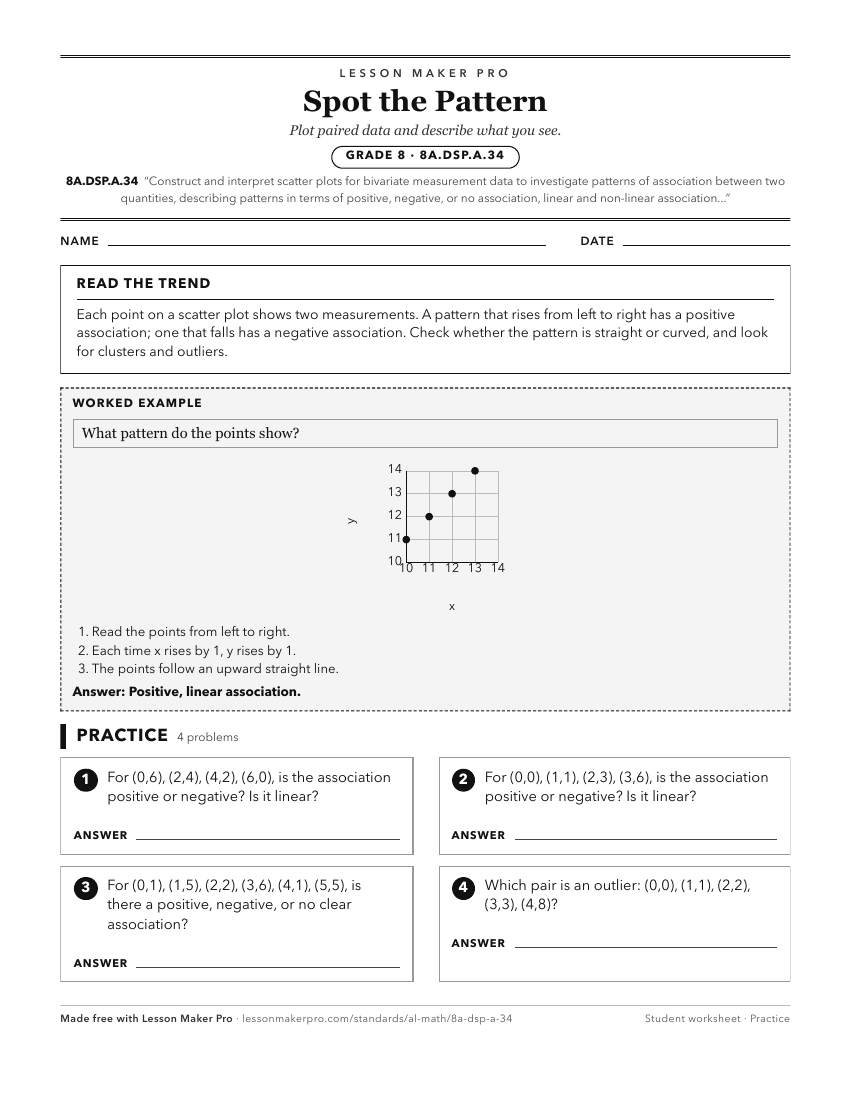
A ready-to-print activity worksheet aligned to 8A.DSP.A.34, with an answer key for the teacher on its own page. No account needed.
PDF, US Letter, prints cleanly in black and white.
Download the worksheetTurn this exact standard into a lesson
Grade, subject, topic, and the complete standard are prefilled. Create one free, no account needed.
Also for this standard:Make a WorksheetMake a QuizMake a Sub Lesson