Alabama Math 8.NS.A.1.a
The Standard
- 8.NS.A
- Understand that the real number system is composed of rational and irrational numbers.
- 8.NS.A.1
- Define the real number system as composed of rational and irrational numbers.
Explain that every number has a decimal expansion; for rational numbers, the decimal expansion repeats or terminates.
2019 Alabama Course of Study: Mathematics
Teacher's field guide
What This Standard Means
What Students Need to Do
- Recognize that every real number has a decimal form. Tell whether its digits end, repeat a fixed block, or continue without repeating, then use that pattern to identify rational numbers.
What Mastery Looks Like
- A student can show that 3/8 = 0.375 and 2/11 = 0.1818..., then explain why both are rational. They can identify a decimal with no repeating block as irrational.
Common Misconceptions
- Students may think any decimal that goes on forever is irrational, so they misclassify 0.333.... They may miss a repeat that starts after a few digits, such as 0.1666....
How to Assess It
- Exit ticket: Classify 0.375, 0.272727..., and 0.1010010001... (with one extra zero between each 1) as rational or irrational. Give one reason for each.
Lesson moves
Ways to Teach It
Use base-ten blocks to divide one whole among three groups, trading leftovers for smaller pieces and recording each new decimal digit.
Ask students to explain whether 0.25 and 0.25000... name the same number, and why both are rational.
Play a card sort with 0.625, 0.1818..., 0.1010010001... (growing runs of zeros), and 7/9; partners explain each choice.
Split a $1 bill equally among three friends on paper; compare each exact share with $0.33 and explain the leftover cent.
Free download
Printable 8.NS.A.1.a Worksheet
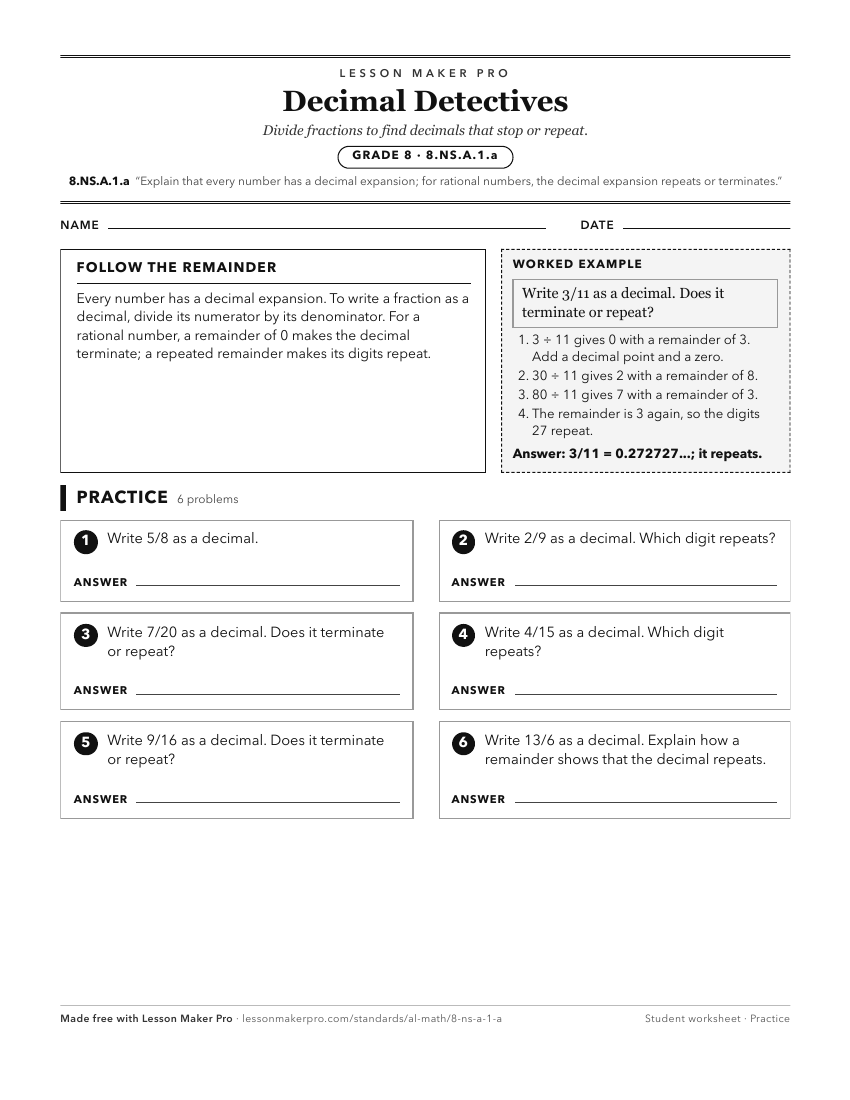
A ready-to-print activity worksheet aligned to 8.NS.A.1.a, with an answer key for the teacher on its own page. No account needed.
PDF, US Letter, prints cleanly in black and white.
Download the worksheetKeep exploring
Related Standards
- 7A.NS.B.10.a
Explain that every number has a decimal expansion; for rational numbers, the decimal expansion repeats in a pattern or terminates.
- 7.NS.A.4.g
Convert a rational number to a decimal using long division, explaining that the decimal form of a rational number terminates or eventually repeats.
- 7A.NS.A.8.g
Convert a rational number to a decimal using long division, explaining that the decimal form of a rational number terminates or eventually repeats.
- 8.NS.A.1.b
Convert a decimal expansion that repeats into a rational number.
Turn this exact standard into a lesson
Grade, subject, topic, and the complete standard are prefilled. Create one free, no account needed.
Also for this standard:Make a WorksheetMake a QuizMake a Sub Lesson