Alabama Math 7A.AF.B.16
Standard Cluster
- 7A.AF.B
- Apply concepts of rational and integer exponents
Express and compare very large or very small numbers in scientific notation. a. Perform operations with numbers expressed in scientific notation, including problems where both decimal and scientific notation are used, expressing answers in scientific notation. b. Use scientific notation and choose units of appropriate size for measurements of very large or very small quantities. c. Interpret scientific notation that has been generated by technology.
2019 Alabama Course of Study: Mathematics
Cluster contents
Standards in This Cluster
7A.AF.B.16 is a cluster heading. These are the individual standards under it.
- 7A.AF.B.16.a
Perform operations with numbers expressed in scientific notation, including problems where both decimal and scientific notation are used, expressing answers in ...
- 7A.AF.B.16.b
Use scientific notation and choose units of appropriate size for measurements of very large or very small quantities.
- 7A.AF.B.16.c
Interpret scientific notation that has been generated by technology.
Teacher's field guide
What This Cluster Means
What Students Need to Do
- Students write and compare very large and very small numbers using powers of 10. They calculate with scientific notation and decimals, then write answers in scientific notation. They choose useful units and read calculator displays such as 3.2E-5.
What Mastery Looks Like
- A student can explain why 6.4 × 10⁷ is larger than 8 × 10⁶. They can multiply 3 × 10⁴ by 0.2 and give 6 × 10³ as the answer. They can read 4.5E-6 meters as 4.5 micrometers.
Common Misconceptions
- Students may read 3.2E-5 as a negative number or think 10⁻⁶ is larger than 10⁻⁴. They may add exponents when adding numbers. They may use kilometers for cell widths instead of micrometers.
How to Assess It
- Exit ticket: A calculator shows 3.2E-5 meters for a cell's width. Multiply it by 2.5, give the result in scientific notation, compare it with 9E-5 meters, and choose a sensible unit.
Lesson moves
Ways to Teach It
Hand out cards marked 0.000004 meters, 4 × 10⁻⁶ meters, and 4 micrometers; students sort matching sets.
Ask, “Why is 8 × 10⁻⁶ smaller than 2 × 10⁻⁵, even though 8 is larger than 2?”
Deal cards showing 0.003, 6E4, and 7 × 10⁻⁵; partners convert each and race to compute 0.003 × 6E4.
Show a calculator screen reading 1.5E8 kilometers for the Earth to Sun distance; students write it out and explain why kilometers fit.
Free download
Printable 7A.AF.B.16 Worksheet
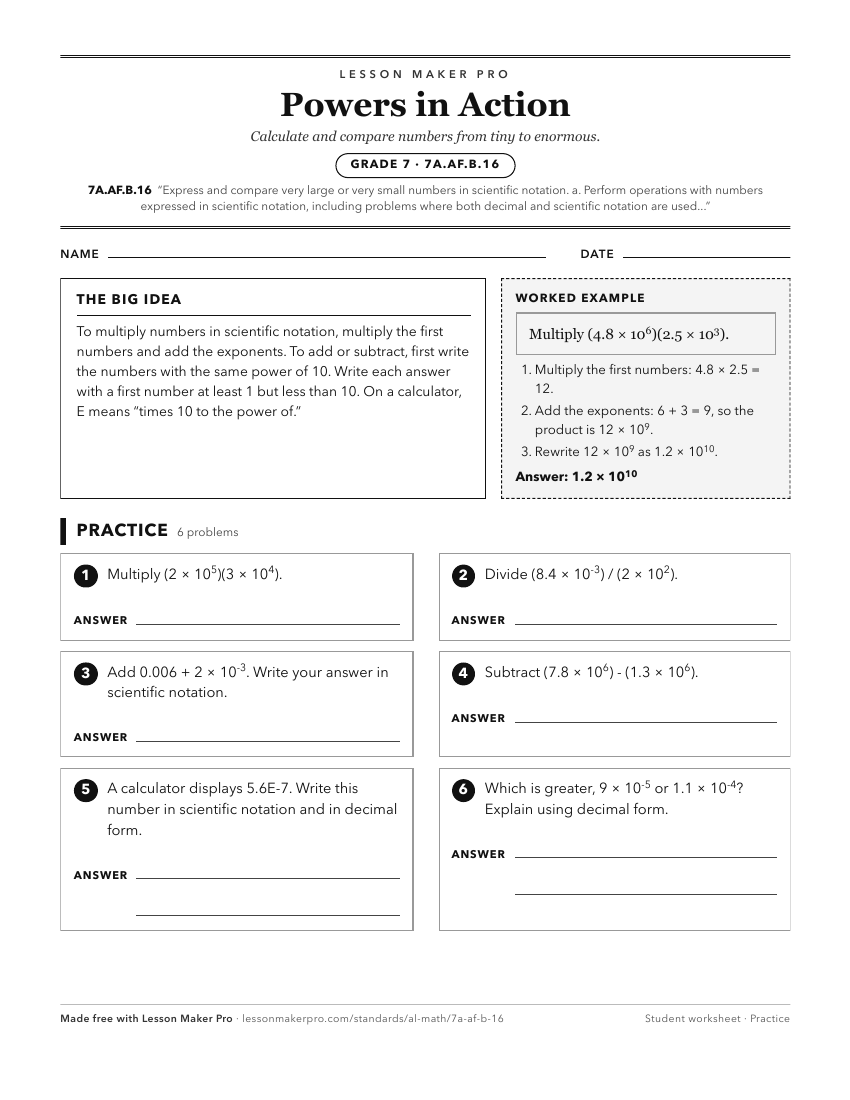
A ready-to-print activity worksheet aligned to 7A.AF.B.16, with an answer key for the teacher on its own page. No account needed.
PDF, US Letter, prints cleanly in black and white.
Download the worksheetKeep exploring
Related Standards
- 8.AF.A.5
Estimate and compare very large or very small numbers in scientific notation.
- 8.AF.A.6.a
Use scientific notation and choose units of appropriate size for measurements of very large or very small quantities.
- 8.AF.A.6
Perform operations with numbers expressed in scientific notation, including problems where both decimal and scientific notation are used.
Turn this cluster into a lesson
Grade, subject, topic, and the complete cluster are prefilled. Create one free, no account needed.
Also for this cluster:Make a WorksheetMake a QuizMake a Sub Lesson