Alabama Math 6.GM.A.25
Standard Cluster
- 6.GM.A
- Graph polygons in the coordinate plane to solve real-world and mathematical problems.
Graph polygons in the coordinate plane given coordinates of the vertices to solve real-world and mathematical problems. a. Determine missing vertices of a rectangle with the same x-coordinate or the same y-coordinate when graphed in the coordinate plane. b. Use coordinates to find the length of a side between points having the same x-coordinate or the same y-coordinate. c. Calculate perimeter and area of a polygon graphed in the coordinate plane (limiting to polygons in which consecutive vertices have the same x-coordinate or the same y-coordinate).
2019 Alabama Course of Study: Mathematics · Geometry and Measurement
Cluster contents
Standards in This Cluster
6.GM.A.25 is a cluster heading. These are the individual standards under it.
- 6.GM.A.25.a
Determine missing vertices of a rectangle with the same x-coordinate or the same y-coordinate when graphed in the coordinate plane.
- 6.GM.A.25.b
Use coordinates to find the length of a side between points having the same x-coordinate or the same y-coordinate.
- 6.GM.A.25.c
Calculate perimeter and area of a polygon graphed in the coordinate plane (limiting to polygons in which consecutive vertices have the same x-coordinate or the ...
Teacher's field guide
What This Cluster Means
What Students Need to Do
- Plot vertices and connect them in order to draw polygons. Find a missing rectangle corner, use coordinates to measure horizontal and vertical sides, and calculate perimeter and area.
What Mastery Looks Like
- Given three rectangle corners, a student finds the fourth by matching x- and y-coordinates. They find positive side lengths, add the outside edges for perimeter, and split a stepped polygon into rectangles to find its area.
Common Misconceptions
- Students may swap x and y when plotting or choose the wrong coordinates for a missing corner. They may report a negative side length or find the area of the rectangle around an L-shaped figure instead of the figure itself.
How to Assess It
- Exit ticket: Plot A(−2, −1), B(3, −1), and C(3, 2). Find D to complete rectangle ABCD, then label its side lengths and find its perimeter and area.
Lesson moves
Ways to Teach It
On graph paper, give students three rectangle corners and have them place a sticky dot at the fourth corner.
Ask, “Why is the side from (−4, 2) to (3, 2) seven units, not negative seven?”
Play distance bingo: call (−3, 2) to (4, 2), then (1, −4) to (1, 3); students mark the lengths.
Using a one-meter grid, plot a garden with vertices (0,0), (6,0), (6,2), (2,2), (2,5), (0,5); calculate fencing length and planting area.
Free download
Printable 6.GM.A.25 Worksheet
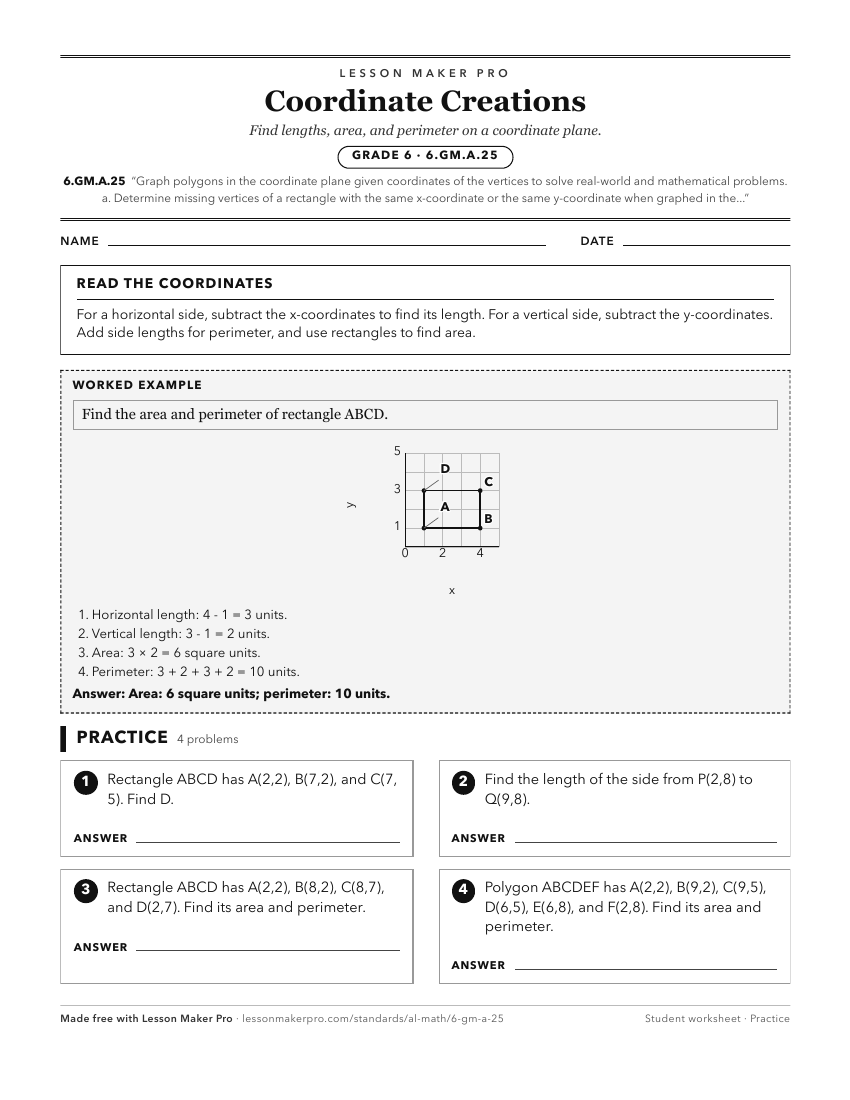
A ready-to-print activity worksheet aligned to 6.GM.A.25, with an answer key for the teacher on its own page. No account needed.
PDF, US Letter, prints cleanly in black and white.
Download the worksheetKeep exploring
Related Standards
- 6.GM.A
Graph polygons in the coordinate plane to solve real-world and mathematical problems.
- GDA.AF.A.3
Find the coordinates of the vertices of a polygon determined by a set of lines, given their equations, by setting their function rules equal and solving, or by ...
- 6.NS.C.11.d
Solve real-world and mathematical problems by graphing points in all four quadrants of the coordinate plane, including finding distances between points with the...
Turn this cluster into a lesson
Grade, subject, topic, and the complete cluster are prefilled. Create one free, no account needed.
Also for this cluster:Make a WorksheetMake a QuizMake a Sub Lesson