Alabama Math 5.NF.B.13
Standard Cluster
- 5.NF.B
- Apply and extend previous understandings of multiplication and division to multiply and divide fractions.
Interpret multiplication as scaling (resizing). a. Compare the size of a product to the size of one factor on the basis of the size of the other factor, without performing the indicated multiplication. b. Explain why multiplying a given number by a fraction greater than 1 results in a product greater than the given number and relate the principle of fraction equivalence. c. Explain why multiplying a given number by a fraction less than 1 results in a product smaller than the given number and relate the principle of fraction equivalence.
2019 Alabama Course of Study: Mathematics · Apply and extend previous understandings of multiplication and division to multiply and divide fractions.
Cluster contents
Standards in This Cluster
5.NF.B.13 is a cluster heading. These are the individual standards under it.
- 5.NF.B.13.b
Explain why multiplying a given number by a fraction greater than 1 results in a product greater than the given number and relate the principle of fraction equi...
- 5.NF.B.13.c
Explain why multiplying a given number by a fraction less than 1 results in a product smaller than the given number and relate the principle of fraction equival...
Teacher's field guide
What This Cluster Means
What Students Need to Do
- Students predict whether multiplying by a fraction makes a number larger, smaller, or unchanged, without calculating the product. They compare the fraction with 1 and recognize that equivalent fractions have the same effect.
What Mastery Looks Like
- Given 18 × 5/4, a student predicts a result greater than 18 because 5/4 is greater than 1. They know 4/4 leaves 18 unchanged, while 3/4 and 6/8 shrink it by the same amount.
Common Misconceptions
- Students may assume multiplication always makes a number bigger. Some look only at the numerator or think 3/4 and 6/8 will resize a number differently.
How to Assess It
- Exit ticket: Without calculating, compare 18 × 5/4, 18 × 4/4, and 18 × 3/4 with 18. Explain each choice and why replacing 3/4 with 6/8 changes nothing.
Lesson moves
Ways to Teach It
Cut a 12-unit paper strip into fourths, then use the pieces to show 3/4, 4/4, and 5/4 of its length.
Ask students to write why 16 × 6/8 is less than 16, even though 6 is greater than 1.
Give pairs fraction cards to match, then have them sort each pair by whether it grows, shrinks, or keeps a starting number.
Give students a photo width of 20 centimeters and ask how printing at 3/4 or 5/4 scale affects its width.
Free download
Printable 5.NF.B.13 Worksheet
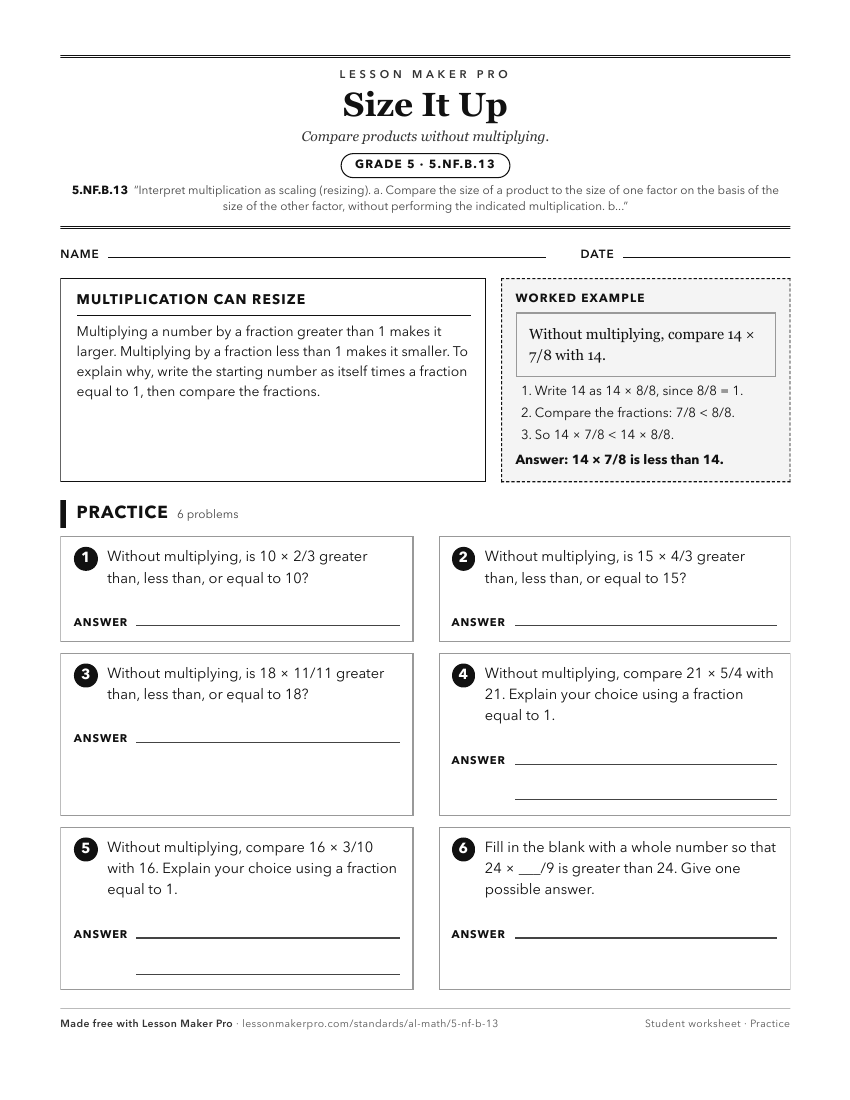
A ready-to-print activity worksheet aligned to 5.NF.B.13, with an answer key for the teacher on its own page. No account needed.
PDF, US Letter, prints cleanly in black and white.
Download the worksheetKeep exploring
Related Standards
Turn this cluster into a lesson
Grade, subject, topic, and the complete cluster are prefilled. Create one free, no account needed.
Also for this cluster:Make a WorksheetMake a QuizMake a Sub Lesson