Alabama Math 4.OA.B.4.b
The Standard
- 4.OA.B
- Gain familiarity with factors and multiples.
- 4.OA.B.4
- For whole numbers in the range 1 to 100, find all factor pairs, identifying a number as a multiple of each of its factors.
Determine whether a whole number in the range 1 to 100 is prime or composite.
2019 Alabama Course of Study: Mathematics
Teacher's field guide
What This Standard Means
What Students Need to Do
- Students find the factors of whole numbers from 1 to 100. They use those factors to decide whether each number is prime, composite, or neither.
What Mastery Looks Like
- A student can explain that 29 is prime because its only factors are 1 and 29. They can show that 21 is composite because 3 and 7 are also factors, and that 1 is neither.
Common Misconceptions
- Students may call 1 prime because it has only one factor. Some assume every odd number is prime, overlooking numbers like 9 and 15. Others call 2 composite because it is even.
How to Assess It
- Exit ticket: Classify 1, 2, 21, and 29 as prime, composite, or neither. List each number's factors to support your answers.
Lesson moves
Ways to Teach It
Give pairs 29 and 30 counters; have them build equal-row arrays and record every row arrangement they find.
Ask students to write why 1 belongs in neither group, using factor lists for 1, 2, and 4.
Play a card sort with numbers 1 to 30; partners sort prime, composite, and neither cards, then check disputed cards with factor lists.
Arrange 17 and 18 chairs into equal rows; ask which chair count allows another layout besides one row.
Free download
Printable 4.OA.B.4.b Worksheet
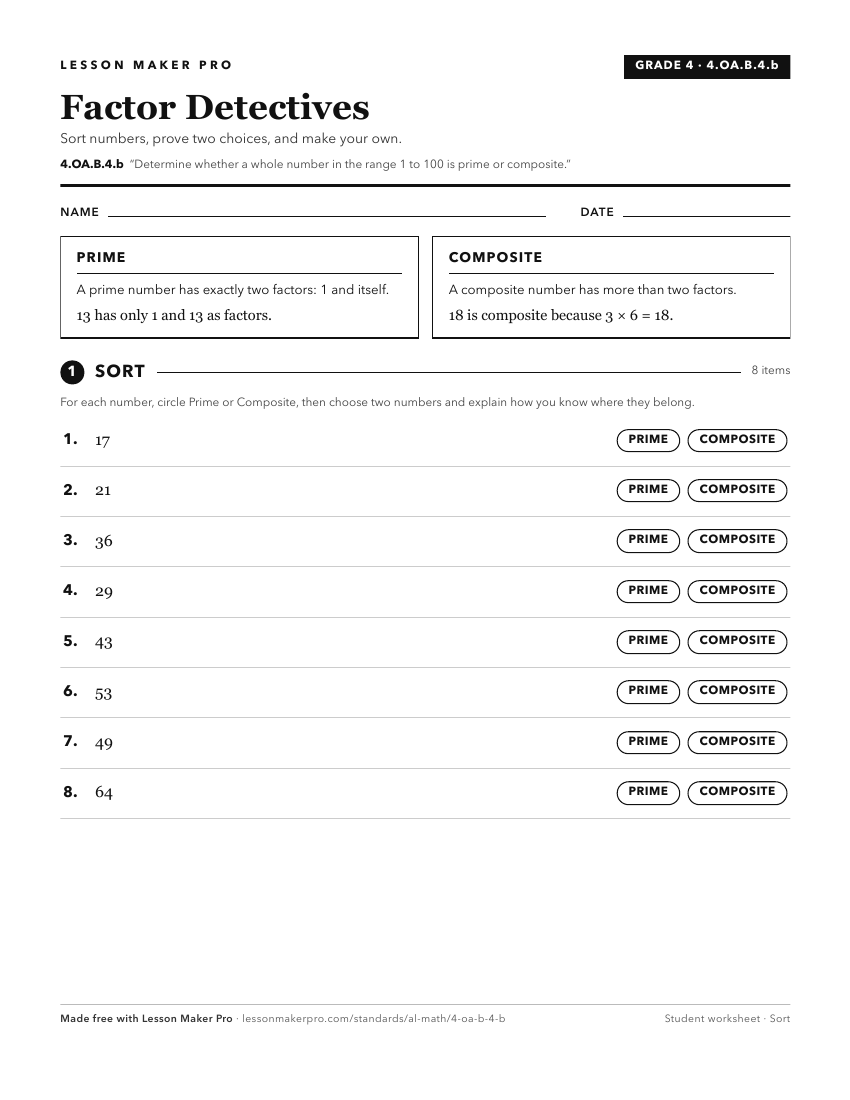
A ready-to-print activity worksheet aligned to 4.OA.B.4.b, with an answer key for the teacher on its own page. No account needed.
PDF, US Letter, prints cleanly in black and white.
Download the worksheetKeep exploring
Related Standards
- 4.OA.B.4.a
Determine whether a whole number in the range 1 to 100 is a multiple of a given one-digit number.
- 4.OA.B.4
For whole numbers in the range 1 to 100, find all factor pairs, identifying a number as a multiple of each of its factors.
- 6.NS.B.8.a
Use factors and multiples to determine prime factorization.
- K.FC.A.2
Count to 100 by ones beginning with any given number between 0 and 99.
Turn this exact standard into a lesson
Grade, subject, topic, and the complete standard are prefilled. Create one free, no account needed.
Also for this standard:Make a WorksheetMake a QuizMake a Sub Lesson