Alabama Math 4.NF.A.14.a
The Standard
- 4.NF.A
- Extend understanding of fraction equivalence and ordering.
- 4.NF.A.14
- Compare two fractions with different numerators and different denominators using concrete models, benchmarks (0, ½, 1), common denominators, and/or common numerators, recording the comparisons with symbols >, =, or <, and justifying the conclusions.
Explain that comparison of two fractions is valid only when the two fractions refer to the same whole.
2019 Alabama Course of Study: Mathematics
Teacher's field guide
What This Standard Means
What Students Need to Do
- Students compare fractions only when the fractions describe equal-sized wholes. They explain why a larger fraction does not always mean a larger amount when the wholes differ.
What Mastery Looks Like
- A student can compare shaded parts of two equal-sized rectangles. If the rectangles differ in size, they say why the fractions alone cannot settle which shaded area is larger.
Common Misconceptions
- Students may think one-half of a small pizza is always more food than one-third of a large pizza. They may count shaded pieces without checking the size of each whole.
How to Assess It
- Draw one strip of 6 squares with half shaded and another of 12 equal-sized squares with one-third shaded. Ask: “Which has more shaded area, and why doesn't comparing the fractions alone give that answer?”
Lesson moves
Ways to Teach It
Have students cut strips of 6 and 12 equal squares, shade half of one and one-third of the other, then compare shaded areas.
Ask students to sketch two sandwiches and respond to: “Is half a sandwich always more food than one-third of a sandwich?”
Give pairs cards showing shaded fractions on rectangles of 6, 9, and 12 equal squares; sort by whole size and compare matching pairs.
Show 6-ounce and 12-ounce juice bottles, then ask whether half the small bottle or one-third the large bottle holds more juice.
Free download
Printable 4.NF.A.14.a Worksheet
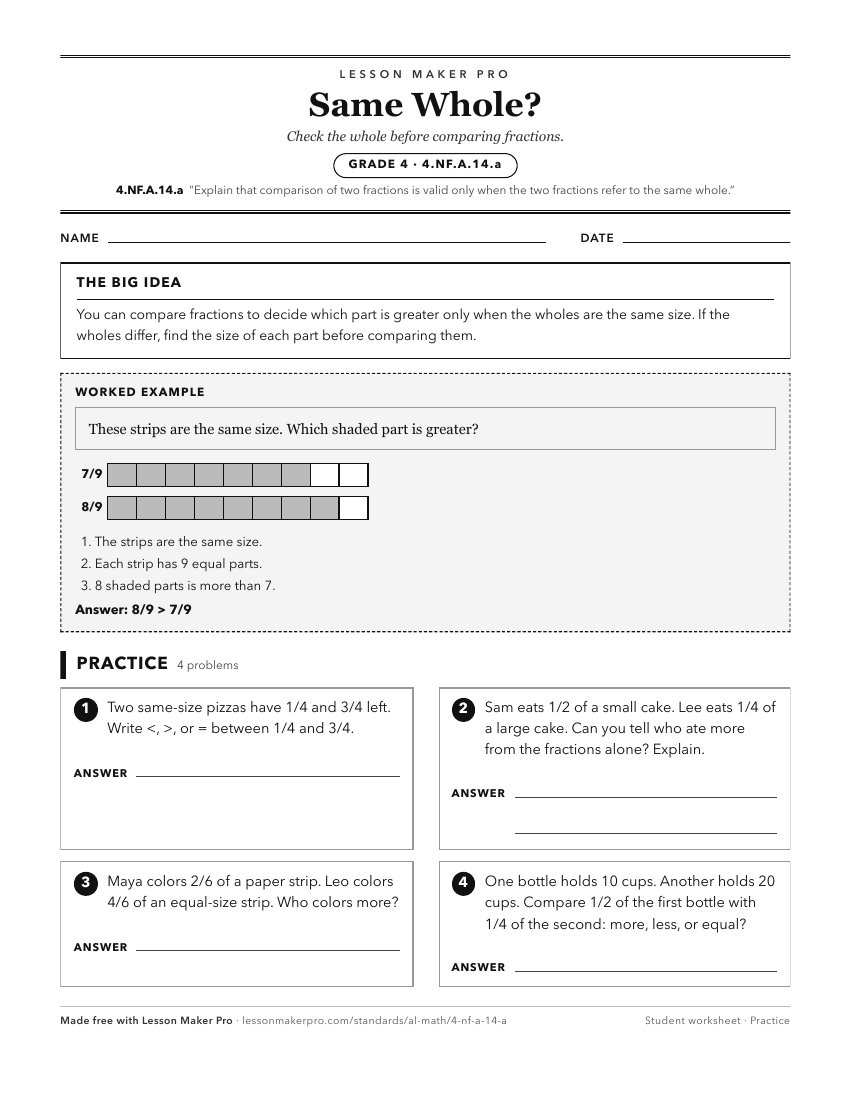
A ready-to-print activity worksheet aligned to 4.NF.A.14.a, with an answer key for the teacher on its own page. No account needed.
PDF, US Letter, prints cleanly in black and white.
Download the worksheetKeep exploring
Related Standards
- 4.NF.A.13
Using area and length fraction models, explain why one fraction is equivalent to another, taking into account that the number and size of the parts differ even ...
- 3.NF.A.15
Explain equivalence and compare fractions by reasoning about their size using visual fraction models and number lines.
- 4.NF.A.14
Compare two fractions with different numerators and different denominators using concrete models, benchmarks (0, ½, 1), common denominators, and/or common numer...
Turn this exact standard into a lesson
Grade, subject, topic, and the complete standard are prefilled. Create one free, no account needed.
Also for this standard:Make a WorksheetMake a QuizMake a Sub Lesson