Alabama Math 4.NBT.B.11.a
The Standard
- 4.NBT.B
- Use place value understanding and properties of operations to perform multi-digit arithmetic with whole numbers.
- 4.NBT.B.11
- Find the product of two factors (up to four digits by a one-digit number and two two-digit numbers), using strategies based on place value and the properties of operations.
Illustrate and explain the product of two factors using equations, rectangular arrays, and area models.
2019 Alabama Course of Study: Mathematics
Teacher's field guide
What This Standard Means
What Students Need to Do
- Students show a multiplication problem with rows and columns and with a rectangle split into smaller parts. They write an equation that adds the parts to find the product.
What Mastery Looks Like
- For 13 × 12, a student draws an array and splits its sides at 10. They label the four parts 100, 20, 30, and 6, then explain why their sum is 156.
Common Misconceptions
- Students may multiply only 10 × 10 and 3 × 2, leaving out two parts. Some count grid lines instead of squares or add the side lengths instead of multiplying them.
How to Assess It
- On grid paper, draw a 12-row, 14-column array. Split it at 10 rows and 10 columns, label each part, and write an equation for the total.
Lesson moves
Ways to Teach It
Build a 6-by-14 array with counters, separate it into 6-by-10 and 6-by-4 groups, then label both products.
Ask: Why does 100 + 20 + 30 + 6 give the same total as 13 × 12? Use a drawing in your answer.
Partners draw two cards from 12, 13, 14, and 15, then race to sketch and label all four parts of their product.
Sketch a 12-by-14 tile floor, split it at 10 tiles on each side, and find how many tiles it needs.
Free download
Printable 4.NBT.B.11.a Worksheet
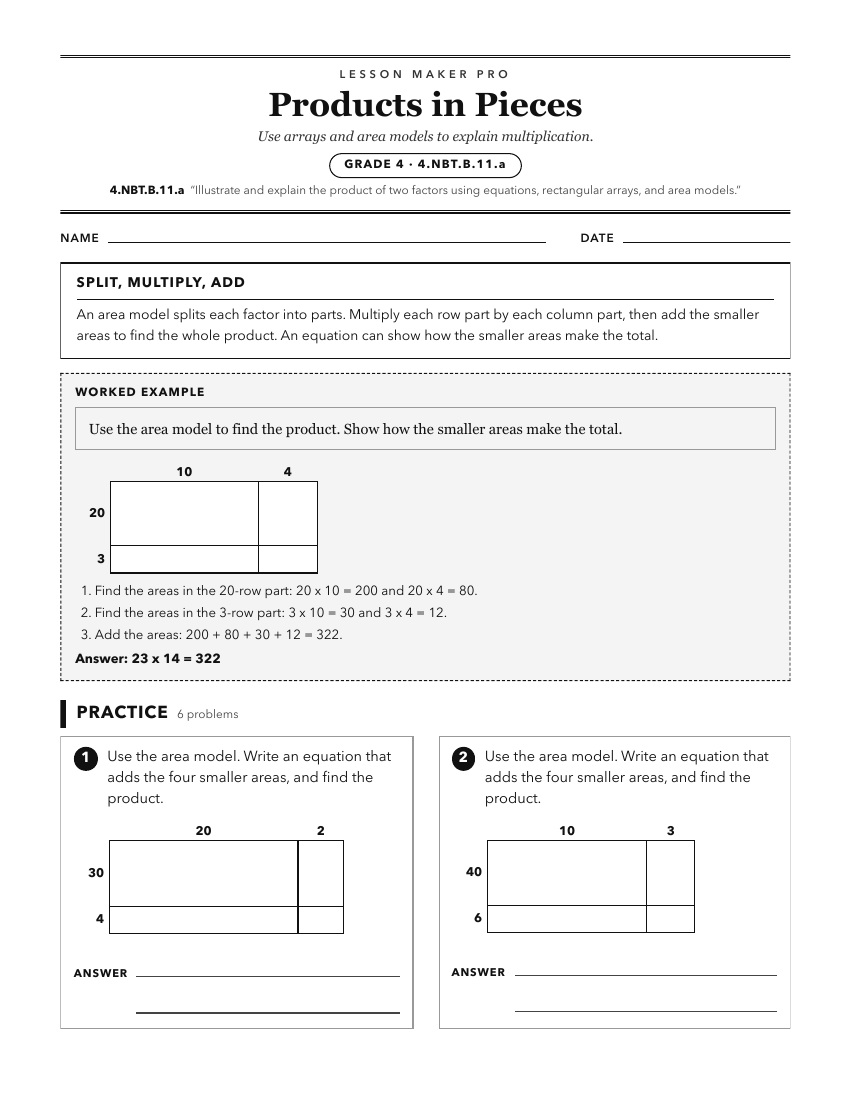
A ready-to-print activity worksheet aligned to 4.NBT.B.11.a, with an answer key for the teacher on its own page. No account needed.
PDF, US Letter, prints cleanly in black and white.
Download the worksheetKeep exploring
Related Standards
- 4.NBT.B.12.a
Illustrate and/or explain quotients using equations, rectangular arrays, and/or area models.
- 5.NF.B.12.b
Use a visual fraction model (area model, set model, or linear model) to show (a/b) × (c/d) and create a story context for this equation to interpret the product...
- 3.M.B.22
Relate area to the operations of multiplication using real-world problems, concrete materials, mathematical reasoning, and the distributive property.
- 5.NF.B.14
Model and solve real-world problems involving multiplication of fractions and mixed numbers using visual fraction models, drawings, or equations to represent th...
Turn this exact standard into a lesson
Grade, subject, topic, and the complete standard are prefilled. Create one free, no account needed.
Also for this standard:Make a WorksheetMake a QuizMake a Sub Lesson