Alabama Math 4.NBT.A.8
The Standard
- 4.NBT.A
- Generalize place value understanding for multi-digit whole numbers.
Use place value understanding to compare two multi-digit numbers using >, =, and < symbols.
2019 Alabama Course of Study: Mathematics · Operations with Numbers: Base Ten
Teacher's field guide
What This Standard Means
What Students Need to Do
- Students check how many digits each number has. If the numbers have the same number of digits, they compare from left to right and use >, <, or = to show the result.
What Mastery Looks Like
- A student writes 48,306 < 48,360 and points to the tens digits as the first difference. They can also explain why 10,000 is greater than 9,999.
Common Misconceptions
- Some students look at the last digit first and say 48,306 is greater than 48,360. Others reverse the comparison sign or think 9,999 is greater than 10,000 because 9 is greater than 1.
How to Assess It
- Exit ticket: Fill in 71,408 __ 71,480; 9,999 __ 10,000; and 42,300 __ 42,300. Write one reason for each choice.
Lesson moves
Ways to Teach It
Give pairs digit tiles 5, 3, 2, 0, and 7 to make two numbers, then place a comparison sign between them.
Ask students to write why 60,104 is greater than 59,999, even though the thousands digit is smaller.
Play comparison war: partners flip five-digit number cards, place a sign between them, and name the first place that differs.
Post library book counts of 12,608 and 12,680, then ask which branch has more books and how students know.
Free download
Printable 4.NBT.A.8 Worksheet
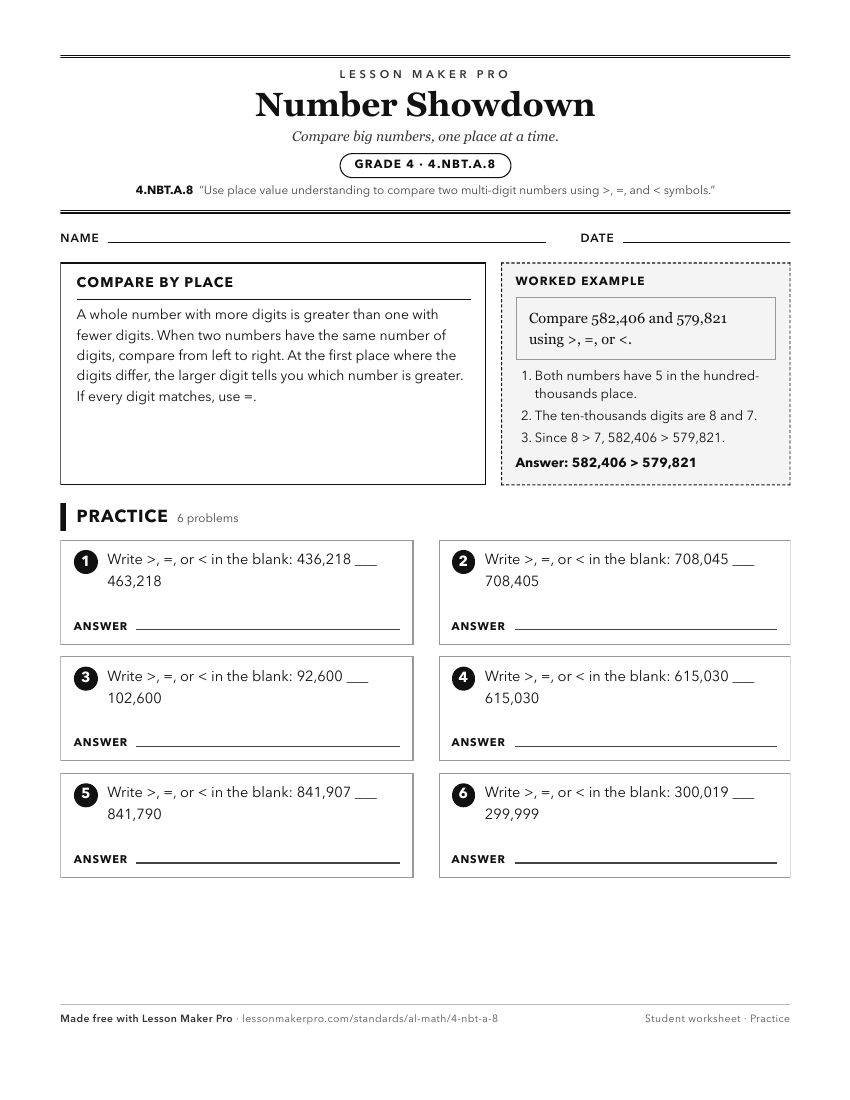
A ready-to-print activity worksheet aligned to 4.NBT.A.8, with an answer key for the teacher on its own page. No account needed.
PDF, US Letter, prints cleanly in black and white.
Download the worksheetKeep exploring
Related Standards
- 2.NBT.A.9
Compare two three-digit numbers based on the value of the hundreds, tens, and ones digits, recording the results of comparisons with the symbols >, =, and < and...
- 1.NBT.B.12
Compare pairs of two-digit numbers based on the values of the tens and ones digits, recording the results of comparisons with the symbols >, =, and < and orally...
Turn this exact standard into a lesson
Grade, subject, topic, and the complete standard are prefilled. Create one free, no account needed.
Also for this standard:Make a WorksheetMake a QuizMake a Sub Lesson