Alabama ELA K.LF.9
Standard Cluster
Demonstrate early phonological awareness to basic phonemic awareness skills in spoken words. a. Count the number of words in a spoken sentence. b. Recognize alliterative spoken words. c. Recognize and produce pairs of rhyming words and distinguish them from non-rhyming pairs using pictures and/or spoken words. d. Count, blend, and segment syllables in spoken words, including compound words. e. Blend and segment onsets and rimes of single-syllable spoken words. f. Identify the initial, final, and medial sounds of spoken words. g. Blend and segment phonemes in single-syllable spoken words made up of three to four phonemes. h. Distinguish between commonly confused cognate consonant sounds, using knowledge of voiced and unvoiced sounds and manner of articulation.
2021 Alabama Course of Study: English Language Arts · Literacy Foundations K-3
Cluster contents
Standards in This Cluster
K.LF.9 is a cluster heading. These are the individual standards under it.
- K.LF.9.a
Count the number of words in a spoken sentence.
- K.LF.9.b
Recognize alliterative spoken words.
- K.LF.9.c
Recognize and produce pairs of rhyming words and distinguish them from non-rhyming pairs using pictures and/or spoken words.
- K.LF.9.d
Count, blend, and segment syllables in spoken words, including compound words.
- K.LF.9.f
Identify the initial, final, and medial sounds of spoken words.
- K.LF.9.g
Blend and segment phonemes in single-syllable spoken words made up of three to four phonemes.
- K.LF.9.h
Distinguish between commonly confused cognate consonant sounds, using knowledge of voiced and unvoiced sounds and manner of articulation.
Teacher's field guide
What This Cluster Means
What Students Need to Do
- Students count words in spoken sentences, hear repeated starting sounds, and match or make rhymes. They clap, split, and blend syllables, then split and blend short words by their first sound and the rest, or by each sound. They name first, middle, and last sounds and compare sounds like /p/ and /b/.
What Mastery Looks Like
- Given “The cat naps,” a student taps three words, hears the shared start in “big bear,” and pairs “cat” with “hat,” not “cup.” They clap “rainbow” into two syllables, join /k/ and /at/ to say “cat,” and move four counters for the sounds in “flag.” They hear /a/ in the middle of “cat” and feel their throat vibrate for /b/ but not /p/.
Common Misconceptions
- Children may count syllables instead of words in “big banana bites.” They may say “cat” and “cup” rhyme because both start with /k/, or count /sh/ in “fish” as two sounds. They may miss the middle vowel in “cat” or confuse /p/ and /b/ because their lips move alike.
How to Assess It
- Say “The cat naps” and have students tap each word, then move a counter for each sound in “cat.” Look for three word taps and three sound counters: /k/ /a/ /t/.
Lesson moves
Ways to Teach It
Give each child four counters; say “flag” and have them push one counter for each sound, then blend the sounds back together.
Show pictures of a cat, hat, and cup; ask, “Which two rhyme? How can you tell by listening?”
Play Odd One Out: say “boat, bear, pig” and have children clap for the word with a different starting sound.
At snack time, say “big banana bites”; have children tap three words and listen for the shared /b/ sound.
Free download
Printable K.LF.9 Worksheet
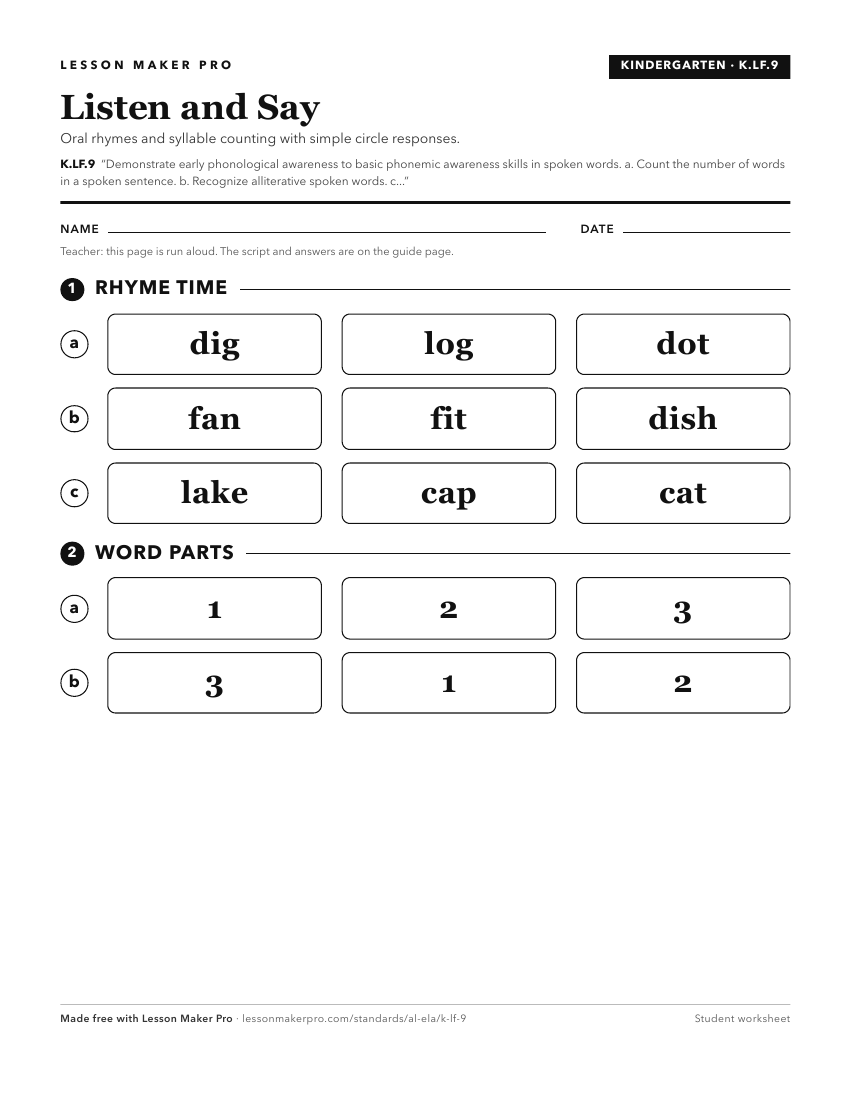
A ready-to-print activity worksheet aligned to K.LF.9, with an answer key for the teacher on its own page. No account needed.
PDF, US Letter, prints cleanly in black and white.
Download the worksheetKeep exploring
Related Standards
Turn this cluster into a lesson
Grade, subject, topic, and the complete cluster are prefilled. Create one free, no account needed.
Also for this cluster:Make a WorksheetMake a QuizMake a Sub Lesson