Alabama ELA K.LF.36
Standard Cluster
When speaking and writing, follow the rules of standard English grammar, punctuation, capitalization, and grade-appropriate spelling. a. With prompting and support, transcribe spoken words to demonstrate that print represents oral language. b. With prompting and support, compose a simple sentence, including necessary components to create a complete sentence rather than a fragment. c. With prompting and support, identify the role or purpose of a noun and a verb within a sentence and the type of information it conveys. d. With prompting and support, write the correct number of words, with proper spacing, for a spoken phrase or sentence. e. With prompting and support, begin each sentence with a capital letter. f. With prompting and support, capitalize the pronoun I and names of individuals. g. With prompting and support, recognize, name, and correctly use end punctuation.
2021 Alabama Course of Study: English Language Arts · Literacy Foundations K-3
Cluster contents
Standards in This Cluster
K.LF.36 is a cluster heading. These are the individual standards under it.
- K.LF.36.a
With prompting and support, transcribe spoken words to demonstrate that print represents oral language.
- K.LF.36.b
With prompting and support, compose a simple sentence, including necessary components to create a complete sentence rather than a fragment.
- K.LF.36.c
With prompting and support, identify the role or purpose of a noun and a verb within a sentence and the type of information it conveys.
- K.LF.36.d
With prompting and support, write the correct number of words, with proper spacing, for a spoken phrase or sentence.
- K.LF.36.e
With prompting and support, begin each sentence with a capital letter.
- K.LF.36.f
With prompting and support, capitalize the pronoun I and names of individuals.
- K.LF.36.g
With prompting and support, recognize, name, and correctly use end punctuation.
Teacher's field guide
What This Cluster Means
What Students Need to Do
- With teacher help, students turn a spoken sentence into written words, leaving a space between each word. They write a complete thought and find the word that names someone or something and the word that tells what happens. They use sounds to spell words, start sentences and names with capitals, and add an ending mark.
What Mastery Looks Like
- A student hears “I see Mia.” and writes three spaced words, with capitals on I and Mia and a period at the end. They identify Mia as the person named and see as the action. They can add an action to “Mia.” to make it a sentence.
Common Misconceptions
- Students may run spoken words together or put spaces inside a word. They may think “Mia.” is a complete sentence because it starts with a capital and ends with a period. They may write I or a name in lowercase or put a period after a question.
How to Assess It
- Say “I see Mia.” twice without showing it. Have students write it, count the three words, circle Mia, underline see, and check the capitals, spaces, and period.
Lesson moves
Ways to Teach It
Give pairs cards reading “I,” “see,” and “Mia,” plus a period card. Have them build the sentence with finger-width spaces.
Ask, “Is ‘Mia.’ a whole sentence?” Have partners explain what is missing, then write “Mia runs.”
Play punctuation corners: say “Mia runs,” “Does Mia run,” and “Hooray, Mia won,” then students choose a period, question mark, or exclamation point.
Use the lunch menu to write “I like pizza.” Count the words, leave spaces, and show a partner where the sentence ends.
Free download
Printable K.LF.36 Worksheet
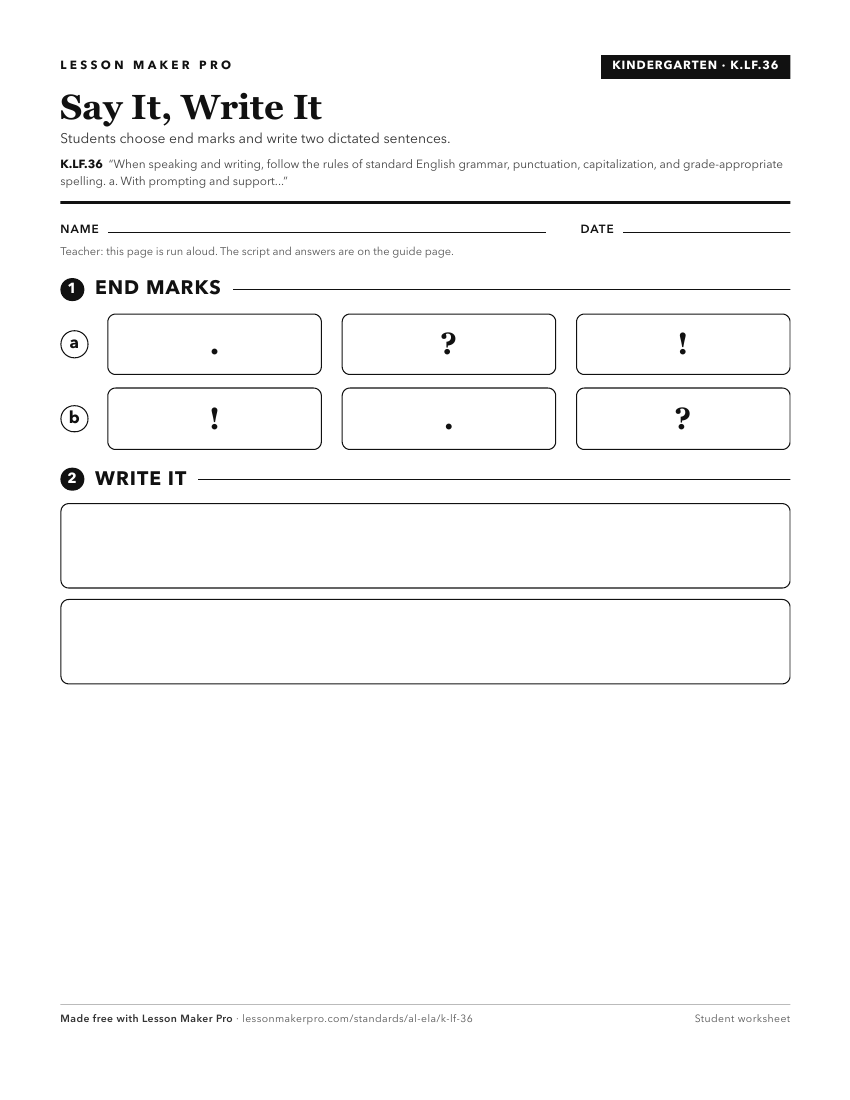
A ready-to-print activity worksheet aligned to K.LF.36, with an answer key for the teacher on its own page. No account needed.
PDF, US Letter, prints cleanly in black and white.
Download the worksheetKeep exploring
Related Standards
- 1.LF.32
Follow the rules of standard English grammar, punctuation, capitalization, and spelling appropriate to grade level.
- 6.LL.19
Demonstrate command of standard English grammar, usage, and mechanics when writing.
- 5.LF.39
Demonstrate command of the conventions of standard English grammar and usage in writing.
Turn this cluster into a lesson
Grade, subject, topic, and the complete cluster are prefilled. Create one free, no account needed.
Also for this cluster:Make a WorksheetMake a QuizMake a Sub Lesson