Alabama ELA 8.CL.2
The Standard
Make complex inferences from the structure and content of a text, including comparison and contrast, problem and solution, cause and effect, and substantiated and unsubstantiated claims and evidence, to draw logical conclusions about the author’s perspective.
2021 Alabama Course of Study: English Language Arts
Teacher's field guide
What This Standard Means
What Students Need to Do
- Students notice how a writer sets up a problem, traces a cause, or compares two choices. They check which claims have proof and use those clues to work out the writer’s view.
What Mastery Looks Like
- A student can point to a problem and proposed fix, then explain what they reveal about the writer’s view. They can spot a claim with no proof and avoid treating it as fact.
Common Misconceptions
- Students may give their own opinion instead of the writer’s view. They may treat a confident claim as proven, even when the text gives no source or example.
How to Assess It
- Post this note: “The hallway is crowded, so staggered dismissals would help. Everyone agrees.” Ask students to name the writer’s view, explain how the problem and solution show it, and flag the claim with no proof.
Lesson moves
Ways to Teach It
Give pairs a printed editorial to mark the problem, proposed fix, and evidence in three colors, then write the writer’s view in the margin.
Post “Buses move 40 people at once, while cars clog the curb”; ask which option the writer favors and why.
Give groups six claim cards about school lunches, three with sources and three without; have them sort the cards and defend each choice.
Show grocery flyer prices and a store claim of “best value”; ask students what the store wants them to believe and whether prices prove it.
Free download
Printable 8.CL.2 Worksheet
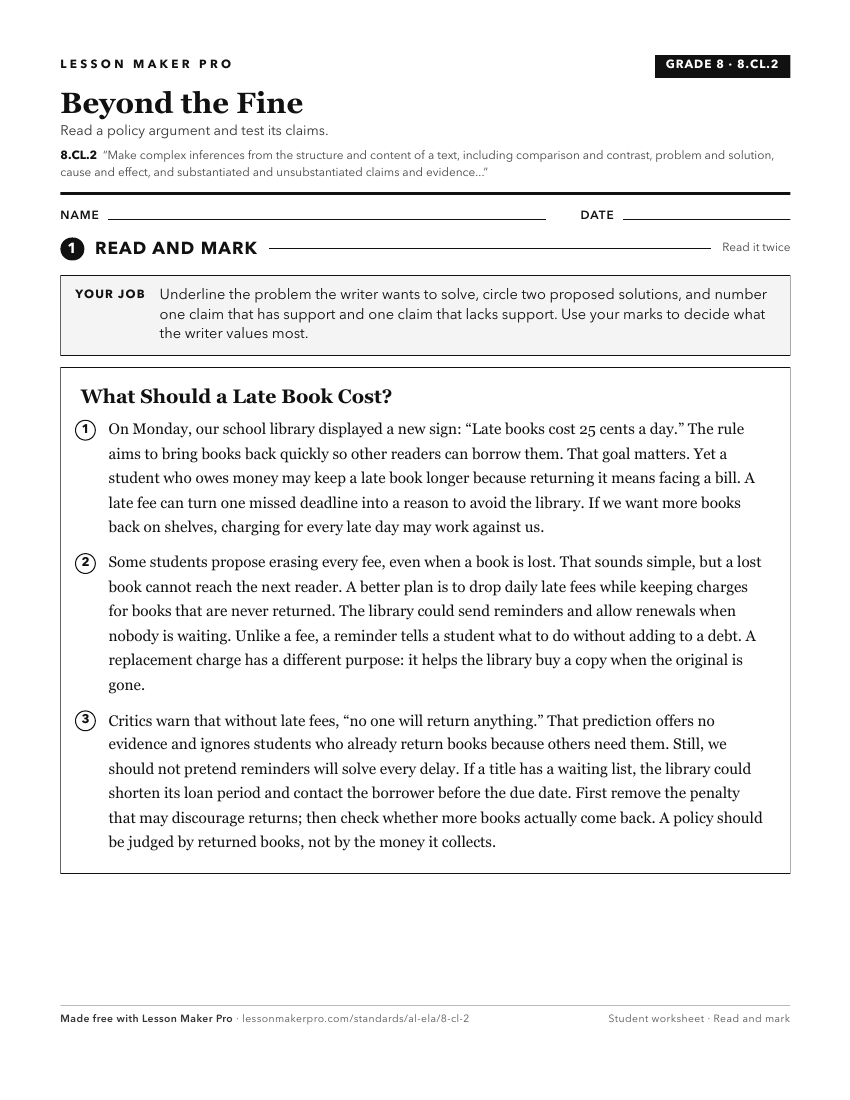
A ready-to-print activity worksheet aligned to 8.CL.2, with an answer key for the teacher on its own page. No account needed.
PDF, US Letter, prints cleanly in black and white.
Download the worksheetKeep exploring
Related Standards
- 6.CL.2
Make inferences and draw logical conclusions from the content and structures of informational texts, including comparison and contrast, problem and solution, cl...
- 4.LF.30.a
Make complex inferences within and across texts to determine the importance of information.
- 7.CL.2
Evaluate how effectively an author uses structures of informational texts, including comparison and contrast, problem and solution, cause and effect, and substa...
- 4.LF.16.c
Make an inference about the meaning of a text and support it with textual evidence.
Turn this exact standard into a lesson
Grade, subject, topic, and the complete standard are prefilled. Create one free, no account needed.
Also for this standard:Make a WorksheetMake a QuizMake a Sub Lesson