Alabama ELA 7.LL.21.b
The Standard
- 7.LL.21
- Create written work using standard English grammar, usage, and mechanics.
Construct simple, compound, complex, and compound-complex sentences to represent relationships among ideas.
2021 Alabama Course of Study: English Language Arts
Teacher's field guide
What This Standard Means
What Students Need to Do
- Students write a single clear thought or link several ideas in one sentence. They choose words and punctuation that show whether ideas add to, depend on, or contrast with each other.
What Mastery Looks Like
- A student can write, 'Although the bell rang, we kept reading, and our teacher let us finish.' They can point out the two complete thoughts, the dependent clause, and why each comma is there.
Common Misconceptions
- Students may join two complete thoughts with only a comma or leave a dependent clause on its own. Some think a long sentence must have more clauses, even when it simply has more words.
How to Assess It
- Exit ticket: Combine 'The rain started. We stayed outside. We finished the game.' into one sentence with two complete thoughts and one dependent clause. Underline the complete thoughts and circle the joining words.
Lesson moves
Ways to Teach It
Give pairs clause strips reading 'The rain started,' 'we stayed outside,' and 'we finished the game'; add 'although' and 'and' cards, then place commas.
Ask students to compare 'We stayed outside because it rained' with 'We stayed outside although it rained' and explain the difference.
Teams sort 'I ran,' 'I ran, and Sam waved,' 'When I ran, Sam waved,' and 'When I ran, Sam waved, and Mom smiled.'
Give students a school lunch notice: 'Lunch starts at noon. Doors open at 11:45. Students can line up early.' Have them combine the details.
Free download
Printable 7.LL.21.b Worksheet
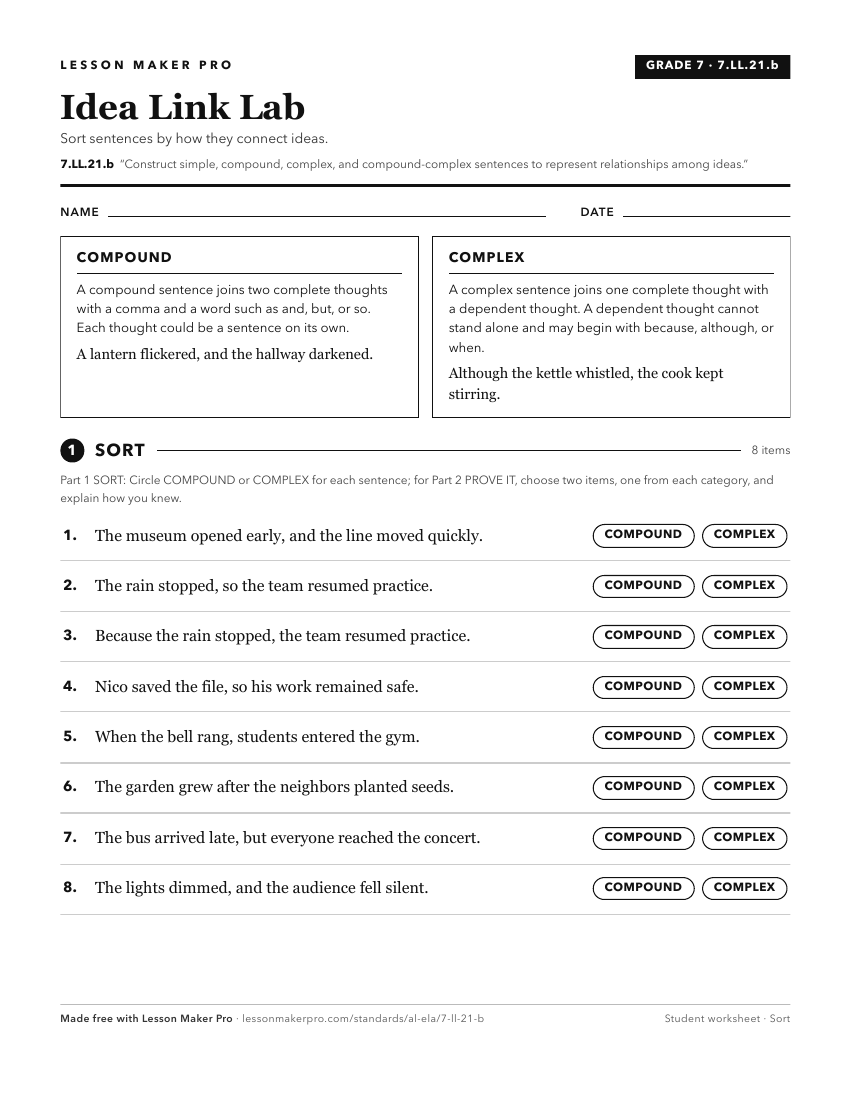
A ready-to-print activity worksheet aligned to 7.LL.21.b, with an answer key for the teacher on its own page. No account needed.
PDF, US Letter, prints cleanly in black and white.
Download the worksheetKeep exploring
Related Standards
- 8.LL.20.d
Construct simple, compound, complex, and compound-complex sentences to signal differing relationships among ideas.
- 7.LL.17.b
Identify the usage of simple, compound, complex, and compound-complex statements and questions to signal differing relationships among ideas in a text.
- 8.LL.16.c
Explain how using simple, compound, complex, or compound-complex statements and questions signals differing relationships among ideas in a text.
- 3.LF.37
Compose simple, compound, and complex sentences with correct subject-verb agreement.
Turn this exact standard into a lesson
Grade, subject, topic, and the complete standard are prefilled. Create one free, no account needed.
Also for this standard:Make a WorksheetMake a QuizMake a Sub Lesson