Alabama ELA 4.LF.20
Standard Cluster
Use details and examples from a text to indicate what the text explicitly states. a. Interpret facts from an informational article, using details and examples from the text to explain the interpretation. b. List the main questions answered by an informational article. c. Categorize statements in an article or other informational text as fact or opinion and give reasons for each choice. d. Explain the differences between primary and secondary sources, giving examples from texts.
2021 Alabama Course of Study: English Language Arts · Literacy Foundations 4-5
Cluster contents
Standards in This Cluster
4.LF.20 is a cluster heading. These are the individual standards under it.
- 4.LF.20.a
Interpret facts from an informational article, using details and examples from the text to explain the interpretation.
- 4.LF.20.b
List the main questions answered by an informational article.
- 4.LF.20.c
Categorize statements in an article or other informational text as fact or opinion and give reasons for each choice.
- 4.LF.20.d
Explain the differences between primary and secondary sources, giving examples from texts.
Teacher's field guide
What This Cluster Means
What Students Need to Do
- Students find what an article says and use its details to explain what the facts mean. They list the main questions the article answers and sort statements into fact or opinion, with reasons. They tell firsthand records from accounts that synthesize other people’s records using examples from the texts.
What Mastery Looks Like
- A student can say the opening was busy using the line about visitors waiting and name the article’s main questions. They explain why the 200-book count is a factual claim but “the best day in town” is an opinion. They identify the participant’s diary as primary evidence about the opening and the nonparticipant’s later synthesis as secondary, using the stated provenance.
Common Misconceptions
- Students may call “the best park has three slides” a fact just because it includes a number. They may classify sources by age or format alone. A witness’s quoted words can be primary evidence within a secondary synthesis; the quotation does not make the whole synthesis firsthand. They may name the article’s topic instead of its questions.
How to Assess It
- Give a nonparticipant’s later article synthesizing others’ records: “The library opened Tuesday with 200 books. Visitors lined up. It was the best day in town.” Pair the librarian’s diary from that day: “I shelved 200 books before opening.” Ask what question the article answers, which detail suggests a busy opening, which claim is opinion and why, and why the diary is primary evidence about the opening while this synthesis is secondary.
Lesson moves
Ways to Teach It
Give pairs a printed weather report and a dated observer’s notebook page; have them highlight firsthand details and circle later summaries.
Read a short article about a new playground, then answer “Was it popular?” with two details and name the article’s main question.
Play fact-or-opinion relay with cards such as “The gym has six hoops” and “The gym is the best room”; require a reason.
Compare a museum label about a town flood with a flood survivor’s letter; mark which is firsthand and which summarizes the event.
Free download
Printable 4.LF.20 Worksheet
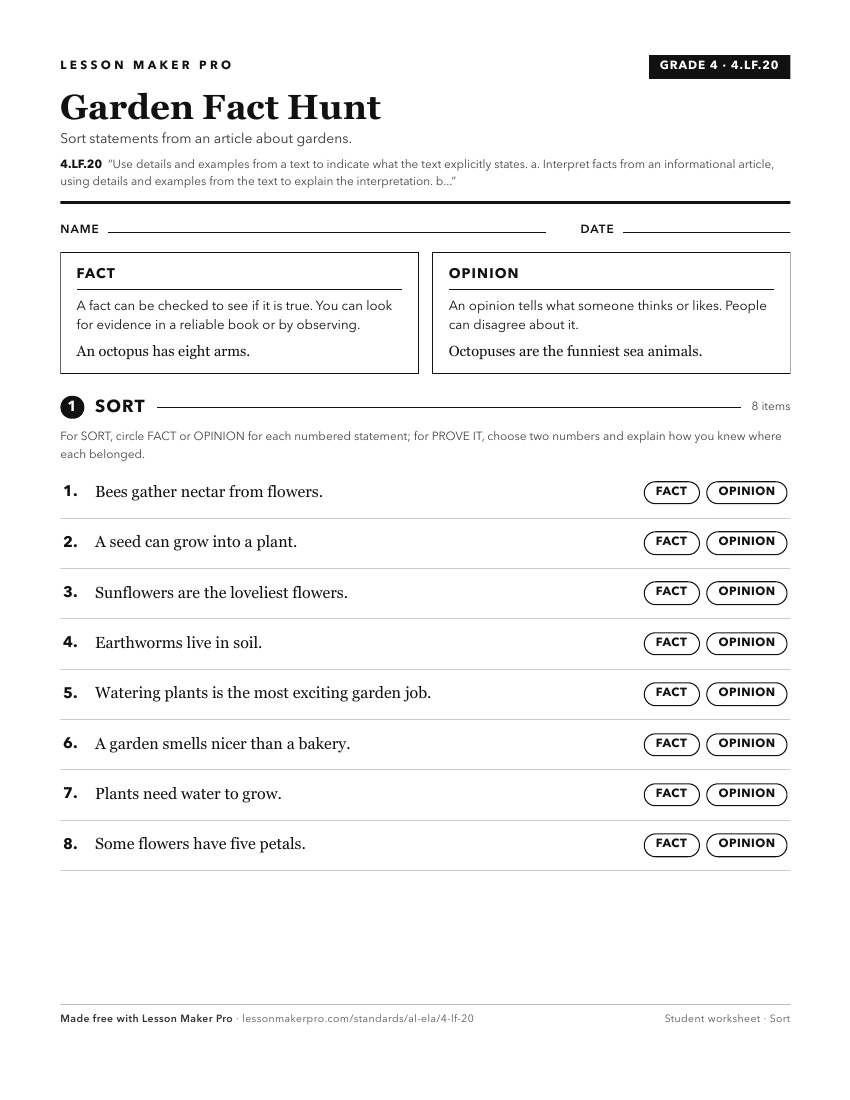
A ready-to-print activity worksheet aligned to 4.LF.20, with an answer key for the teacher on its own page. No account needed.
PDF, US Letter, prints cleanly in black and white.
Download the worksheetKeep exploring
Related Standards
- 4.LF.21
Explain how relevant details support the implied or explicit main idea of a text.
- 3.LF.23.a
Explain how text features support details in the text.
- 3.LF.19
Determine the explicit or implied main idea and supporting details of a text.
- 5.LF.29
Summarize in writing a variety of texts, stating their implied and/or explicit main ideas.
Turn this cluster into a lesson
Grade, subject, topic, and the complete cluster are prefilled. Create one free, no account needed.
Also for this cluster:Make a WorksheetMake a QuizMake a Sub Lesson