Alabama ELA 3.LF.22
Standard Cluster
Describe literary elements within a story, including setting, plot, characters, and themes. a. Describe in detail the characters’ behavior, emotions, and traits and explain how their actions influence events in the story. b. Explain how the characters’ actions and dialogue contribute to the meaning of the story. c. Identify the central message, theme, or moral in a story, including myths, fables, and folktales, and explain the meaning conveyed in the passage. d. Compare and contrast the themes, settings, and plots from two texts.
2021 Alabama Course of Study: English Language Arts · Literacy Foundations K-3
Cluster contents
Standards in This Cluster
3.LF.22 is a cluster heading. These are the individual standards under it.
- 3.LF.22.a
Describe in detail the characters' behavior, emotions, and traits and explain how their actions influence events in the story.
- 3.LF.22.b
Explain how the characters' actions and dialogue contribute to the meaning of the story.
- 3.LF.22.c
Identify the central message, theme, or moral in a story, including myths, fables, and folktales, and explain the meaning conveyed in the passage.
- 3.LF.22.d
Compare and contrast the themes, settings, and plots from two texts.
Teacher's field guide
What This Cluster Means
What Students Need to Do
- Students describe a story’s setting, characters, and main events. They use characters’ words and actions to explain what happens and what the story teaches. They compare the settings, plots, and lessons of two stories, including fables, myths, or folktales.
What Mastery Looks Like
- A student points to words or actions that show how a character feels or behaves. They explain how a character’s choice leads to a later event and support the story’s lesson with details. They name similarities and differences in two stories’ settings, plots, and lessons.
Common Misconceptions
- Students may call friendship the lesson without saying what the story teaches about friendship. They may list events without explaining how a character’s choice causes the next event. They may call a character nice without pointing to anything the character says or does.
How to Assess It
- After reading 'The Tortoise and the Hare' and 'The Ant and the Grasshopper,' ask: What lesson does each teach? Name one character action that supports each lesson, then explain how the lessons differ.
Lesson moves
Ways to Teach It
Give pairs two short folktales and sticky notes; have them mark each setting, three plot events, and an action that changes an ending.
Read a version of 'The Tortoise and the Hare' with dialogue; ask students how the hare’s words help explain the ending.
Make cards with settings, character actions, plot events, and lessons from two fables; have teams sort them by story and explain each match.
Tell a short schoolyard story about returning a lost lunchbox; have students compare its setting and lesson with a familiar folktale.
Free download
Printable 3.LF.22 Worksheet
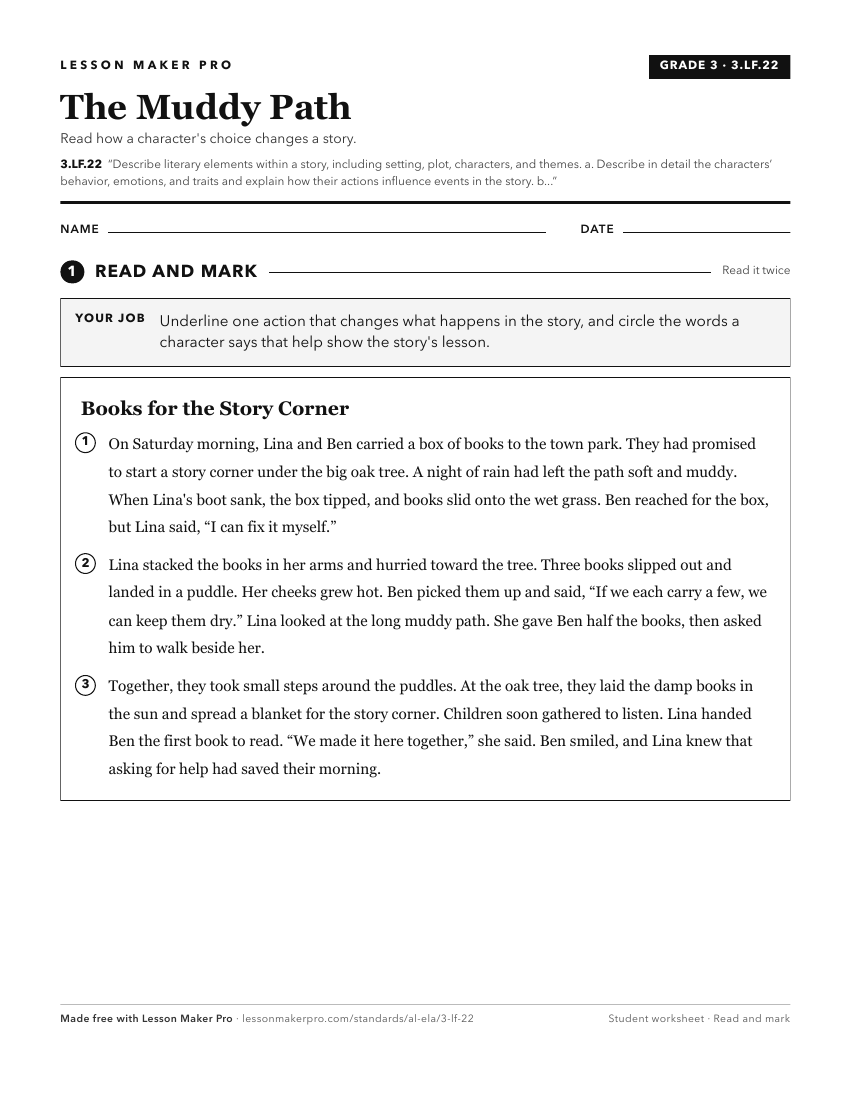
A ready-to-print activity worksheet aligned to 3.LF.22, with an answer key for the teacher on its own page. No account needed.
PDF, US Letter, prints cleanly in black and white.
Download the worksheetKeep exploring
Related Standards
- 5.LF.19
Interpret how authors use literary elements throughout a text, including character, setting, conflict, dialogue, and point of view.
- 1.LF.23
Identify and describe the main story elements in a literary text.
- K.LF.27
Identify and describe the main story elements in a literary text.
- 2.LF.26.b
Compare and contrast story elements of literary texts.
Turn this cluster into a lesson
Grade, subject, topic, and the complete cluster are prefilled. Create one free, no account needed.
Also for this cluster:Make a WorksheetMake a QuizMake a Sub Lesson