Alabama ELA 3.LF.15
Standard Cluster
Analyze meaningful parts (morphemes) of words and phrases in discussions and/or text. a. Identify meaningful parts of words (morphemes) and use them as clues to the meaning of unfamiliar words, including base words, roots, and frequently occurring affixes and inflections. b. Apply knowledge of the changes in tense (-ed), number (-s), and degree (-er and -est) signified by inflected endings to determine the meaning of a word. c. Identify common and derivational prefixes and suffixes and use them as clues to a word’s meaning. d. Identify common Latin and Greek roots and use them to determine the meaning of unfamiliar words. e. Sort words with shared and varied suffixes by parts of speech.
2021 Alabama Course of Study: English Language Arts · Literacy Foundations K-3
Cluster contents
Standards in This Cluster
3.LF.15 is a cluster heading. These are the individual standards under it.
- 3.LF.15.a
Identify meaningful parts of words (morphemes) and use them as clues to the meaning of unfamiliar words, including base words, roots, and frequently occurring a...
- 3.LF.15.b
Apply knowledge of the changes in tense (-ed), number (-s), and degree (-er and -est) signified by inflected endings to determine the meaning of a word.
- 3.LF.15.c
Identify common and derivational prefixes and suffixes and use them as clues to a word's meaning.
- 3.LF.15.d
Identify common Latin and Greek roots and use them to determine the meaning of unfamiliar words.
- 3.LF.15.e
Sort words with shared and varied suffixes by parts of speech.
Teacher's field guide
What This Cluster Means
What Students Need to Do
- Students split unfamiliar words into bases or roots, prefixes, and suffixes. They use word parts to work out meaning, including changes in time, number, and comparison. They sort words by whether suffixes make nouns, adjectives, or adverbs.
What Mastery Looks Like
- A student can explain that replay means play again, jumped happened in the past, and tallest means taller than the others. They can use bio, meaning life, to explain biography. They can sort kindness, helpful, and slowly as a noun, adjective, and adverb.
Common Misconceptions
- Students may treat every word ending in s as a plural, even runs. They may think er always means a person, missing its meaning in taller. They may also call friendly an adverb because it ends in ly.
How to Assess It
- Exit ticket: Underline the helpful parts in replay, jumped, cats, tallest, and biography, then write what each word means. Label kindness, helpful, and slowly as noun, adjective, or adverb.
Lesson moves
Ways to Teach It
Give pairs cards marked re, play, jump, ed, bio, and graphy; have them build replay, jumped, and biography and explain each part.
Ask students to write two sentences explaining how the endings in taller and tallest change the meaning of tall.
Play a suffix sort race with kindness, darkness, helpful, playful, slowly, and quietly under noun, adjective, and adverb headings.
Put reusable bag and refillable bottle labels on two objects; have students mark re and able, then explain each label.
Free download
Printable 3.LF.15 Worksheet
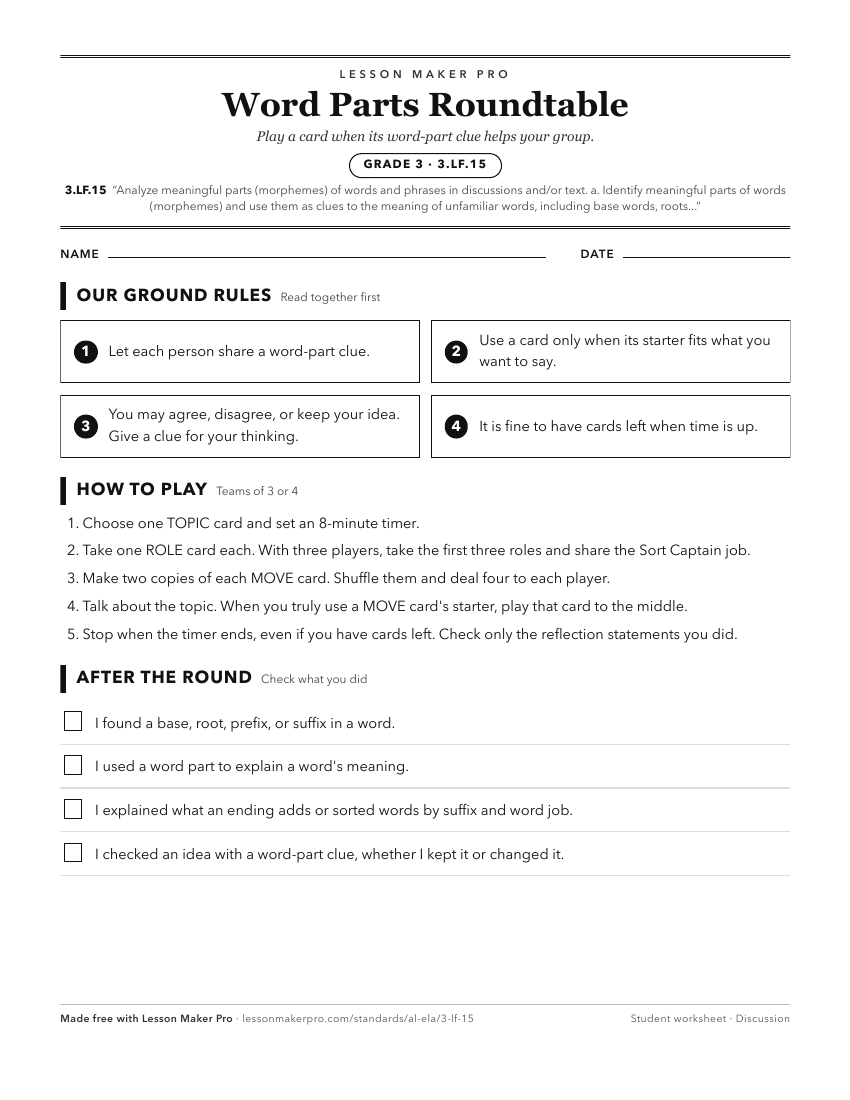
A ready-to-print activity worksheet aligned to 3.LF.15, with an answer key for the teacher on its own page. No account needed.
PDF, US Letter, prints cleanly in black and white.
Download the worksheetKeep exploring
Related Standards
- 2.LF.17
Analyze meaningful parts of words and phrases in discussions and/or text.
- 2.LF.17.b
Identify meaningful parts of words (morphemes) and use them as clues to the meaning of unknown words, including base words, compound words, and frequently occur...
- 1.LF.12.b
Identify meaningful parts of words (morphemes) and use them as clues to the meaning of unknown words, including frequently occurring affixes and inflections -s,...
Turn this cluster into a lesson
Grade, subject, topic, and the complete cluster are prefilled. Create one free, no account needed.
Also for this cluster:Make a WorksheetMake a QuizMake a Sub Lesson