Alabama ELA 2.LF.14
The Standard
Read high-frequency words commonly found in grade-appropriate text.
2021 Alabama Course of Study: English Language Arts · Literacy Foundations K-3
Teacher's field guide
What This Standard Means
What Students Need to Do
- Students read common words like said, could, and because without stopping to sound out each one. They recognize the words in sentences, not just on cards.
What Mastery Looks Like
- A student reads a short grade-level passage and says common words correctly. They keep a steady pace when those words appear in new sentences.
Common Misconceptions
- Students may guess from the first letter and read said as sad. They may know a word on a card but miss it in a sentence.
How to Assess It
- Give students three sentences containing said, could, and because. Ask them to read the sentences aloud, and note any words they skip or guess.
Lesson moves
Ways to Teach It
Give pairs sentence strips and word tiles; have them place said, could, and because in the gaps, then read each sentence aloud.
Write 'I could ___ because ___' on the board; students fill both blanks and read their sentence to a partner.
Play word hunt with a grade-level page: students circle said, could, and because, then reread each sentence aloud.
Show a library reminder that says, 'Bring your book back on Friday'; students find your and on, then read the reminder aloud.
Free download
Printable 2.LF.14 Worksheet
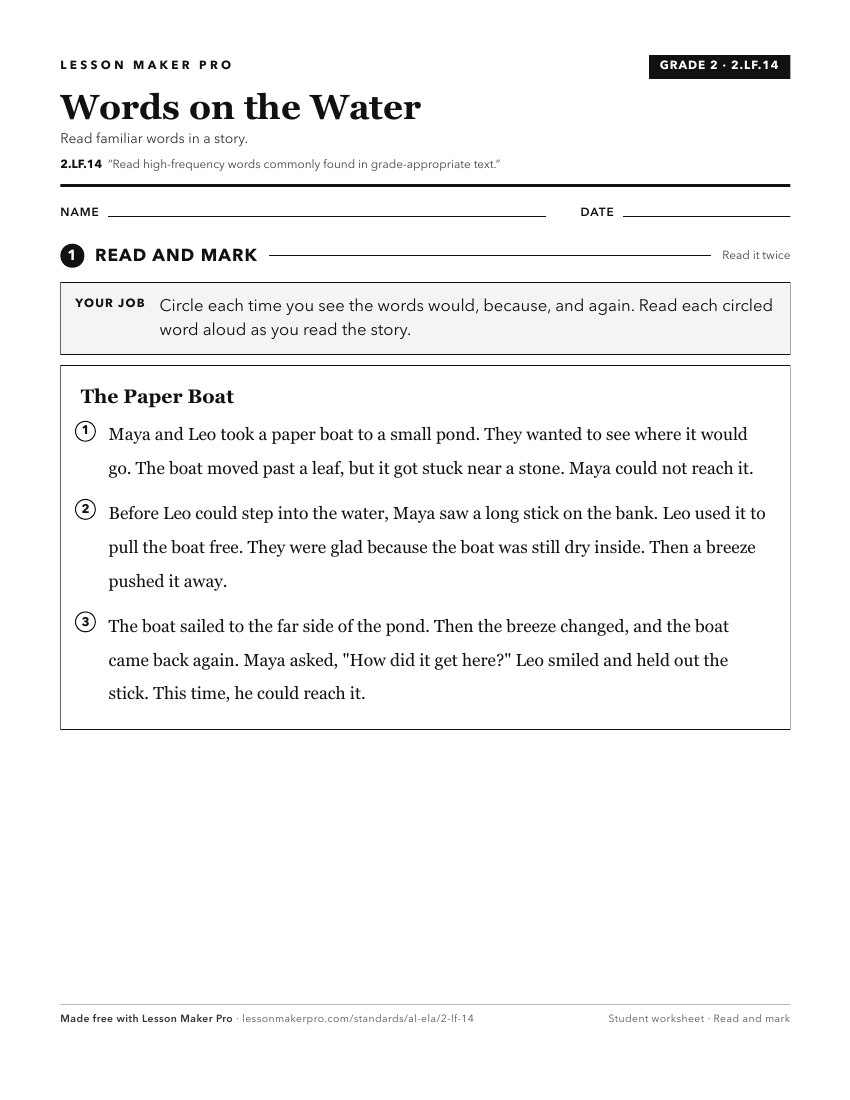
A ready-to-print activity worksheet aligned to 2.LF.14, with an answer key for the teacher on its own page. No account needed.
PDF, US Letter, prints cleanly in black and white.
Download the worksheetKeep exploring
Related Standards
- 1.LF.10
Read high-frequency words commonly found in grade-appropriate text.
- 3.LF.12
Read high-frequency words commonly found in grade-appropriate text accurately and automatically.
- K.LF.16
Recognize and read grade-appropriate high frequency words with accuracy and automaticity.
- K.LF.10.i
Decode grade-appropriate high frequency words that are spelled using predictable, decodable phoneme-grapheme correspondences.
Turn this exact standard into a lesson
Grade, subject, topic, and the complete standard are prefilled. Create one free, no account needed.
Also for this standard:Make a WorksheetMake a QuizMake a Sub Lesson