Alabama ELA 12.CL.10
The Standard
Determine through active listening the purpose, credibility, and effectiveness of a speaker or multiple sources of information by evaluating tone, organization, content, and verbal and non-verbal cues and identifying any fallacious reasoning or distorted evidence.
2021 Alabama Course of Study: English Language Arts
Teacher's field guide
What This Standard Means
What Students Need to Do
- Students listen to one or more speakers and work out what each wants the audience to believe or do. They track tone, the order of ideas, claims, and gestures. They check the evidence and reasoning before deciding whether a speaker is trustworthy and convincing.
What Mastery Looks Like
- A student can name a speaker’s goal and point to a specific claim, pause, or gesture that supports their reading. They can explain why three examples do not prove a claim about everyone and compare two speakers’ evidence.
Common Misconceptions
- Students may treat a confident voice or polished delivery as proof that a claim is true. They may miss when a speaker uses a small sample to make a broad claim or presents an opinion as a fact.
How to Assess It
- Say, “I saw three apples in the trash, so nobody eats fruit. We should stop serving it,” while pointing toward a trash can. On an exit slip, have students name your goal, explain the weak reasoning, and describe how your voice or gesture affects the pitch.
Lesson moves
Ways to Teach It
Give two one-minute pitches for a later school start, changing your tone and gestures; students mark claims and delivery cues on sticky notes.
After a school board speech clip, ask students to write what the speaker wants and which words, pauses, or gestures reveal that goal.
Read three claims aloud, including “Everyone agrees” and “My friend agrees”; teams flag broad claims and weak evidence.
Play two phone-plan video ads; students compare spoken prices with on-screen fine print and note gestures used to build trust.
Free download
Printable 12.CL.10 Worksheet
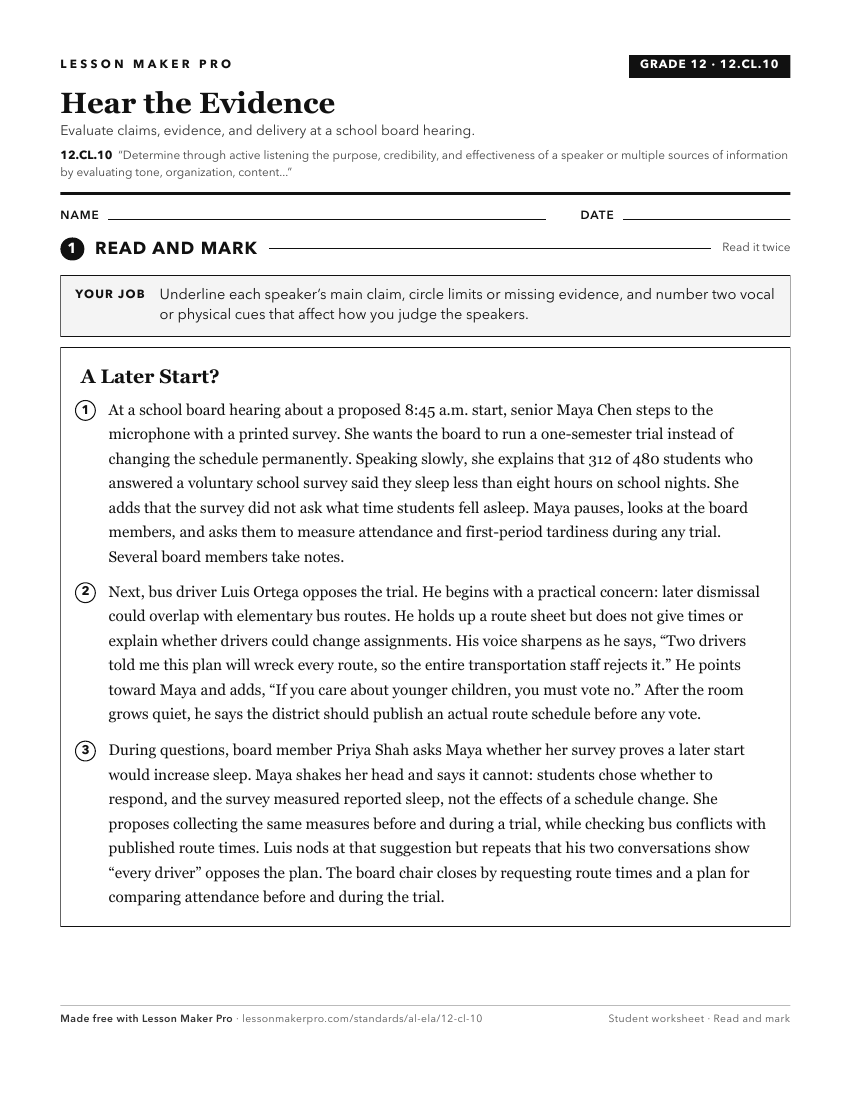
A ready-to-print activity worksheet aligned to 12.CL.10, with an answer key for the teacher on its own page. No account needed.
PDF, US Letter, prints cleanly in black and white.
Download the worksheetKeep exploring
Related Standards
- 11.CL.10
Through active listening, evaluate tone, organization, content, and non-verbal cues to determine the purpose and credibility of a speaker.
- 10.CL.8
Through active listening, evaluate tone, organization, content, and non-verbal cues to determine the purpose and credibility of a speaker.
- 9.CL.8
Through active listening, evaluate tone, organization, content, and non-verbal cues to determine the purpose and credibility of a speaker.
- 8.LL.19
Evaluate a speaker's rhetorical and organizational choices in order to determine point of view, purpose, and effectiveness.
Turn this exact standard into a lesson
Grade, subject, topic, and the complete standard are prefilled. Create one free, no account needed.
Also for this standard:Make a WorksheetMake a QuizMake a Sub Lesson