Alabama ELA 1.LF.7.a
The Standard
- 1.LF.7
- Apply knowledge of phoneme-grapheme correspondences and word analysis skills to decode and encode words accurately both in isolation and within decodable, grade-appropriate texts.
Produce the most frequent sound(s) for each letter of the alphabet, including x, q, and the long and short sounds of the vowels.
2021 Alabama Course of Study: English Language Arts
Teacher's field guide
What This Standard Means
What Students Need to Do
- Students look at a letter and say its common sound or sounds, not just its name. They give the short and long sounds for each vowel. They say /ks/ for x in box and /kw/ for qu in quit.
What Mastery Looks Like
- Given shuffled letter cards, a student says the common consonant sounds without a word to copy. They give two sounds for each vowel and say the sounds of x in box and qu in quit.
Common Misconceptions
- Students may say a letter’s name instead of its sound. They may give only one vowel sound, leave off the /s/ in x, or leave off the /w/ in qu.
How to Assess It
- Show each student shuffled letter cards and ask for each letter’s common sound or sounds, including both sounds for each vowel. Show qu in quit and x in box when checking those sounds.
Lesson moves
Ways to Teach It
Use letter tiles to build box, quit, cap, and cape; students point to x, qu, and each a, then say their sounds.
Ask, “How does the a sound change when cap becomes cape?” Partners point to the a and explain what the final e does.
Play sound bingo: call /ks/, /kw/, and short or long vowel sounds; students cover x, qu, or the matching vowel.
Give students a lunch menu listing milk, rice, and cake; have them underline each vowel and say its sound in the word.
Free download
Printable 1.LF.7.a Worksheet
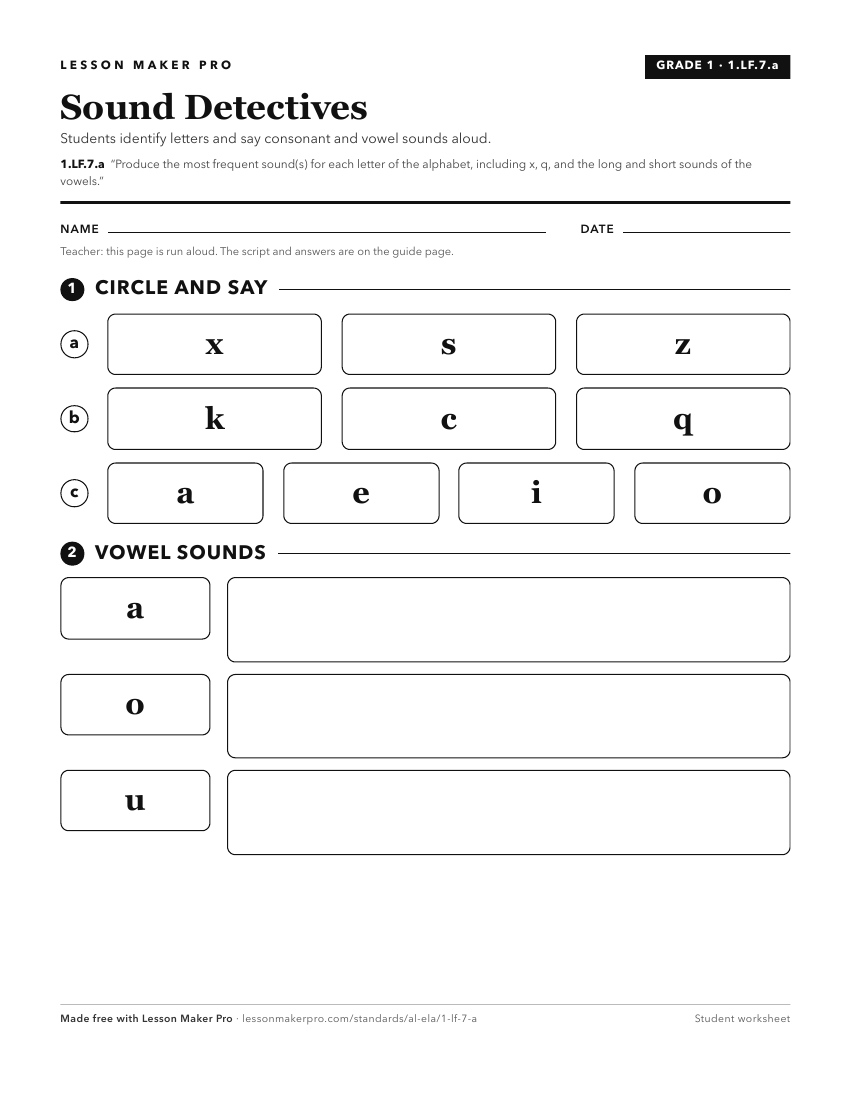
A ready-to-print activity worksheet aligned to 1.LF.7.a, with an answer key for the teacher on its own page. No account needed.
PDF, US Letter, prints cleanly in black and white.
Download the worksheetKeep exploring
Related Standards
- K.LF.10.a
Produce the most frequent sound(s) for each consonant, including x and q, which have two phonemes (sounds).
- K.LF.10.g
With prompting and support, produce the most frequent sound for digraphs ck, sh, th, ch, wh, ng, and combination qu, making the connection that a two-letter gra...
- K.LF.10.e
With prompting and support, identify the vowel-consonant-e syllable pattern and produce the long vowel sounds for the five major vowels in vowel-consonant-e syl...
- K.LF.10.d
Identify the vowel in an open syllable and produce the long vowel sound for the five major vowels when decoding open syllables.
Turn this exact standard into a lesson
Grade, subject, topic, and the complete standard are prefilled. Create one free, no account needed.
Also for this standard:Make a WorksheetMake a QuizMake a Sub Lesson