Alabama ELA 1.LF.6.g
The Standard
- 1.LF.6
- Demonstrate basic to advanced phonological and phonemic awareness skills in spoken words.
Distinguish between commonly-confused vowel sounds and commonly-confused cognate consonant sounds, using knowledge of mouth position, voiced and unvoiced sounds, and manner of articulation.
2021 Alabama Course of Study: English Language Arts
Teacher's field guide
What This Standard Means
What Students Need to Do
- Students hear and say small sound differences in words like “pet” and “pit” or “fan” and “van.” They use mouth position, airflow, and throat vibration to tell the sounds apart.
What Mastery Looks Like
- A student can hear “pet” and “pit” without seeing the words and point to the right picture. They can make /f/ and /v/ with the same lip and teeth position, then show that only /v/ makes their throat buzz.
Common Misconceptions
- Some children hear “pet” and “pit” as the same word or listen only to the first sound. Others think /f/ and /v/ need different mouth shapes, or mistake a louder sound for a voiced sound.
How to Assess It
- Say “pet,” “pit,” “fan,” and “van” without showing print. Have students point to matching pictures, then touch their throats and tell which sound, /f/ or /v/, makes a buzz.
Lesson moves
Ways to Teach It
Give each child a mirror; have them say “fan” and “van,” watch their lip and teeth, and feel their throat vibrate for /v/.
Have partners say “set” and “sit”; ask, “Which vowel makes your mouth open wider?” Let them explain what they felt.
Set out picture cards for pet, pit, fan, and van; call one word and have students slap the matching card.
At a pretend store, students request a fan or toy van from picture cards; the shopkeeper repeats the word before handing one over.
Free download
Printable 1.LF.6.g Worksheet
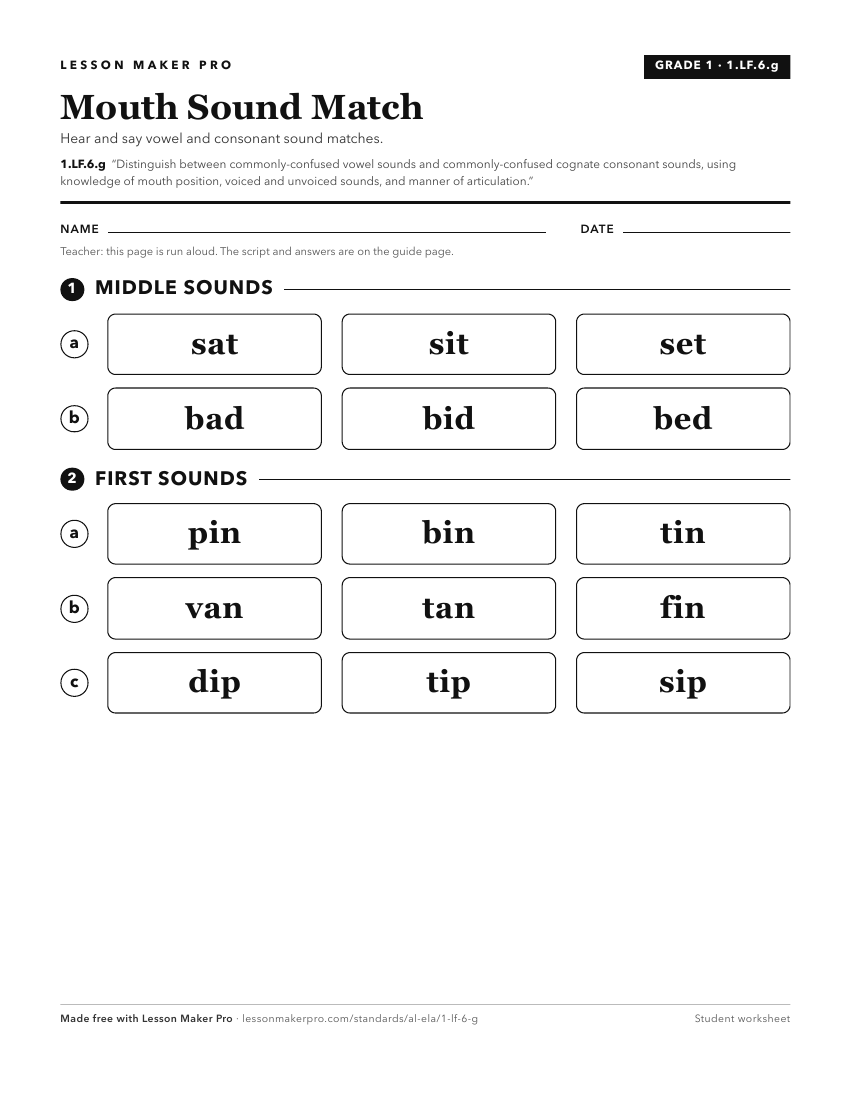
A ready-to-print activity worksheet aligned to 1.LF.6.g, with an answer key for the teacher on its own page. No account needed.
PDF, US Letter, prints cleanly in black and white.
Download the worksheetKeep exploring
Related Standards
- K.LF.9.h
Distinguish between commonly confused cognate consonant sounds, using knowledge of voiced and unvoiced sounds and manner of articulation.
- 2.LF.8
Apply knowledge of voiced and unvoiced sounds and manner of articulation to distinguish between commonly-confused vowel sounds and commonly-confused cognate con...
- 1.LF.31.a
Encode vowel-consonant (VC) and consonant-vowel-consonant (CVC) words, while using some knowledge of basic position-based rules for spelling English words in cl...
- 1.LF.31.c
Encode words with two-consonant blends in beginning position, including blends that are commonly confused with other spellings, by distinguishing the placement ...
Turn this exact standard into a lesson
Grade, subject, topic, and the complete standard are prefilled. Create one free, no account needed.
Also for this standard:Make a WorksheetMake a QuizMake a Sub Lesson