Alabama ELA 1.LF.12
Standard Cluster
Ask and answer questions about unfamiliar words and phrases in discussions and/or text. a. Identify possessives and plurals and use them as clues to the meaning of text. b. Identify meaningful parts of words (morphemes) and use them as clues to the meaning of unknown words, including frequently occurring affixes and inflections -s, -es, -ed, -ing, -er, and -est. c. Describe word relationships and nuances in word meanings, including relating them to their opposites and distinguishing shades of meaning in similar or related words.
2021 Alabama Course of Study: English Language Arts · Literacy Foundations K-3
Cluster contents
Standards in This Cluster
1.LF.12 is a cluster heading. These are the individual standards under it.
- 1.LF.12.a
Identify possessives and plurals and use them as clues to the meaning of text.
- 1.LF.12.b
Identify meaningful parts of words (morphemes) and use them as clues to the meaning of unknown words, including frequently occurring affixes and inflections -s,...
- 1.LF.12.c
Describe word relationships and nuances in word meanings, including relating them to their opposites and distinguishing shades of meaning in similar or related ...
Teacher's field guide
What This Cluster Means
What Students Need to Do
- Students ask about unfamiliar words and use the sentence and class discussion to work out meanings. They use ownership marks, plural endings, and word parts as clues. They compare opposites and words with slightly different meanings, like warm and hot.
What Mastery Looks Like
- A student reads “The dog’s puppies jumped” and explains the ownership mark, the plural, and -ed. They explain the difference between taller and tallest, name the opposite of hot, and say why sprint is faster than walk. When they meet a new word, they ask about it and use nearby words to suggest a meaning.
Common Misconceptions
- Students may read dog’s as more than one dog, or dogs as something owned by a dog. They may miss -ed in jumped and think the jump is happening now. They may treat taller and tallest, or warm and hot, as exact matches.
How to Assess It
- Write: “The girl’s dogs jumped after the fastest cat, which dashed away.” Have students mark the ownership and plural words, explain jumped and fastest, then write and answer a question about dashed.
Lesson moves
Ways to Teach It
Give pairs cards labeled dog, dogs, and dog’s to match with drawings of one dog, three dogs, and a dog’s bowl.
Read “The rabbit hopped, then dashed away.” Ask: “How is dashed different from hopped? What in the sentence helps you decide?”
Play suffix switch: pairs add -s or -es to cat and box, then build jumped, jumping, taller, and tallest, explaining each change.
Label classroom items “Sam’s pencil,” “three pencils,” and “the longest pencil”; have students find the items and explain each label.
Free download
Printable 1.LF.12 Worksheet
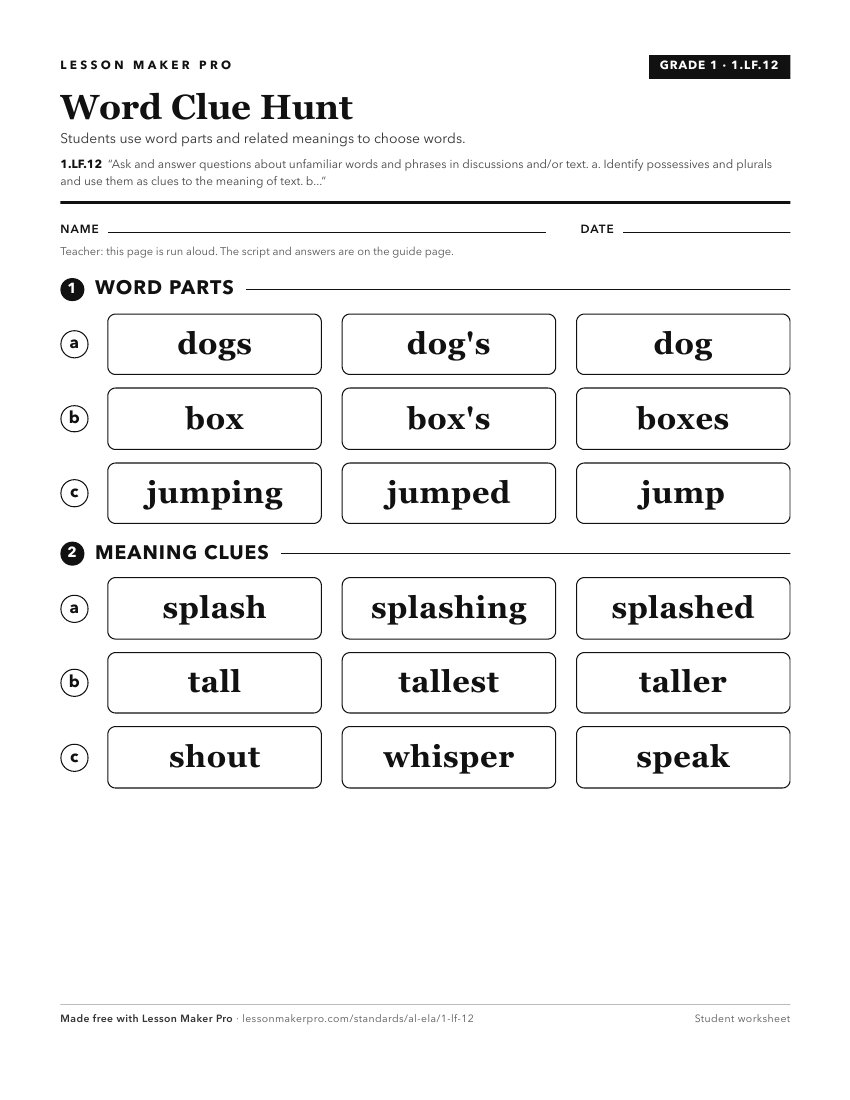
A ready-to-print activity worksheet aligned to 1.LF.12, with an answer key for the teacher on its own page. No account needed.
PDF, US Letter, prints cleanly in black and white.
Download the worksheetKeep exploring
Related Standards
Turn this cluster into a lesson
Grade, subject, topic, and the complete cluster are prefilled. Create one free, no account needed.
Also for this cluster:Make a WorksheetMake a QuizMake a Sub Lesson