Virginia SOL 2.NS.3.c
The Standard
Compose the whole for a given fractional part and its value (in context) for halves, fourths, eighths, thirds, and sixths (e.g., when given 1 4 , determine how many pieces would be needed to make 4 4 ).
Virginia Standards of Learning for Mathematics · The student will use mathematical reasoning and justification to solve contextual problems that involve partitioning models into equal-sized parts (halves, fourths, eighths, thirds, and sixths).
Teacher's field guide
What This Standard Means
What Students Need to Do
- Students use the value of one equal part to find the value of the whole. They make the number of equal groups named by the denominator, then combine those groups.
What Mastery Looks Like
- Given that one fourth contains 3 objects, a student builds four equal groups and finds 12 objects in the whole. The student can use drawings, counters, repeated addition, or skip-counting and explain why the groups must be equal.
Common Misconceptions
- Students may treat the denominator as the whole’s value or add it to the part’s value. They may build unequal groups or confuse the number of groups with the number in each group.
How to Assess It
- Exit ticket: One sixth of a sticker sheet has 4 stickers. Draw the whole sheet, find the total stickers, and explain your reasoning.
Lesson moves
Ways to Teach It
Give students counters and unit-fraction cards, then have them copy the shown group enough times to build one whole.
Ask, “One third of a box holds 5 crayons. How many crayons fill the box?” Students draw and explain.
Play Whole Builder: students draw a fraction card and part-value card, build equal groups, then record the whole.
Use an egg carton context: if one sixth holds 2 eggs, students model and find how many eggs fill the carton.
Free download
Printable 2.NS.3.c Worksheet
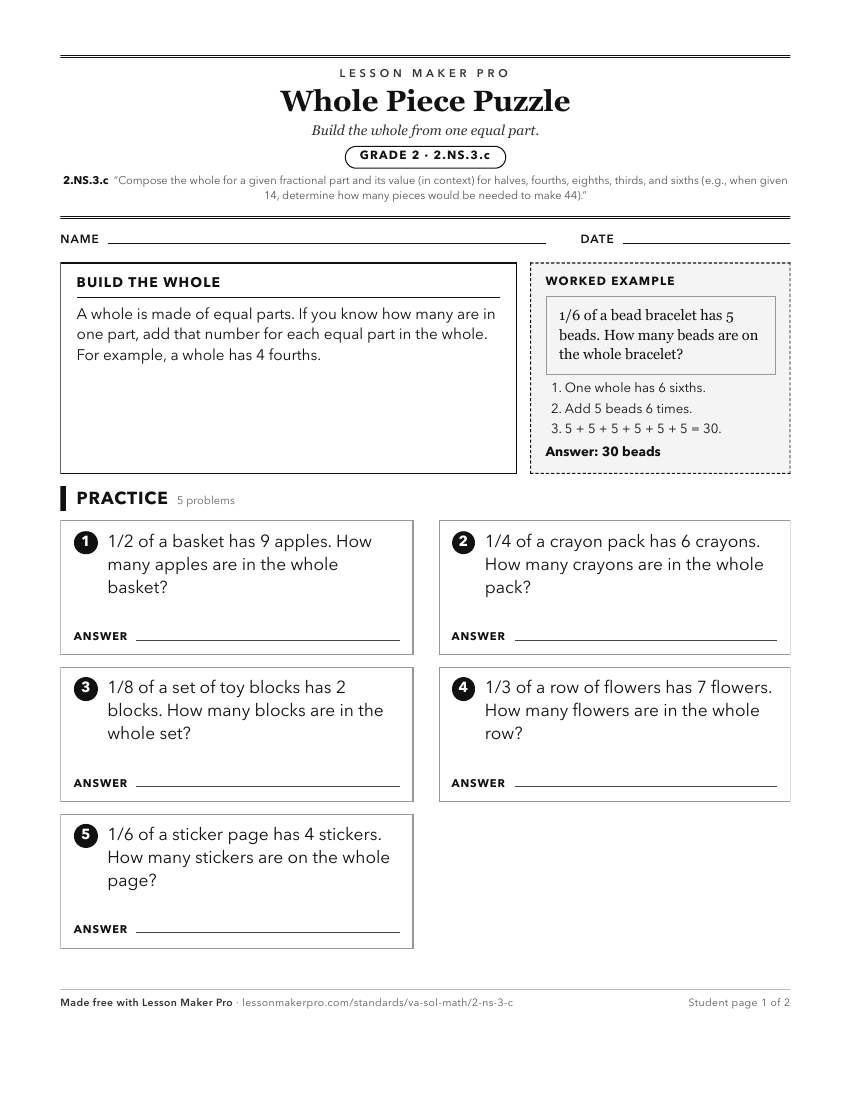
A ready-to-print activity worksheet aligned to 2.NS.3.c, with an answer key for the teacher on its own page. No account needed.
PDF, US Letter, prints cleanly in black and white.
Download the worksheetKeep exploring
Related Standards
- 2.NS.3.d
Using same-size fraction pieces, from a region/area model, count by unit fractions up to two wholes (e.g., zero one-fourths, one one-fourth, two one-fourths, th...
- 3.NS.3.d
Compose and decompose fractions (proper and improper) with denominators of 2, 3, 4, 5, 6, 8, and 10 in multiple ways (e.g., 7 4 = 4 4 + 3 4 or 4 6 = 3 6 + 1 6 =...
- 4.NS.5.a
Represent fractions (proper or improper) and/or mixed numbers as decimals through hundredths, using multiple representations, limited to halves, fourths, fifths...
- 4.NS.3.f
Compose and decompose fractions (proper and improper) and/or mixed numbers with denominators of 12 or less, in multiple ways, with and without models.*
Turn this exact standard into a lesson
Grade, subject, topic, and the complete standard are prefilled. Create one free, no account needed.
Also for this standard:Make a WorksheetMake a QuizMake a Sub Lesson