Virginia SOL 12.RI.2.B
The Standard
Analyze the cumulative impact of specific word choices on meaning, author’s attitude toward the subject, and mood.
Virginia Standards of Learning for English · Craft and Style
Teacher's field guide
What This Standard Means
What Students Need to Do
- Students track repeated, contrasting, and loaded words across an informational text. They explain how those choices build meaning, reveal the writer’s attitude, and shape the reader’s mood.
What Mastery Looks Like
- A student selects precise words from different parts of a text and identifies a pattern. The student explains how that pattern develops an idea, supports a specific attitude, and creates a mood.
Common Misconceptions
- Students often use vague labels such as “good” or “bad,” or confuse the writer’s attitude with the reader’s mood. They may analyze one striking word alone instead of showing how several choices build an effect across the text.
How to Assess It
- Give students a short editorial and ask: “Circle three words that work together. Explain what idea they emphasize, what attitude they reveal, and what mood they create.”
Lesson moves
Ways to Teach It
Print a paragraph twice. Students highlight charged words, replace them with neutral synonyms, then compare how meaning, attitude, and mood change.
After reading a speech, ask: Which three words most clearly reveal the speaker’s attitude, and how do they affect the audience?
Teams sort quotation cards by attitude and mood, then earn points by defending each label with a pattern of words.
Compare two headlines about the same event, and annotate how verbs and labels guide readers toward different interpretations and feelings.
Free download
Printable 12.RI.2.B Worksheet
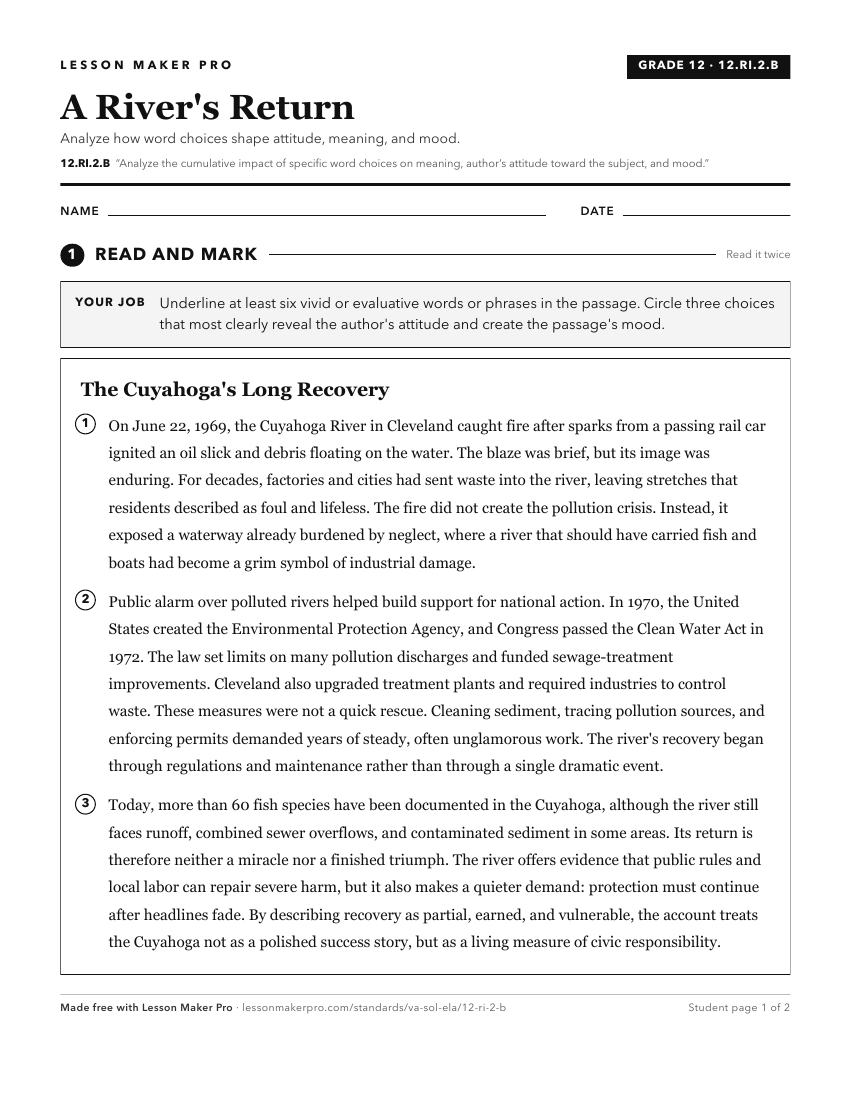
A ready-to-print activity worksheet aligned to 12.RI.2.B, with an answer key for the teacher on its own page. No account needed.
PDF, US Letter, prints cleanly in black and white.
Download the worksheetKeep exploring
Related Standards
- 10.RL.2.C
Analyze how authors use specific word choices, syntax, tone, and voice to convey the author’s intent and viewpoint.
- 5.RL.2.B
Analyze the author’s use of language (e.g., synonyms, figurative language, sensory words, dialogue, dialect) and their impact on understanding characters, setti...
- 7.RI.2.B
Analyze how an author’s word choice, organizational pattern, and language structure impact the author’s purpose and support the reader’s comprehension.
- 11.RL.2.B
Evaluate how authors use specific word choices, syntax, tone, and voice to convey the author’s intent and viewpoint.
Turn this exact standard into a lesson
Grade, subject, topic, and the complete standard are prefilled. Create one free, no account needed.
Also for this standard:Make a WorksheetMake a QuizMake a Sub Lesson