NGSS K-PS3-2
The Standard
Use tools and materials to design and build a structure that will reduce the warming effect of sunlight on an area.
Next Generation Science Standards
Teacher's field guide
What This Standard Means
What Students Need to Do
- Students create a small shelter that keeps a target spot shaded. They test it against an uncovered spot and use what they observe to improve the design.
What Mastery Looks Like
- A student builds a stable shelter that shades the chosen area. The student compares covered and uncovered spots and uses an observation or thermometer reading as evidence.
Common Misconceptions
- Students may think any roof works, even when sunlight enters from the side. They may also confuse making shade with blocking wind or assume a larger structure is always better.
How to Assess It
- Give each student an index card, two craft sticks, tape, and a black paper square. Ask them to build shade over the square and explain how it limits warming.
Lesson moves
Ways to Teach It
Place two ice cubes in sunlight, then have pairs build a craft-stick and paper shelter over one cube and compare melting.
Ask, “Where should we add shade on our playground, and what shape should the cover have?” Students draw and label their ideas.
Play Shade Sort by showing picture cards of shelters and having students group them by how much sunlight reaches the ground.
Walk around the school grounds to find umbrellas, trees, awnings, and covered benches, then identify one sunny place that needs shade.
Free download
Printable K-PS3-2 Worksheet
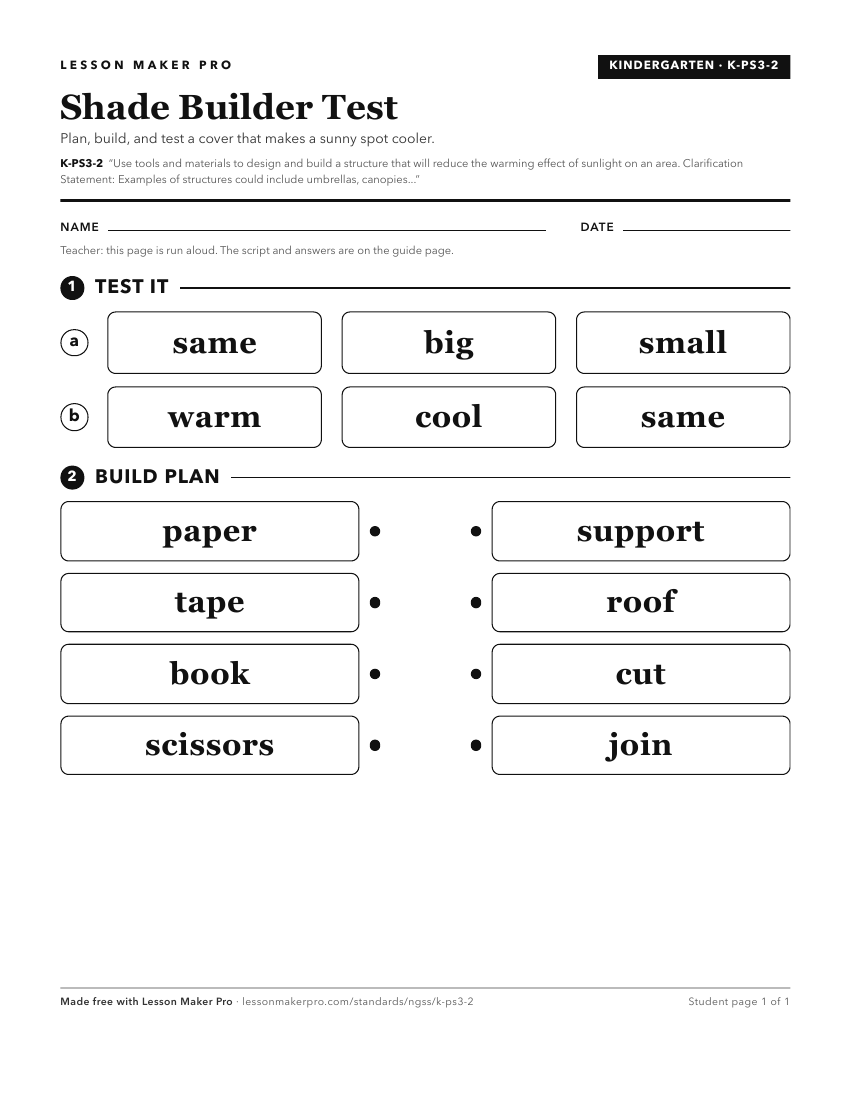
A ready-to-print activity worksheet aligned to K-PS3-2, with an answer key for the teacher on its own page. No account needed.
PDF, US Letter, prints cleanly in black and white.
Download the worksheetKeep exploring
Related Standards
- MS-ESS3-3
Apply scientific principles to design a method for monitoring and minimizing a human impact on the environment.
- MS-PS3-3
Apply scientific principles to design, construct, and test a device that either minimizes or maximizes thermal energy transfer.
- 1-PS4-4
Use tools and materials to design and build a device that uses light or sound to solve the problem of communicating over a distance.
- 3-ESS3-1
Make a claim about the merit of a design solution that reduces the impacts of a weather-related hazard.
Turn this exact standard into a lesson
Grade, subject, topic, and the complete standard are prefilled. Create one free, no account needed.
Also for this standard:Make a WorksheetMake a QuizMake a Sub Lesson