NGSS K-PS2-2
The Standard
Analyze data to determine if a design solution works as intended to change the speed or direction of an object with a push or a pull.
Next Generation Science Standards
Teacher's field guide
What This Standard Means
What Students Need to Do
- Students test a ramp, barrier, or other simple setup by moving a ball or toy. They record repeated results, then decide whether the setup changed its speed or path as planned.
What Mastery Looks Like
- A student can run several fair trials, mark results with pictures or tally marks, and compare outcomes. They can use the recorded results to say whether the design met the goal.
Common Misconceptions
- Students may think a stronger push is the only way to change motion. They may confuse moving farther with moving faster, or judge a design after only one trial.
How to Assess It
- Show results where Design A hit a target once in five trials and Design B hit it four times. Ask students to circle the better design and explain why.
Lesson moves
Ways to Teach It
Build two cardboard ramps, release the same marble three times from each, and tally which ramp gets it to the finish line first.
Ask, “Which block wall made the ball turn toward the cup, and what trial results support your answer?”
Play Target Turn: teams place one block as a guide, roll a ball three times, and earn a point for each target hit.
Make a toy car road with blocks, then test where a guardrail must go to turn the car away from a paper pond.
Free download
Printable K-PS2-2 Worksheet
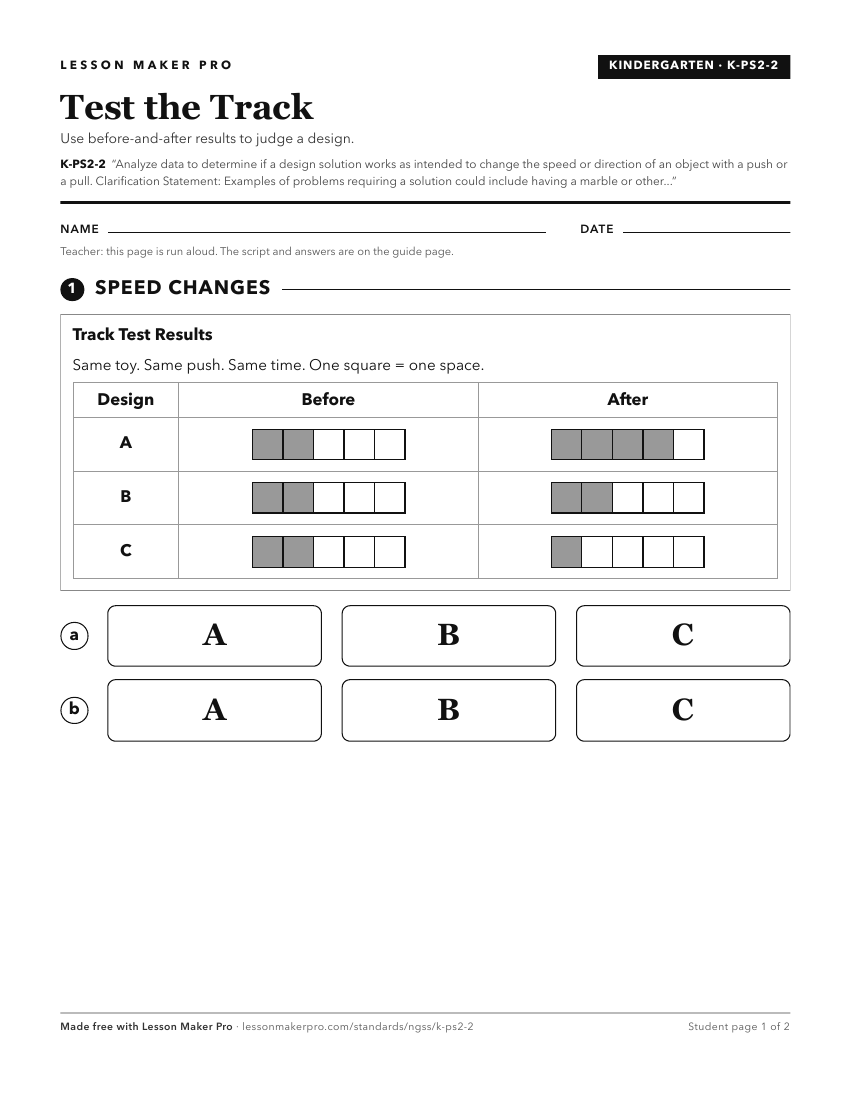
A ready-to-print activity worksheet aligned to K-PS2-2, with an answer key for the teacher on its own page. No account needed.
PDF, US Letter, prints cleanly in black and white.
Download the worksheetKeep exploring
Related Standards
- K-PS2-1
Plan and conduct an investigation to compare the effects of different strengths or different directions of pushes and pulls on the motion of an object.
- 3-PS2-1
Plan and conduct an investigation to provide evidence of the effects of balanced and unbalanced forces on the motion of an object.
- MS-ETS1-3
Analyze data from tests to determine similarities and differences among several design solutions to identify the best characteristics of each that can be combin...
- HS-PS2-3
Apply scientific and engineering ideas to design, evaluate, and refine a device that minimizes the force on a macroscopic object during a collision.
Turn this exact standard into a lesson
Grade, subject, topic, and the complete standard are prefilled. Create one free, no account needed.
Also for this standard:Make a WorksheetMake a QuizMake a Sub Lesson