NGSS HS-PS4-4
The Standard
Evaluate the validity and reliability of claims in published materials of the effects that different frequencies of electromagnetic radiation have when absorbed by matter. Clarification Statement: Emphasis is on the idea that different frequencies of light have different energies, and the damage to living tissue from electromagnetic radiation depends on the energy of the radiation. Examples of published materials could include trade books, magazines, web resources, videos, and other passages that may reflect bias. Assessment Boundary: Assessment is limited to qualitative descriptions.
Next Generation Science Standards
Teacher's field guide
What This Standard Means
What Students Need to Do
- Students compare claims about how electromagnetic radiation affects matter, especially living tissue. They use frequency, energy, and absorption to judge the science, then check each source for evidence, expertise, and bias.
What Mastery Looks Like
- Students can explain qualitatively that higher-frequency radiation carries more energy and that tissue damage depends on absorption. They can identify evidence, author expertise, citations, date, and bias when judging a claim.
Common Misconceptions
- Students may think all electromagnetic radiation is equally harmful or confuse frequency with intensity. They may assume higher frequency always means greater damage, even when the radiation is not absorbed. They may also judge reliability by website design or domain name alone.
How to Assess It
- Give students two short sources making different claims about UV exposure. Ask them to choose the better-supported claim and cite one science reason and two source-quality clues.
Adopted as
This framework is adopted as written in California, Connecticut, Delaware, District of Columbia, Hawaii, Illinois, Kansas, Maryland, Nevada, New Hampshire, New Mexico, Rhode Island, Vermont.
Lesson moves
Ways to Teach It
Test UV-sensitive beads under plastic coated with sunscreen, lotion, or nothing, then connect color changes to radiation absorption.
Write a CER response to: Which source gives the more trustworthy claim about UV exposure, and what evidence supports your judgment?
Play Source Detective with four claim cards, ranking each by author expertise, evidence, date, citations, and possible bias.
Compare a tanning salon advertisement with CDC guidance, then annotate how each describes UV frequency, energy, absorption, and tissue damage.
Free download
Printable HS-PS4-4 Worksheet
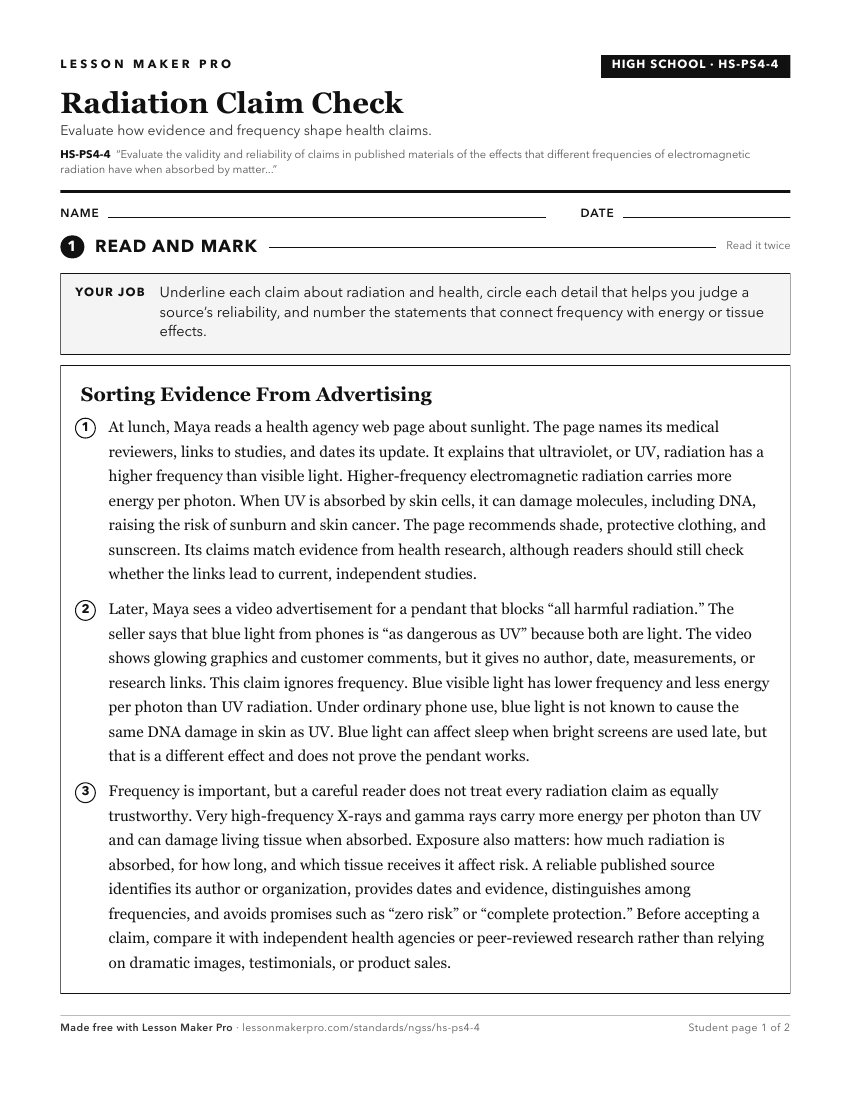
A ready-to-print activity worksheet aligned to HS-PS4-4, with an answer key for the teacher on its own page. No account needed.
PDF, US Letter, prints cleanly in black and white.
Download the worksheetLearning progression
Where This Standard Sits
See the whole path on the Physical Science progression map.
Before This Standard
If students are struggling here, check these first.
Keep exploring
Related Standards
- HS-PS4-3
Evaluate the claims, evidence, and reasoning behind the idea that electromagnetic radiation can be described either by a wave model or a particle model, and tha...
- HS-PS4-1
Use mathematical representations to support a claim regarding relationships among the frequency, wavelength, and speed of waves traveling in various media.
- 3-PS2-3
Ask questions to determine cause and effect relationships of electric or magnetic interactions between two objects not in contact with each other.
Turn this exact standard into a lesson
Grade, subject, topic, and the complete standard are prefilled. Create one free, no account needed.
Also for this standard:Make a WorksheetMake a QuizMake a Sub Lesson