Georgia K.GSR.8.4
The Standard
Use two or more basic shapes to form larger shapes.
Georgia's K-12 Mathematics Standards · Identify, describe, and compare basic shapes encountered in the environment, and form two-dimensional shapes and three-dimensional figures.
Teacher's field guide
What This Standard Means
What Students Need to Do
- Students join two or more familiar shapes to create one larger shape or picture. They identify the smaller pieces and name the shape they made.
What Mastery Looks Like
- Students arrange two or more shape pieces to make a larger shape without gaps or overlaps. They name the larger shape and identify the pieces used.
Common Misconceptions
- Students may think pieces cannot make a new shape if their colors or sizes differ. They may leave gaps, overlap pieces, or name only the small pieces. Some may believe a rotated shape becomes a different shape.
How to Assess It
- Give each student two triangles and ask, “Make one larger shape, then name it.” Check that the edges meet without gaps or overlaps.
Lesson moves
Ways to Teach It
Give students pattern blocks and challenge them to build a hexagon, rectangle, or picture using at least two pieces.
Show a shape made from pieces and ask, “Which shapes were used, and how do you know?”
Play Shape Builder Bingo, where students cover a target after combining pieces to match the pictured larger shape.
Study a house, window, or road sign and recreate its outline by joining paper shape cutouts.
Free download
Printable K.GSR.8.4 Worksheet
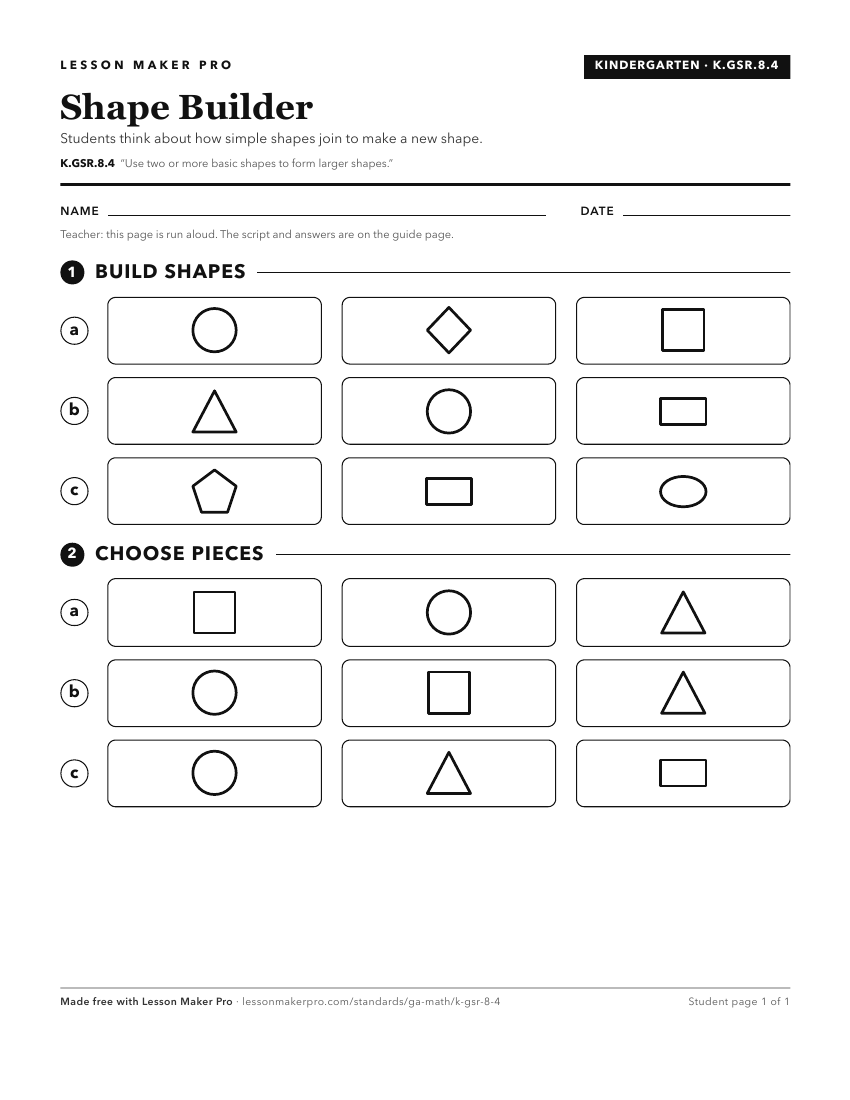
A ready-to-print activity worksheet aligned to K.GSR.8.4, with an answer key for the teacher on its own page. No account needed.
PDF, US Letter, prints cleanly in black and white.
Download the worksheetKeep exploring
Related Standards
- 1.GSR.4
Compose shapes, analyze the attributes of shapes, and relate their parts to the whole.
- 1.GSR.4.2
Compose two-dimensional shapes (rectangles, squares, triangles, half-circles, and quarter-circles) and three-dimensional figures (cubes, rectangular prisms, con...
- K.GSR.8
Identify, describe, and compare basic shapes encountered in the environment, and form two-dimensional shapes and three-dimensional figures.
- K.GSR.8.3
Use basic shapes to represent specific shapes found in the environment by creating models and drawings.
Turn this exact standard into a lesson
Grade, subject, topic, and the complete standard are prefilled. Create one free, no account needed.
Also for this standard:Make a WorksheetMake a QuizMake a Sub Lesson