Georgia K.T.T.4.a
The Standard
Identify poetic techniques used to craft poetic texts, including rhyme. (I)
Georgia's K-12 English Language Arts Standards · Texts (T) · Techniques
Teacher's field guide
What This Standard Means
What Students Need to Do
- Students listen for words with matching ending sounds in short poems. They point out rhyming pairs and describe what they hear. They may try a rhyming word of their own.
What Mastery Looks Like
- After hearing a short poem, the student points out rhyming pairs such as cat and hat. The student can say that the word endings sound alike.
Common Misconceptions
- Students may match words by first sound, such as cat and cup. They may choose words that look alike instead of listening to ending sounds. Some think repeating the same word counts as rhyme.
How to Assess It
- Read, “A fox sat on a box.” Ask, “Which two words rhyme, and what part sounds the same?”
Lesson moves
Ways to Teach It
Give students picture cards for cat, hat, log, and frog, then have them match rhyming pairs and say each pair aloud.
Read two short poem lines and ask, “Which words rhyme, and how does the rhyme make the poem sound?”
Play Rhyme Toss by saying a word, tossing a beanbag, and having the catcher say a rhyming word.
Create a cleanup chant using classroom words that rhyme, such as “Shut the door, check the floor.”
Free download
Printable K.T.T.4.a Worksheet
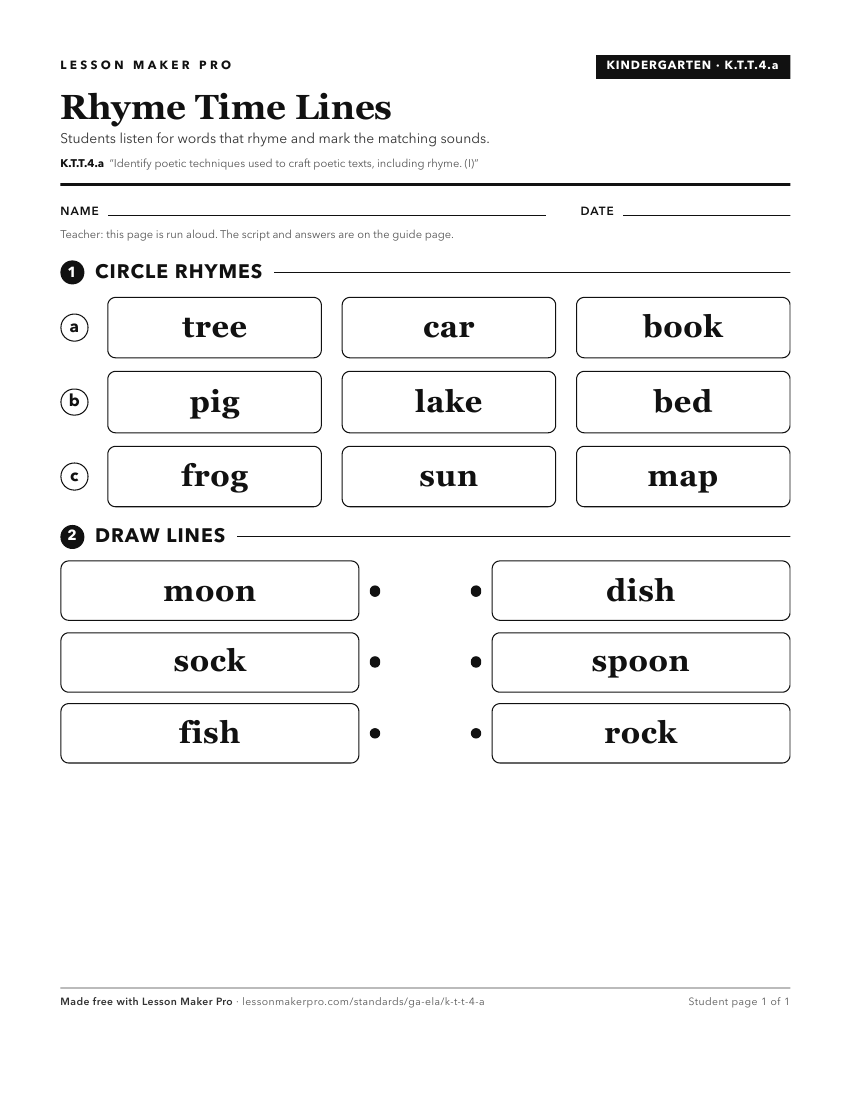
A ready-to-print activity worksheet aligned to K.T.T.4.a, with an answer key for the teacher on its own page. No account needed.
PDF, US Letter, prints cleanly in black and white.
Download the worksheetKeep exploring
Related Standards
- 7.T.T.4.a
Analyze poetic techniques used to present and design content, including stanzas, rhyme scheme, imagery, figurative language, and/or sound devices. (I)
- 6.T.T.4.a
Recognize and describe poetic techniques used to present and design content, including stanzas, rhyme scheme, imagery, figurative language, and/or sound devices...
- 2.T.T.4.a
Identify, classify, and describe poetic techniques used to craft texts, including rhyme, alliteration, repeated lines, stanzas, and line breaks. (I)
- 1.T.T.4.a
Identify and describe poetic techniques used to craft texts, including rhyme, alliteration, and repeated lines. (I)
Turn this exact standard into a lesson
Grade, subject, topic, and the complete standard are prefilled. Create one free, no account needed.
Also for this standard:Make a WorksheetMake a QuizMake a Sub Lesson