Georgia 9.T.RA.1.c
The Standard
Integrate paraphrased, summarized, and quoted material into original texts in various ways for intended purposes that strengthen the writing, citing ideas in Modern Language Association (MLA) format. (C)
Georgia's K-12 English Language Arts Standards · Texts (T) · Research & Analysis
Teacher's field guide
What This Standard Means
What Students Need to Do
- Students select useful evidence from sources and blend it into their own writing as quotations, paraphrases, or summaries. They connect evidence to their purpose and cite borrowed ideas in MLA format.
What Mastery Looks Like
- Students choose whether a quotation, paraphrase, or summary best serves their purpose. They introduce the source, use accurate MLA citations, and explain how the evidence supports their own point.
Common Misconceptions
- Students may drop a quotation into a paragraph without explaining how it supports the claim. They may confuse paraphrasing with changing a few words, or cite quotations but not paraphrases and summaries. MLA citations may omit the author, page number, or matching Works Cited entry.
How to Assess It
- Give students a short source and a claim. Ask them to write three sentences that introduce, paraphrase, cite, and explain one relevant idea using MLA format.
Lesson moves
Ways to Teach It
Give groups printed source excerpts to cut, label as quote, paraphrase, or summary, and place within a paragraph frame.
Ask students to explain in writing when exact wording matters more than a paraphrase or summary.
Play Citation Repair Relay, where teams correct dropped quotations, weak paraphrases, and incomplete MLA parenthetical citations on task cards.
Have students write a brief school policy recommendation using evidence from a news article and a district document.
Free download
Printable 9.T.RA.1.c Worksheet
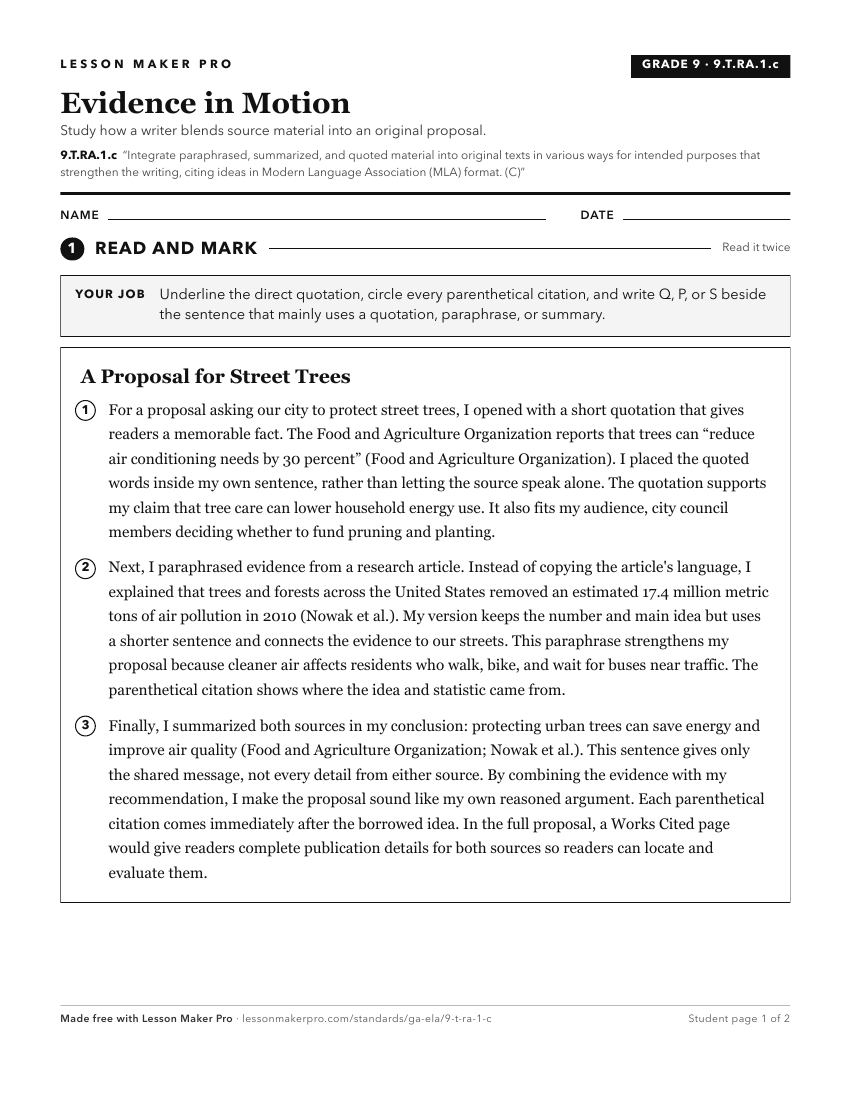
A ready-to-print activity worksheet aligned to 9.T.RA.1.c, with an answer key for the teacher on its own page. No account needed.
PDF, US Letter, prints cleanly in black and white.
Download the worksheetKeep exploring
Related Standards
- 10.T.RA.1.c
Integrate paraphrased, summarized, and quoted material into original texts in various ways for intended purposes that strengthen the writing, citing the sources...
- 8.T.RA.2.c
Follow Modern Language Association (MLA) guidelines when integrating textual evidence, clearly identifying and citing the ideas and information of others and en...
- 12.T.RA.1.c
Integrate paraphrased, summarized, and quoted material into original texts in various ways for intended purposes that strengthen the writing, citing the sources...
- 11.T.RA.1.c
Integrate paraphrased, summarized, and quoted material into original texts in various ways for intended purposes that strengthen the writing, citing the sources...
Turn this exact standard into a lesson
Grade, subject, topic, and the complete standard are prefilled. Create one free, no account needed.
Also for this standard:Make a WorksheetMake a QuizMake a Sub Lesson