Georgia 8.T.SS.2.c
The Standard
Use formal or informal style characteristics as indicated by a text’s purpose, audience, and disciplinary context. (C)
Georgia's K-12 English Language Arts Standards · Texts (T) · Structure & Style
Teacher's field guide
What This Standard Means
What Students Need to Do
- Students decide how polished, conversational, or technical their language should sound for a given writing situation. They adjust word choice, contractions, sentence structure, and tone to fit the reader and task.
What Mastery Looks Like
- Students can select a fitting style for a specific writing situation and explain their choice. They can rewrite one message for different readers while keeping its meaning clear.
Common Misconceptions
- Students may think formal writing requires long words or that informal writing can be careless. They may also shift tone halfway through a text or use slang in academic explanations.
How to Assess It
- Exit ticket: Rewrite “We need to fix this problem soon” for an email to the principal and a text to a friend. Label each style and explain one choice.
Lesson moves
Ways to Teach It
Sort sample emails, texts, reports, and posts into formal and informal groups, then underline the language clues that guided each choice.
Write the same school announcement for a principal, a classmate, and a public website, then explain three style changes.
Play Style Switch: draw an audience and purpose card, then revise a neutral sentence to fit both.
Compare a company’s social media post with its customer policy, and list how tone, vocabulary, and sentence structure change.
Free download
Printable 8.T.SS.2.c Worksheet
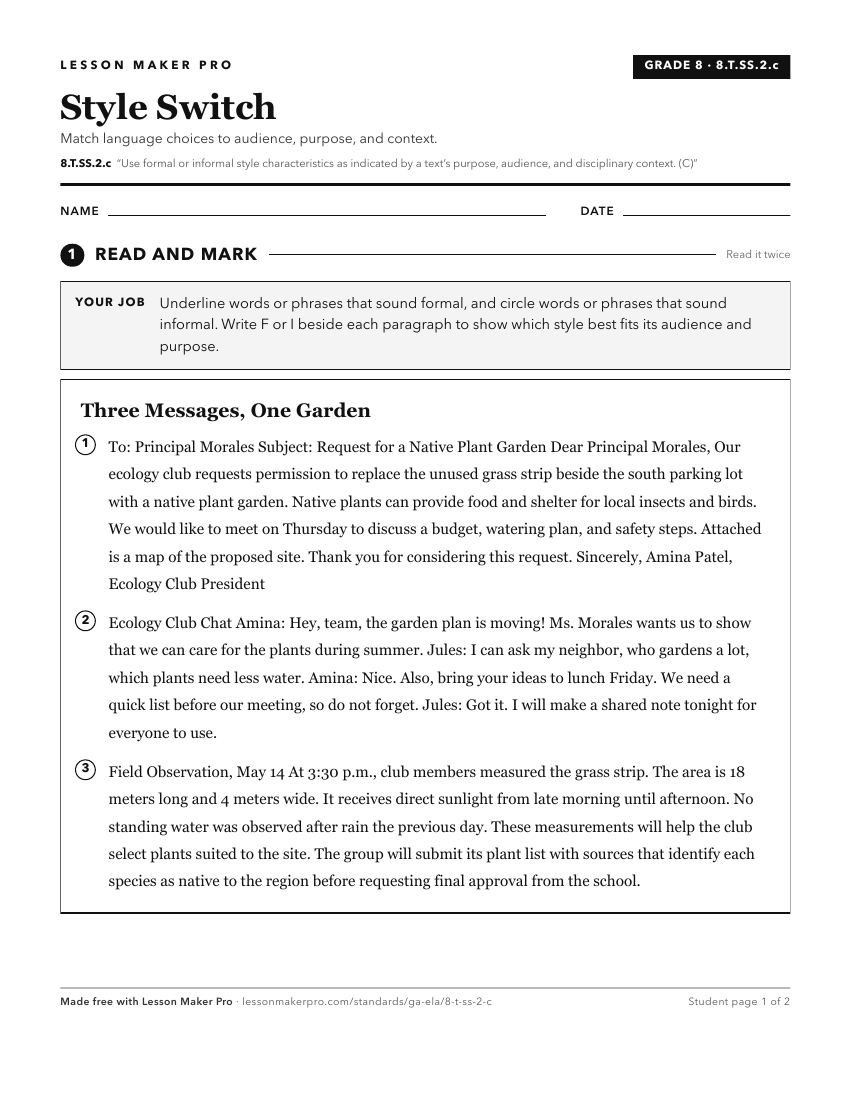
A ready-to-print activity worksheet aligned to 8.T.SS.2.c, with an answer key for the teacher on its own page. No account needed.
PDF, US Letter, prints cleanly in black and white.
Download the worksheetKeep exploring
Related Standards
- 10.T.SS.2.c
Use formal style when speaking or writing to establish credibility and tone. (C)
- 6.T.SS.2.c
Compare and contrast characteristics of formal style (e.g., jargon, complete sentences) with those of informal style (e.g., contractions, slang, sentence fragme...
- 7.T.SS.2.c
Determine situational use for formal or informal style and apply that determination to choices when writing or speaking. (C)
- 9.T.SS.2.c
Use formal or informal style, as appropriate to audience, purpose, and context. (C)
Turn this exact standard into a lesson
Grade, subject, topic, and the complete standard are prefilled. Create one free, no account needed.
Also for this standard:Make a WorksheetMake a QuizMake a Sub Lesson