Florida B.E.S.T. MA.912.LT.5.4
The Standard
Perform the set operations of taking the complement of a set and the union, intersection, difference and product of two sets.
Florida B.E.S.T. Standards for Mathematics
Teacher's field guide
What This Standard Means
What Students Need to Do
- Students find complements relative to a stated universal set. They combine two sets using union, intersection, difference, and Cartesian product, then list or describe each result.
What Mastery Looks Like
- Given two sets and a universal set, students correctly list the result of each operation. They keep set difference in the stated order and write every Cartesian product element as an ordered pair.
Common Misconceptions
- Students may confuse union with intersection or assume set difference works the same in either order. They may find a complement without using the stated universal set. Some multiply elements instead of listing ordered pairs for a Cartesian product.
How to Assess It
- Use this exit ticket: Let U = {1, 2, 3, 4}, A = {1, 2}, and B = {2, 4}. Find Aᶜ, A ∪ B, A ∩ B, A − B, and A × B using roster notation.
Lesson moves
Ways to Teach It
Use number cards and two hoops; students build unions, intersections, differences, and complements, then write Cartesian product ordered pairs on cards.
Ask students to explain why A minus B usually differs from B minus A, using a Venn diagram and set lists.
Run a matching game where teams pair operation cards with result cards for three given sets and a stated universe.
Analyze a school club roster with union, intersection, difference, and complement, then pair club choices with meeting days in a Cartesian product.
Free download
Printable MA.912.LT.5.4 Worksheet
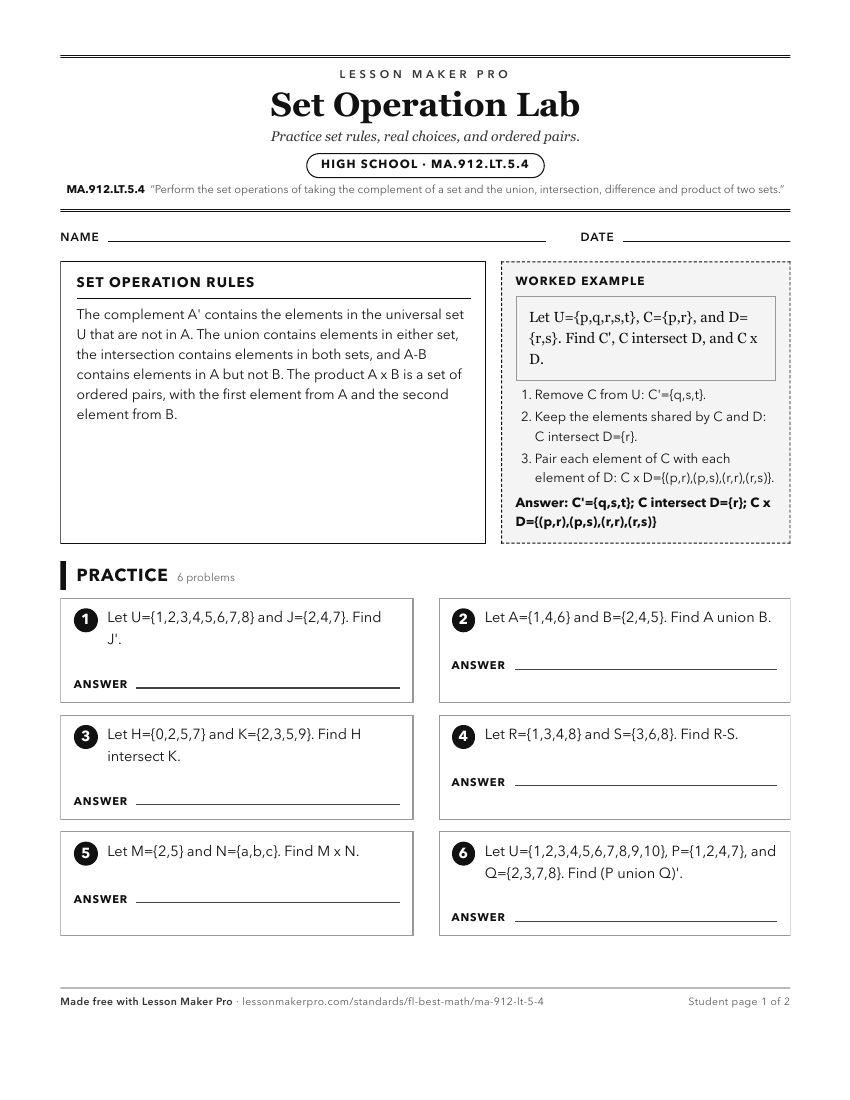
A ready-to-print activity worksheet aligned to MA.912.LT.5.4, with an answer key for the teacher on its own page. No account needed.
PDF, US Letter, prints cleanly in black and white.
Download the worksheetKeep exploring
Related Standards
- MA.912.LT.5
Apply properties from Set Theory to solve problems.
- MA.912.F.3.3
Solve mathematical and real-world problems involving functions that have been combined using arithmetic operations.
- MA.912.LT.5.1
Given two sets, determine whether the two sets are equivalent and whether one set is a subset of another. Given one set, determine its power set.
- MA.912.LT.5.6
Prove set relations, including DeMorgan’s Laws and equivalence relations.
Turn this exact standard into a lesson
Grade, subject, topic, and the complete standard are prefilled. Create one free, no account needed.
Also for this standard:Make a WorksheetMake a QuizMake a Sub Lesson