Florida B.E.S.T. ELA.10.C.1.2
The Standard
Write narratives using an appropriate pace to create tension, mood, and/or tone.
Florida B.E.S.T. Standards for English Language Arts
Teacher's field guide
What This Standard Means
What Students Need to Do
- Students decide which moments deserve close detail and which events can be summarized or skipped. They vary sentence length, dialogue, action, reflection, and scene breaks to shape the reader's response.
What Mastery Looks Like
- A student can expand a decisive moment with action, sensory detail, or dialogue, then summarize routine events without losing clarity. The pacing shifts create a clear emotional effect rather than feeling random.
Common Misconceptions
- Students may think slower pacing means adding many adjectives, or faster pacing means using only short sentences. They often give every event equal space, which makes key moments feel flat. They may also confuse the narrator's tone with the reader's mood.
How to Assess It
- Ask students to rewrite a three-sentence accident scene, stretching the moment before impact and compressing what happens afterward. Have them underline two pacing choices.
Lesson moves
Ways to Teach It
Cut a 200-word scene into sentence strips, then rearrange and remove strips to make the discovery feel slower and more suspenseful.
Read a suspense scene aloud, then discuss: Where does time stretch, where does it jump, and what feeling does each shift create?
Draw event cards and race to write one event in slow motion, then compress the next three events into one clear sentence.
Compare a live-play clip with its slow-motion replay, then write how each version changes anticipation and emotional effect.
Free download
Printable ELA.10.C.1.2 Worksheet
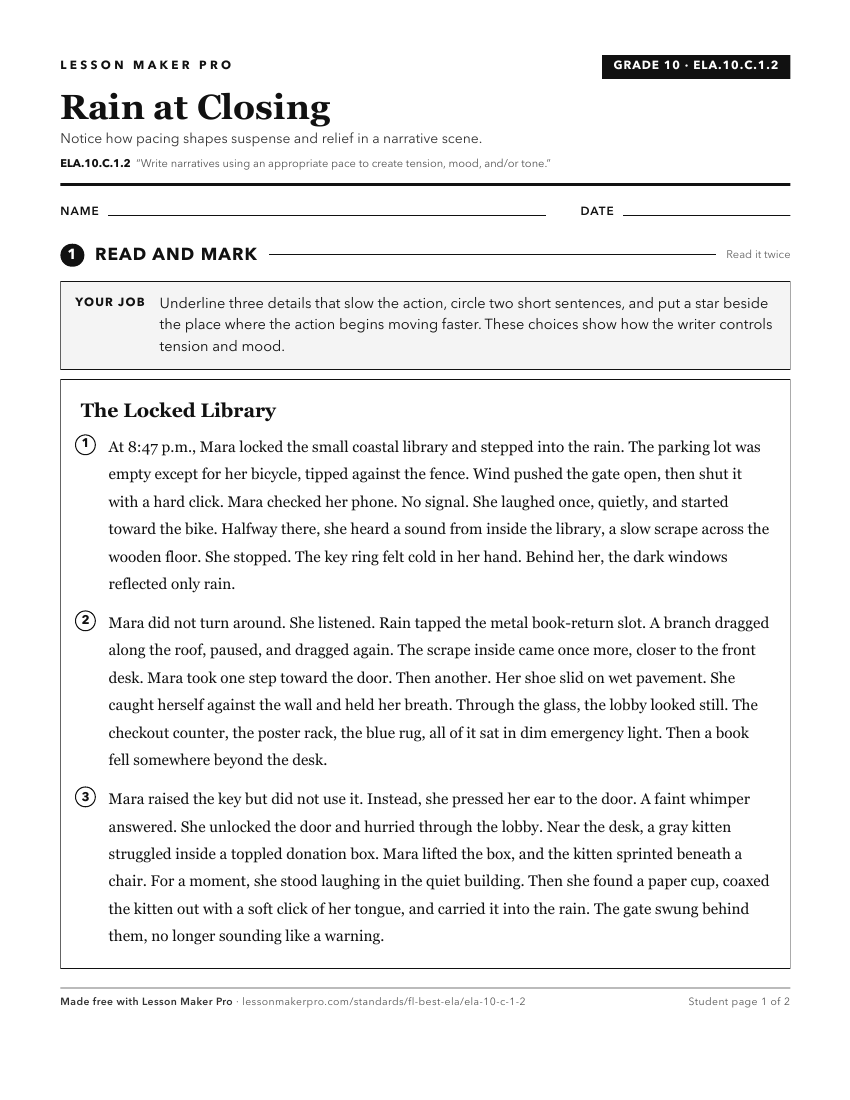
A ready-to-print activity worksheet aligned to ELA.10.C.1.2, with an answer key for the teacher on its own page. No account needed.
PDF, US Letter, prints cleanly in black and white.
Download the worksheetKeep exploring
Related Standards
- ELA.8.C.1.2
Write personal or fictional narratives using narrative techniques, varied transitions, and a clearly established point of view.
- ELA.5.C.1.2
Write personal or fictional narratives using a logical sequence of events and demonstrating an effective use of techniques such as dialogue, description, and tr...
- ELA.3.C.1.2
Write personal or fictional narratives using a logical sequence of events, appropriate descriptions, dialogue, a variety of transitional words or phrases, and a...
- ELA.9.C.1.2
Write narratives using narrative techniques, varied transitions, and a clearly established point of view.
Turn this exact standard into a lesson
Grade, subject, topic, and the complete standard are prefilled. Create one free, no account needed.
Also for this standard:Make a WorksheetMake a QuizMake a Sub Lesson