Florida B.E.S.T. ELA.5.C.1.2
The Standard
Write personal or fictional narratives using a logical sequence of events and demonstrating an effective use of techniques such as dialogue, description, and transitional words and phrases.
Florida B.E.S.T. Standards for English Language Arts · Communication
Teacher's field guide
What This Standard Means
What Students Need to Do
- Students write a personal or made-up story with events in an order readers can follow. They use dialogue, focused description, and varied transitions to develop the action and connect each part.
What Mastery Looks Like
- The story has a clear beginning, rising action, turning point, and ending. Dialogue moves the action, descriptions help readers picture events, and transitions make time and place changes easy to follow.
Common Misconceptions
- Students may list events instead of shaping them into a connected story. They may add random dialogue, repeat “then,” shift verb tense, or include details that do not support the action.
How to Assess It
- Ask students to write an eight-sentence story beginning, “When I opened the door, everyone went silent.” Require two lines of dialogue, three descriptive details, and three transitions.
Lesson moves
Ways to Teach It
Give groups six mixed-up event cards, have students order them, justify the sequence, then add transition cards between events.
Write about a time a plan failed, then discuss which dialogue and sensory details make the turning point clear.
Play Transition Relay: teams replace repeated “then” words in a short story with precise time, place, or cause transitions.
Create a class newsletter story about a recent school event, using quoted dialogue, clear sequencing, and details readers need.
Free download
Printable ELA.5.C.1.2 Worksheet
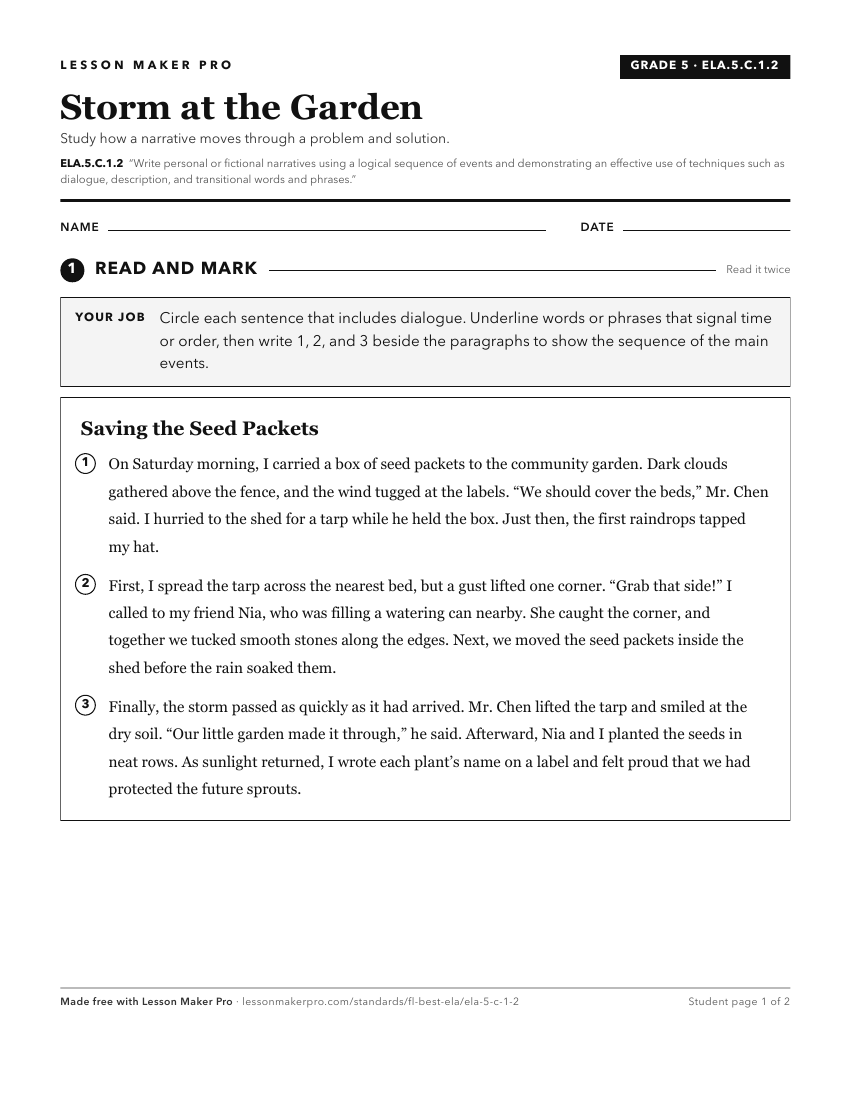
A ready-to-print activity worksheet aligned to ELA.5.C.1.2, with an answer key for the teacher on its own page. No account needed.
PDF, US Letter, prints cleanly in black and white.
Download the worksheetKeep exploring
Related Standards
- ELA.8.C.1.2
Write personal or fictional narratives using narrative techniques, varied transitions, and a clearly established point of view.
- ELA.4.C.1.2
Write personal or fictional narratives using a logical sequence of events and demonstrating an effective use of techniques such as descriptions and transitional...
- ELA.3.C.1.2
Write personal or fictional narratives using a logical sequence of events, appropriate descriptions, dialogue, a variety of transitional words or phrases, and a...
- ELA.2.C.1.2
Write personal or fictional narratives using a logical sequence of events, transitions, and an ending.
Turn this exact standard into a lesson
Grade, subject, topic, and the complete standard are prefilled. Create one free, no account needed.
Also for this standard:Make a WorksheetMake a QuizMake a Sub Lesson