CCSS.
The Standard
Model with mathematics. Mathematically proficient students can apply the mathematics they know to solve problems arising in everyday life, society, and the workplace. In early grades, this might be as simple as writing an addition equation to describe a situation. In middle grades, a student might apply proportional reasoning to plan a school event or analyze a problem in the community. By high school, a student might use geometry to solve a design problem or use a function to describe how one quantity of interest depends on another. Mathematically proficient students who can apply what they know are comfortable making assumptions and approximations to simplify a complicated situation, realizing that these may need revision later. They are able to identify important quantities in a practical situation and map their relationships using such tools as diagrams, two-way tables, graphs, flowcharts and formulas. They can analyze those relationships mathematically to draw conclusions. They routinely interpret their mathematical results in the context of the situation and reflect on whether the results make sense, possibly improving the model if it has not served its purpose.
Common Core State Standards for Mathematics
Teacher's field guide
What This Standard Means
What Students Need to Do
- Students turn a real situation into a diagram, table, graph, equation, or formula. They choose useful information, make reasonable assumptions, solve, and explain the result in context. They adjust the model if the answer does not make sense.
What Mastery Looks Like
- Students identify useful quantities and represent their relationships with a diagram, table, graph, equation, or formula. They explain what the result means, check whether it is reasonable, and revise the model when needed.
Common Misconceptions
- Students may use every number given, even when some details do not matter. They may treat assumptions as facts or report a number without units, context, or a reasonableness check.
How to Assess It
- Ask: “Plan seating for our class using tables that hold four students. Show a model, state one assumption, and explain whether your plan works.”
Lesson moves
Ways to Teach It
Give groups counters, cups, and a sharing problem, then have them build, record, and explain a model that fits the situation.
Ask students to write when rounding up or down makes sense while planning buses, pizzas, or containers for a group.
Create card sets with situations, diagrams, tables, graphs, and equations, then have teams race to build matching model sets.
Use a grocery ad and a fixed budget to plan a class snack, including quantities, costs, assumptions, and leftover money.
Free download
Printable CCSS.Math.Practice.MP4 Worksheet
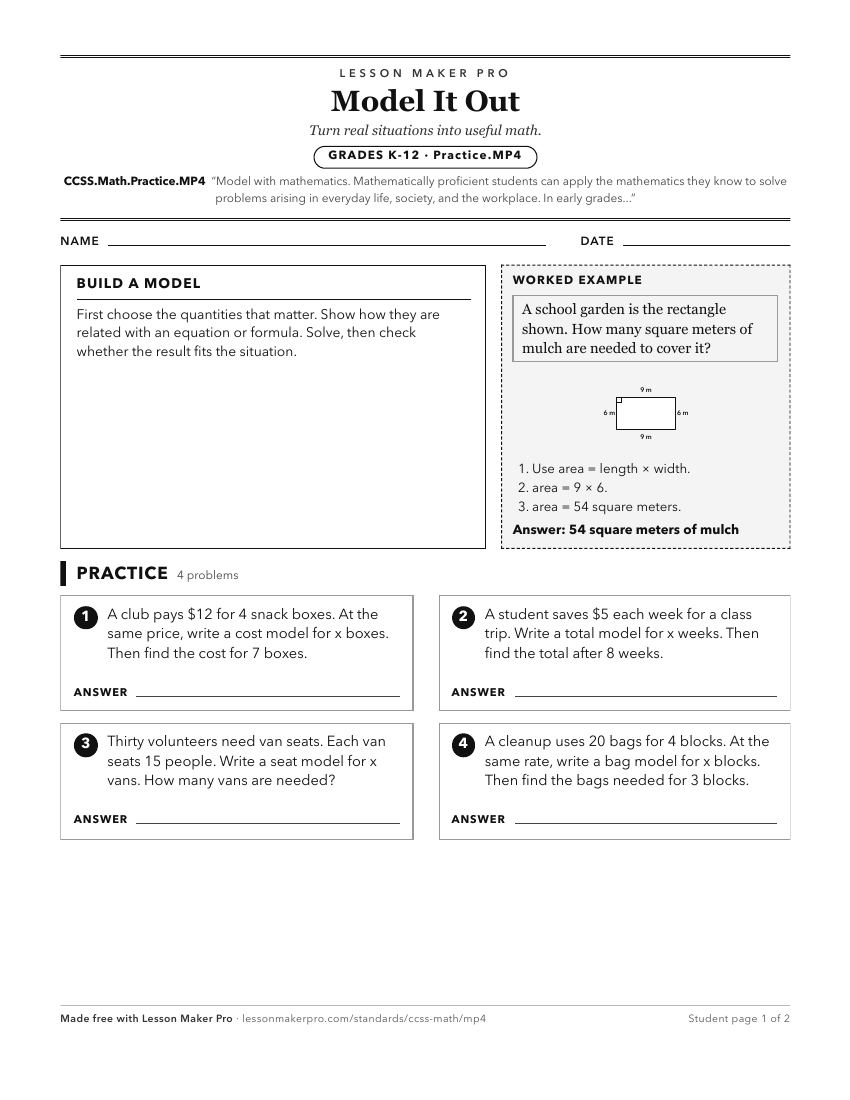
A ready-to-print activity worksheet aligned to CCSS.Math.Practice.MP4, with an answer key for the teacher on its own page. No account needed.
PDF, US Letter, prints cleanly in black and white.
Download the worksheetKeep exploring
Related Standards
- CCSS.Math.Content.HSA-CED.A
Create equations that describe numbers or relationships
- CCSS.Math.Content.HSN-VM.A
Represent and model with vector quantities.
- CCSS.Math.Content.HSG-MG.A
Apply geometric concepts in modeling situations
- CCSS.Math.Content.8.F.B
Use functions to model relationships between quantities.
Turn this exact standard into a lesson
Grade, subject, topic, and the complete standard are prefilled. Create one free, no account needed.
Also for this standard:Make a WorksheetMake a QuizMake a Sub Lesson