CCSS.
Standard Cluster
Compare numbers.
Common Core State Standards for Mathematics
Cluster contents
Standards in This Cluster
CCSS.Math.Content.K.CC.C is a cluster heading. These are the individual standards under it.
Teacher's field guide
What This Cluster Means
What Students Need to Do
- Students compare two groups with up to 10 objects and tell which has more, fewer, or the same number. They also compare two written numerals from 1 to 10.
What Mastery Looks Like
- Students correctly compare groups of up to 10 objects, even when the objects are arranged differently. They compare written numerals from 1 to 10 and explain using counting or matching.
Common Misconceptions
- Students may think a spread-out group has more objects than a close-together group. They may confuse greater and less, or compare numeral shapes instead of values.
How to Assess It
- Show 7 dots beside 5 dots, then show the numerals 4 and 9. Ask students to circle the greater amount in each pair and explain one choice.
Lesson moves
Ways to Teach It
Give partners two cups of counters, then have them build, count, and label which group has more, fewer, or the same.
Show two dot cards and ask, “How do you know which has more?” Record students’ counting and matching explanations.
Play Number War with numeral cards 1 to 10, with the student holding the greater number keeping both cards.
Set two snack plates with different numbers of crackers and ask students which plate has more, fewer, or the same.
Free download
Printable K.CC.C Worksheet
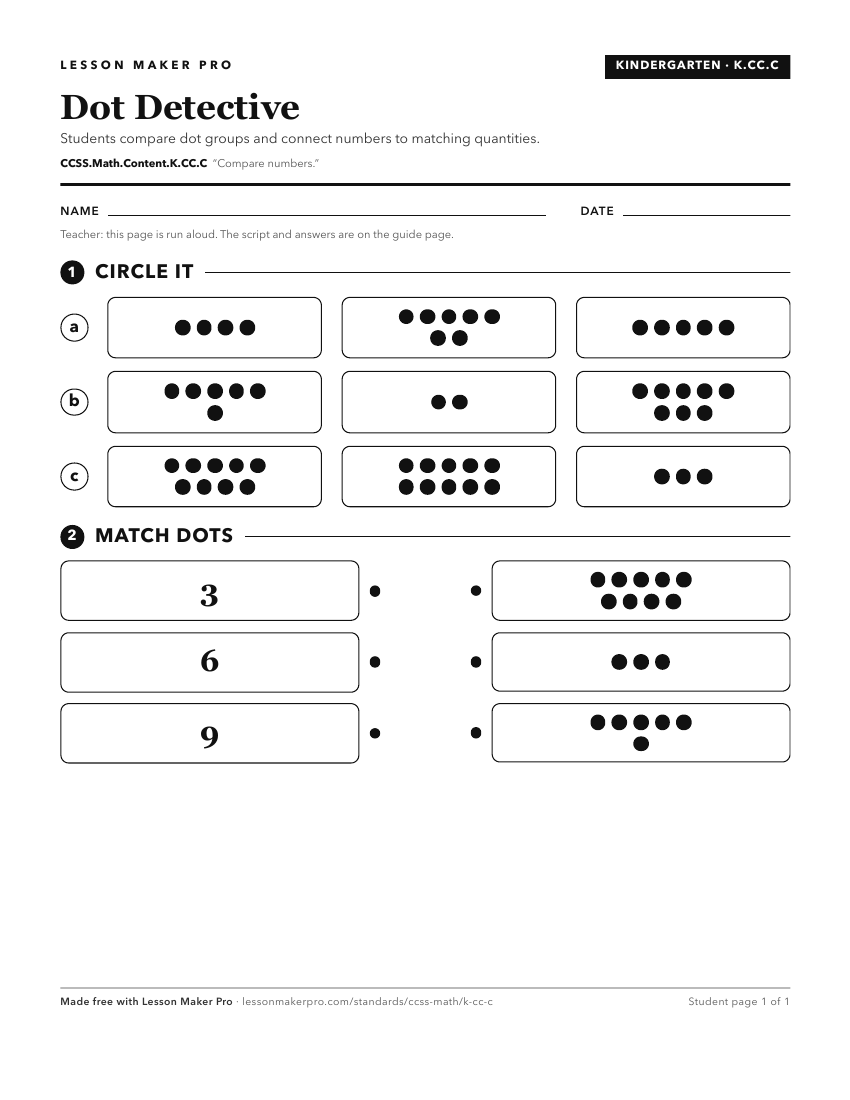
A ready-to-print activity worksheet aligned to CCSS.Math.Content.K.CC.C, with an answer key for the teacher on its own page. No account needed.
PDF, US Letter, prints cleanly in black and white.
Download the worksheetKeep exploring
Related Standards
- CCSS.Math.Content.5.NBT.A.3b
Compare two decimals to thousandths based on meanings of the digits in each place, using >, =, and < symbols to record the results of comparisons.
- CCSS.Math.Content.1.NBT.B.3
Compare two two-digit numbers based on meanings of the tens and ones digits, recording the results of comparisons with the symbols >, =, and <.
- CCSS.Math.Content.2.NBT.A.4
Compare two three-digit numbers based on meanings of the hundreds, tens, and ones digits, using >, =, and < symbols to record the results of comparisons.
Turn this cluster into a lesson
Grade, subject, topic, and the complete cluster are prefilled. Create one free, no account needed.
Also for this cluster:Make a WorksheetMake a QuizMake a Sub Lesson