CCSS.
The Standard
Acknowledge new information expressed by others and, when warranted, modify their own views.
Common Core State Standards for English Language Arts
Teacher's field guide
What This Standard Means
What Students Need to Do
- Students listen closely enough to identify a classmate’s idea or evidence. They explain how that contribution affects their thinking, then revise their claim when the evidence supports a change.
What Mastery Looks Like
- Students accurately paraphrase a peer’s point before responding. They can update a claim, or keep it, and give a clear reason based on evidence.
Common Misconceptions
- Students may agree politely without naming the idea that affected them. They may also refuse to revise a claim, or change it only because the group disagrees.
How to Assess It
- Use this exit ticket: “A classmate’s point that ___ changed, added to, or confirmed my view because ___. My view now is ___.”
Lesson moves
Ways to Teach It
Give groups evidence cards about school start times, then have students sort them and rewrite their original claim on a new card.
After a fishbowl discussion, prompt students: “Which speaker added most to your thinking, and what changed or stayed the same?”
Play Change, Add, or Hold: students hear a peer’s evidence, choose a response card, and explain their choice.
Compare two product reviews, then ask partners to identify one fact that could change which product they would buy.
Free download
Printable SL.7.1d Worksheet
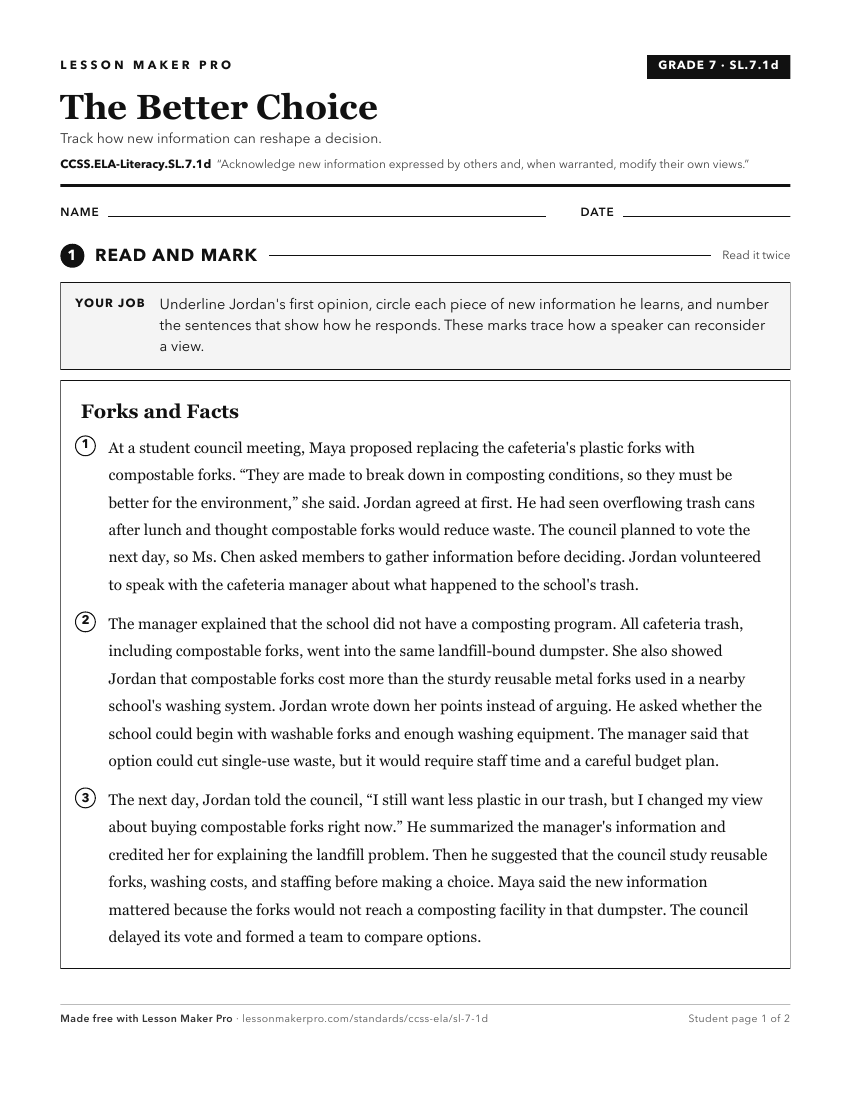
A ready-to-print activity worksheet aligned to CCSS.ELA-Literacy.SL.7.1d, with an answer key for the teacher on its own page. No account needed.
PDF, US Letter, prints cleanly in black and white.
Download the worksheetLearning progression
Where This Standard Sits
Before This Standard
If students are struggling here, check these first.
What This Unlocks
Mastery here sets students up for these next.
Keep exploring
Related Standards
- CCSS.ELA-Literacy.SL.3.1d
Explain their own ideas and understanding in light of the discussion.
- CCSS.ELA-Literacy.SL.11-12.1d
Respond thoughtfully to diverse perspectives; synthesize comments, claims, and evidence made on all sides of an issue; resolve contradictions when possible; and...
- CCSS.ELA-Literacy.SL.9-10.1d
Respond thoughtfully to diverse perspectives, summarize points of agreement and disagreement, and, when warranted, qualify or justify their own views and unders...
Turn this exact standard into a lesson
Grade, subject, topic, and the complete standard are prefilled. Create one free, no account needed.
Also for this standard:Make a WorksheetMake a QuizMake a Sub Lesson