CCSS.
The Standard
Adapt speech to a variety of contexts and tasks, demonstrating a command of formal English when indicated or appropriate. (See grades 11-12 Language standards 1 and 3 for specific expectations.)
Common Core State Standards for English Language Arts · Speaking and Listening Standards
Teacher's field guide
What This Standard Means
What Students Need to Do
- Students change how they speak based on the audience, setting, and purpose. They choose a suitable tone, vocabulary, level of detail, and degree of formality.
What Mastery Looks Like
- Students adjust tone, word choice, detail, and delivery for the audience and purpose. They use clear grammar and complete sentences in formal settings without sounding forced or unnatural.
Common Misconceptions
- Students may think formal speech means using long words or sounding stiff. They may also use the same tone, vocabulary, and detail for every audience, or treat informal speech as careless speech.
How to Assess It
- Exit ticket: Students give a 30-second opinion about school phone rules, first to a classmate and then to the school board. Ask them to name two changes they made.
Lesson moves
Ways to Teach It
Draw an audience card, then deliver the same one-minute school update to a principal, a classmate, and a younger student.
Write two versions of a request, one for a friend and one for the school board, then explain each language choice.
Play a register-switch game where students revise casual phrases into formal speech, then switch formal phrases back for a peer conversation.
Role-play a job interview, using precise wording, complete sentences, and a tone suited to the employer and position.
Free download
Printable SL.11-12.6 Worksheet
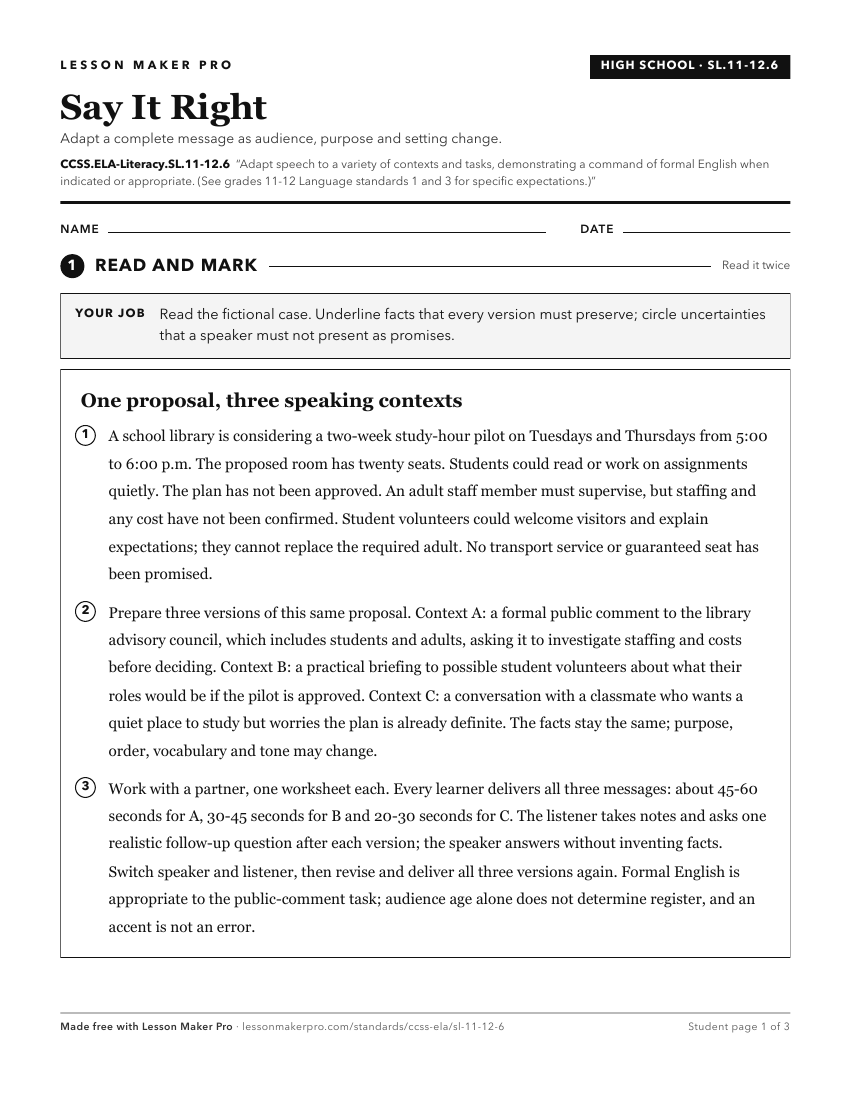
A ready-to-print activity worksheet aligned to CCSS.ELA-Literacy.SL.11-12.6, with an answer key for the teacher on its own page. No account needed.
PDF, US Letter, prints cleanly in black and white.
Download the worksheetKeep exploring
Related Standards
- CCSS.ELA-Literacy.SL.6.6
Adapt speech to a variety of contexts and tasks, demonstrating command of formal English when indicated or appropriate.
- CCSS.ELA-Literacy.SL.9-10.6
Adapt speech to a variety of contexts and tasks, demonstrating command of formal English when indicated or appropriate.
- CCSS.ELA-Literacy.SL.8.6
Adapt speech to a variety of contexts and tasks, demonstrating command of formal English when indicated or appropriate.
- CCSS.ELA-Literacy.SL.7.6
Adapt speech to a variety of contexts and tasks, demonstrating command of formal English when indicated or appropriate.
Turn this exact standard into a lesson
Grade, subject, topic, and the complete standard are prefilled. Create one free, no account needed.
Also for this standard:Make a WorksheetMake a QuizMake a Sub Lesson