CCSS.
The Standard
Recognize common types of texts (e.g., storybooks, poems).
Common Core State Standards for English Language Arts · Reading Standards for Literature
Teacher's field guide
What This Standard Means
What Students Need to Do
- Students tell whether a familiar text is a storybook or a poem. They notice clues in how the text looks, sounds, and is organized.
What Mastery Looks Like
- Students correctly label familiar examples as storybooks or poems. They use clues such as characters and events, line breaks, rhythm, or repeated words.
Common Misconceptions
- Students may call any illustrated book a storybook. They may think every poem rhymes or that a rhyming story must be a poem.
How to Assess It
- Show one short storybook page and one short poem. Ask each student to name each type and point to one clue that helped.
Lesson moves
Ways to Teach It
Place several storybooks and poetry books in a basket, then have students sort them into labeled hoops using visible text clues.
Read a story and a poem, then ask, “What did you notice about how each one looked and sounded?”
Play Book Type Corners, where students move to the storybook or poem corner after hearing a short excerpt.
Examine a bedtime story and a nursery rhyme, then discuss when families might read or recite each one.
Free download
Printable RL.K.5 Worksheet
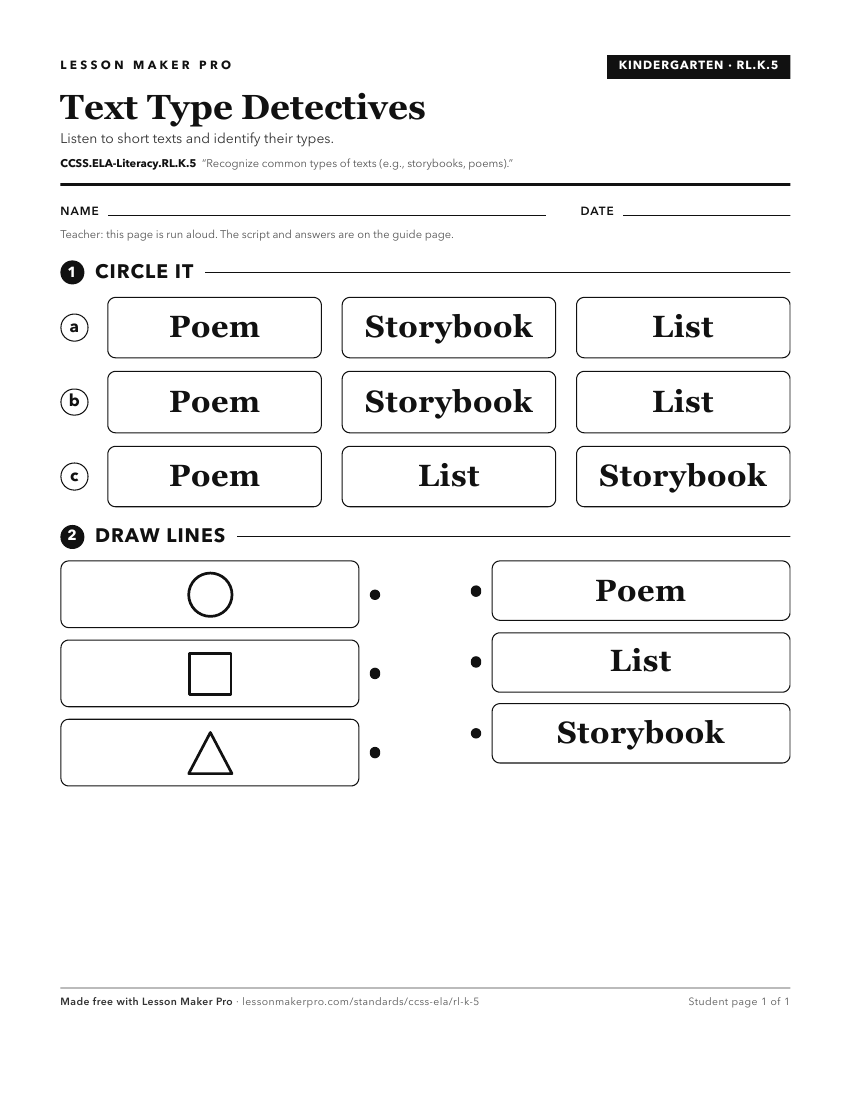
A ready-to-print activity worksheet aligned to CCSS.ELA-Literacy.RL.K.5, with an answer key for the teacher on its own page. No account needed.
PDF, US Letter, prints cleanly in black and white.
Download the worksheetLearning progression
Where This Standard Sits
See the whole path on the Reading: Literature progression map.
What This Unlocks
Mastery here sets students up for these next.
Keep exploring
Related Standards
- CCSS.ELA-Literacy.RI.1.9
Identify basic similarities in and differences between two texts on the same topic (e.g., in illustrations, descriptions, or procedures).
- CCSS.ELA-Literacy.W.6.9a
Apply grade 6 Reading standards to literature (e.g., "Compare and contrast texts in different forms or genres [e.g., stories and poems; historical novels and fa...
- CCSS.ELA-Literacy.RL.6.9
Compare and contrast texts in different forms or genres (e.g., stories and poems; historical novels and fantasy stories) in terms of their approaches to similar...
- CCSS.ELA-Literacy.RI.K.9
With prompting and support, identify basic similarities in and differences between two texts on the same topic (e.g., in illustrations, descriptions, or procedu...
Turn this exact standard into a lesson
Grade, subject, topic, and the complete standard are prefilled. Create one free, no account needed.
Also for this standard:Make a WorksheetMake a QuizMake a Sub Lesson